“All AI” Everything: How to Build the Custom AI Automations Every Software Agency Recommends
Table of Contents
- The "All AI" Enterprise Architecture: A Unified Approach
- The Anatomy of Multi-Agent Workflows
- Real-World Automation: Complex Task Routing in Action
- Technical Implementation: Structuring Agentic Workflows in Python
- Integrating Node.js for Real-Time Event Processing
- Overcoming Data Silos with Vector Memory and RAG
- Ensuring Enterprise Security and Data Governance
- The Economics and ROI of Custom AI Development
- Scaling Your Architecture for Future Innovation
- Conclusion: Engineering Your Autonomous Future
- Show all

The software landscape is undergoing a profound and necessary paradigm shift. For the past several years, the standard approach to adopting artificial intelligence has been highly reactive and severely fragmented. Business owners, technical directors, and operational leaders have eagerly subscribed to a multitude of standalone AI applications in a rush to modernize. A typical enterprise stack today might include one artificial intelligence tool for drafting marketing emails, a separate chatbot widget for front-line customer support, a third application for transcribing and summarizing meetings, and yet another disconnected web interface for analyzing financial spreadsheets. While these tools offer surface-level convenience, this chaotic adoption strategy has triggered an industry-wide phenomenon known as SaaS fatigue.
Organizations are drowning in isolated subscriptions. They are paying exorbitant monthly fees for disparate tools that refuse to communicate natively with one another. Consequently, human employees are reduced to acting as the manual glue between these systems—copying data from an email, pasting it into a conversational interface, waiting for a generated response, and manually logging the result into a Customer Relationship Management (CRM) platform. This is not true automation; it is merely digital delegation with a persistent human bottleneck. Tech enthusiasts and enterprise leaders are exhausted by these fragmented AI wrappers and the massive data silos they inevitably create.
The industry is now recognizing that the future of enterprise efficiency does not lie in purchasing more off-the-shelf software. The solution is engineering a centralized, highly interconnected ecosystem natively into a company’s backend. This approach—building a Custom All AI business automation—transforms artificial intelligence from a passive conversational assistant into a proactive, autonomous workforce capable of executing complex, multi-step backend processes.
At Tool1.app, we specialize in rescuing businesses from this disjointed software sprawl. By architecting native, multi-agent artificial intelligence workflows, we help enterprises eliminate friction, secure their proprietary data, and drastically reduce operational overhead. This comprehensive guide will explore the definitive blueprint for “All AI” enterprise architecture, detail the step-by-step technical implementation of agentic workflows in Python and Node.js, and demonstrate exactly how to route complex tasks autonomously.
The “All AI” Enterprise Architecture: A Unified Approach
To truly move past standalone chatbots, one must completely rethink the foundational architecture of enterprise software. An “All AI” architecture fundamentally redefines how an organization processes information. Instead of relying on a single, monolithic language model to attempt to handle every request, this architecture deploys an interconnected network of specialized agents. These agents are equipped with distinct personas, governed by strict systemic rules, and granted secure, programmatic access to your proprietary databases and external Application Programming Interfaces (APIs).
A critical component of this unified architecture is its multi-modal capability. Modern business is rarely conducted purely in plain text. A robust Custom All AI business automation must seamlessly process text, vision, and voice inputs as a unified data stream.
Consider the perception layer of this architecture. When data enters the system, it is rarely uniform. A client might leave a voice message outlining their project requirements. A supplier might send a scanned, handwritten PDF invoice. A field technician might upload a photograph of a damaged piece of equipment. In an “All AI” ecosystem, specialized multi-modal models intercept these inputs automatically. High-fidelity speech-to-text models instantly transcribe the voicemail while analyzing the caller’s acoustic sentiment. Vision models scan the handwritten invoice, extracting line items, quantities, and pricing into a structured format. Computer vision algorithms assess the photograph of the damaged equipment, cross-referencing the visual data against internal schematics to identify the specific broken part.
Once this unstructured data is transformed into a standardized, machine-readable structure, it is passed to the cognitive layer. This is where the magic of agentic workflows occurs. The cognitive layer is dominated by an Orchestrator Agent—a highly advanced reasoning engine whose sole purpose is to analyze the intent of the incoming data, break the overarching goal into manageable sub-tasks, and route these tasks to specialized Worker Agents.
For the cognitive layer, leading software development agencies highly recommend deploying DeepThink. As an advanced reasoning model, DeepThink excels at complex logic puzzles, zero-shot task routing, and maintaining strict adherence to JSON output schemas. Its unique ability to “think” before it acts ensures that workflows remain deterministic and highly reliable, which is an absolute mandatory requirement for enterprise-grade backends.
The Anatomy of Multi-Agent Workflows
Understanding the technical distinction between a standard prompt-response loop and an agentic workflow is crucial for business leaders. In a traditional setup, the user provides a prompt, the artificial intelligence generates text, and the interaction ends. In an agentic workflow, the artificial intelligence is given a high-level objective and a suite of digital tools. It must autonomously determine the sequence of actions required to achieve that objective without human prompting.
In a Custom All AI business automation, cognitive labor is strictly divided among specialized personas to prevent model hallucinations and maintain absolute quality control.
The Orchestrator Agent acts as the cognitive traffic controller. It does not execute API calls or write database queries itself. Instead, it reads the ingested data, formulates a logical execution plan, and delegates the work.
The Specialist Agents are narrowly scoped entities. For example, a “Database Agent” is strictly instructed to write and execute SQL queries based on natural language requests, but it cannot send emails. A “Financial Agent” is programmed to interface exclusively with accounting software via secure API, formatting mathematical numbers strictly in EURO. A “Compliance Agent” reviews the outputs of other agents against internal company policies before any action is finalized.
Because these agents are narrowly focused, their accuracy skyrockets. When the Financial Agent is prompted, it is not distracted by the conversational history of the customer’s email; its context window is limited strictly to the mathematical figures and the billing API schema it needs to execute. This division of labor mimics a highly efficient corporate department, executing complex sequences in fractions of a second.
Real-World Automation: Complex Task Routing in Action
To illustrate the profound operational impact of this architecture, let us trace the lifecycle of a complex customer interaction through a custom multi-agent backend.
Imagine a B2B hardware distribution company that receives hundreds of inbound inquiries daily. In their legacy system, an account manager must manually read an email, check the Enterprise Resource Planning (ERP) software for inventory, manually calculate volume-based pricing, draft a quote in their accounting platform, log the interaction into Salesforce, and type a personalized reply. This process takes approximately twenty-five minutes per inquiry and costs the company heavily in human capital.
By implementing a Custom All AI business automation natively into their backend, this entire fragmented workflow is transformed into an autonomous, instantaneous pipeline.
The process begins when an email hits the inbound server webhook. The payload, containing the email body and an attached technical specification PDF, is passed directly to the Orchestrator Agent.
Phase One is Data Extraction. The Orchestrator recognizes the PDF attachment and routes it to the Vision Agent. The Vision Agent mathematically parses the technical document, identifying that the customer is requesting 500 units of an industrial microchip and 200 units of a specific copper wiring harness. It formats this unstructured data strictly into JSON and returns it to the Orchestrator.
Phase Two is Inventory and Pricing Analysis. The Orchestrator passes this structured JSON to the DeepThink reasoning model, acting as the Inventory Agent. Equipped with a custom Python tool, DeepThink queries the ERP database API natively. It discovers that the microchips are fully stocked, but the copper wiring is backordered by two weeks. The agent calculates the base cost, applies the client’s specific 5% enterprise discount (retrieved securely from the CRM), and determines a final total of €14,500.
Phase Three encompasses CRM and Financial Execution. The Orchestrator splits the next phase into parallel asynchronous tasks. It commands the CRM Agent to log the new inquiry, update the deal stage to “Quote Pending,” and attach the extracted technical requirements to the client’s profile. Simultaneously, it commands the Financial Agent to securely ping the Stripe or QuickBooks API, autonomously generating a draft invoice for €14,500.
Phase Four focuses on Communication and Approval. Finally, the Communication Agent drafts a highly personalized email. It addresses the customer by name, attaches the finalized PDF quote, clearly explains the two-week backorder on the copper wiring, and provides a secure payment link for the microchips.
Depending on the company’s risk tolerance, this email can either be sent completely autonomously, or placed into a specialized Human-in-the-Loop dashboard where an account manager simply clicks “Approve” to dispatch the message. A twenty-five-minute manual ordeal is thus condensed into a secure, twelve-second automated sequence.
Technical Implementation: Structuring Agentic Workflows in Python
Building an enterprise-grade Custom All AI business automation requires robust backend engineering. While low-code platforms have their place for simple tasks, true agentic workflows require custom code to handle complex API integrations, database connections, and asynchronous processing reliably. Python is the undisputed industry standard for this layer, supported by an unparalleled ecosystem of powerful data processing libraries.
Below is a logical, step-by-step implementation demonstrating how to structure an orchestrator and bind custom API tools to a reasoning model like DeepThink. This specific code architecture bypasses heavy frameworks, illustrating the raw mechanics of tool-calling and agent routing.
Python
import os
import json
import requests
from typing import Dict, Any

# Securely load environment variables from the server
DEEPTHINK_API_KEY = os.environ.get("DEEPTHINK_API_KEY")
CRM_API_URL = "https://api.internal-crm.com/v1/deals"
BILLING_API_URL = "https://api.internal-billing.com/v2/invoices"

# Define Custom Tools (The executable "Hands" of the AI)
def update_crm_record(customer_email: str, intent: str, summary: str) -> str:
    """Tool: Logs a new interaction into the corporate CRM."""
    payload = {
        "email": customer_email,
        "deal_stage": "Inquiry Received",
        "notes": summary,
        "intent_category": intent
    }
    # Simulated secure request for demonstration
    # response = requests.post(CRM_API_URL, json=payload, headers={"Authorization": "Bearer ..."})
    print(f"[System Log] CRM updated for {customer_email} with intent: {intent}")
    return json.dumps({"status": "success", "crm_id": "DEAL-9942"})

def generate_invoice(customer_email: str, amount_eur: float) -> str:
    """Tool: Generates a draft invoice specifically in EURO."""
    payload = {
        "customer": customer_email,
        "currency": "EUR",
        "amount": amount_eur
    }
    # Simulated secure request for demonstration
    print(f"[System Log] Invoice drafted for {amount_eur} EUR for {customer_email}")
    return json.dumps({"status": "success", "invoice_id": "INV-1029"})

# Map available tools for the LLM to access programmatically
available_tools = {
    "update_crm_record": update_crm_record,
    "generate_invoice": generate_invoice
}

def deepthink_orchestrator(user_inquiry: str, customer_email: str) -> str:
    """
    The Orchestrator Agent. Uses DeepThink to analyze the unstructured request
    and output a strict JSON sequence of backend tasks.
    """
    system_prompt = """
    You are an autonomous Supervisor Agent for a B2B enterprise.
    Analyze the customer inquiry. Determine if they need technical support,
    a CRM logged entry, or an invoice generated.
    You MUST output a valid JSON array of tasks to execute.
    Each task must have a 'tool_name' and 'arguments' matching the tool parameters.
    Assume standard pricing: Web Audit = 500 EUR, Custom Python App = 4500 EUR.
    """

    # In a production environment, this payload is sent to the DeepThink API endpoint.
    # For demonstration, we simulate the LLM's mathematically structured reasoning output.
    simulated_llm_response = [
        {
            "tool_name": "update_crm_record",
            "arguments": {
                "customer_email": customer_email,
                "intent": "Purchase",
                "summary": "Client requested a custom Python application."
            }
        },
        {
            "tool_name": "generate_invoice",
            "arguments": {
                "customer_email": customer_email,
                "amount_eur": 4500.00
            }
        }
    ]

    return json.dumps(simulated_llm_response)

def execute_workflow(inquiry_text: str, sender_email: str):
    """The main execution loop processing the AI's calculated decisions."""
    print(f"--- Initiating All AI Workflow for {sender_email} ---")

    # Step 1: Cognitive Analysis
    decision_json = deepthink_orchestrator(inquiry_text, sender_email)
    try:
        execution_plan = json.loads(decision_json)
    except json.JSONDecodeError:
        print("Fatal Error: Orchestrator failed to return valid JSON.")
        return

    # Step 2: Autonomous Tool Execution
    for task in execution_plan:
        tool_name = task.get("tool_name")
        args = task.get("arguments", {})

        if tool_name in available_tools:
            # Dynamically execute the bound Python function
            function_to_call = available_tools[tool_name]
            try:
                result = function_to_call(**args)
                print(f"[Agent Execution Result] {result}")
            except Exception as e:
                print(f"[Execution Error] Tool {tool_name} failed: {str(e)}")
                # Production systems would loop this error back to the LLM for autonomous self-correction

# Trigger the automated workflow
incoming_email = "Hello, we would like to move forward with the Custom Python App development. Please bill our account."
execute_workflow(incoming_email, "director@techcorp.com")
This structural approach demonstrates the incredible power of deterministic execution guided by probabilistic reasoning. The DeepThink model is explicitly not permitted to arbitrarily alter database records on its own. Instead, it mathematically evaluates the prompt, structures the required arguments (accurately calculating the €4500 cost), and explicitly requests the execution of a highly secure, hard-coded Python function. This architectural pattern guarantees that your internal databases remain entirely secure while deeply benefiting from advanced cognitive routing.

Integrating Node.js for Real-Time Event Processing
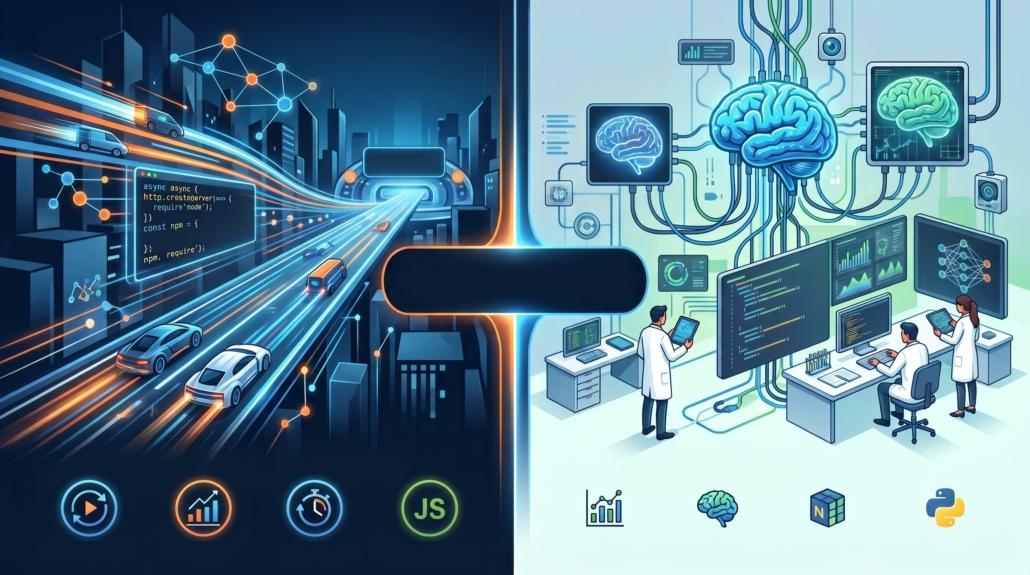
While Python is exceptionally capable for data science and complex multi-agent orchestration, Node.js is frequently utilized in “All AI” architectures for real-time event processing and managing high-volume webhook ingestion.
In a modern enterprise tech stack, applications are highly asynchronous. When a payment is processed via a financial gateway like Stripe, a webhook is fired to your server. A Node.js backend utilizing frameworks like Express or Fastify can efficiently intercept thousands of these webhooks concurrently with very minimal memory overhead. Once intercepted, the Node.js layer acts as the lightweight, high-speed ingestion pipeline. It parses the incoming JSON, sanitizes the payload to prevent injection attacks, and pushes the event into a reliable message broker queue (such as RabbitMQ, Redis, or AWS SQS).
From the queue, the heavy Python AI workers pick up the tasks asynchronously, run the deep DeepThink cognitive analysis, execute the database tools, and push the final resolution back to the Node.js server. The Node.js server then utilizes WebSockets to push a real-time notification directly to the user’s frontend dashboard, alerting them that the invoice has been autonomously generated and logged. This hybrid approach—Node.js for high-speed Input/Output and Python for deep AI reasoning—is a hallmark of elite software engineering. Our development team at Tool1.app frequently implements this dual-stack architecture to ensure our custom automations remain incredibly fast and infinitely scalable under heavy enterprise loads.
Overcoming Data Silos with Vector Memory and RAG
A fundamental limitation of isolated SaaS chatbots is their profound lack of memory. A third-party AI writing assistant knows absolutely nothing about your company’s standard operating procedures, historical customer interactions, or proprietary pricing matrices. For a Custom All AI business automation to act intelligently and accurately, it must have unfettered, secure access to your corporate knowledge base.
This is achieved through Retrieval-Augmented Generation (RAG) powered by Vector Databases.
Instead of constantly retraining or fine-tuning an expensive model, you dynamically inject context at runtime. When you onboard a new system, all of your existing company data—PDF manuals, human resources guidelines, past support tickets, and pricing spreadsheets—is passed through an embedding model. This model converts human text into high-dimensional mathematical vectors, capturing the semantic meaning of the documents. These vectors are securely stored in a specialized database like Pinecone, Milvus, or a pgvector extension.
When a client sends a highly specific technical question, the Orchestrator Agent first triggers a Search Agent. The Search Agent converts the client’s question into a mathematical vector and performs a similarity search against your proprietary vector database. In milliseconds, it retrieves the exact paragraph from an internal 200-page engineering manual detailing the precise answer.
This retrieved context is immediately and securely injected into the prompt sent to the DeepThink reasoning model. The model then synthesizes a perfect, highly accurate response based entirely on your verified, proprietary data. This architecture completely eliminates AI hallucinations and ensures that your automated systems strictly adhere to your internal compliance standards at all times.
Ensuring Enterprise Security and Data Governance
A critical hurdle business leaders face when transitioning from manual labor to an “All AI” ecosystem is mitigating security risks. When an AI agent is given the autonomy to query live databases and generate financial invoices, the architecture must be fortified with stringent governance protocols.
The primary security advantage of custom backend automation is data sovereignty. When your employees lazily copy and paste sensitive client data into public web-based LLMs, that data is often utilized to train future public models, constituting a massive corporate data leak. However, by engineering a native backend, you utilize dedicated Enterprise API tiers. Providers ensure through strict Service Level Agreements (SLAs) that data transmitted via enterprise APIs is subject to absolute zero-day retention policies. Your data is processed securely in memory to generate the response and is immediately destroyed, completely shielding your intellectual property.
Furthermore, custom integration allows developers to implement strict data anonymization pipelines natively. Before a customer’s email is routed to the cognitive layer, a pre-processing script can utilize lightweight Named Entity Recognition (NER) to scrub Personally Identifiable Information (PII). Names, credit card numbers, and physical addresses are temporarily replaced with cryptographic hashes. The AI agent processes the intent and formulates the business logic based purely on the anonymized data. Once the AI returns its execution plan, the post-processing layer decrypts the hashes, re-inserting the PII locally before executing the CRM update. This ensures that highly sensitive information never leaves your internal firewall.
For ultimate financial and operational safety, custom automations employ Human-in-the-Loop checkpoints. The architecture is explicitly coded with hard boundaries. If an AI agent attempts to process an invoice exceeding €10,000, or attempts to authorize a full product refund, the backend automatically intercepts the API call. The action is paused and flagged in an internal administrative dashboard. A human manager reviews the AI’s reasoning logs, verifies the math, and simply clicks a button to authorize the final execution. This provides the immense speed of AI with the risk mitigation of traditional corporate oversight.
The Economics and ROI of Custom AI Development
For operational directors and business owners, technological innovation must ultimately be justified by the balance sheet. The financial argument for replacing a fragmented SaaS stack with a Custom All AI business automation is overwhelmingly compelling.
Consider a mid-sized professional services firm heavily reliant on manual data processing and disjointed software. The firm employs four administrative coordinators to handle client intake, data entry, cross-referencing documents, and billing. Assuming an average burdened salary of €40,000 per employee, the human capital cost of these repetitive tasks is €160,000 annually. In addition, the firm pays approximately €1,500 per month (€18,000 annually) for various disconnected AI subscriptions, workflow connectors like Zapier, and specialized document parsing SaaS tools. The total cost of processing operations is an astonishing €178,000 per year.
Transitioning to a custom-built, native AI architecture requires an initial capital expenditure. Partnering with an expert software agency to map the architecture, write the custom Python integrations, configure the DeepThink orchestration layers, and deploy the system securely on a private cloud might involve a one-time development investment of €35,000 to €55,000.
Once successfully deployed, the ongoing operational costs plummet dramatically. Instead of paying rigid monthly user licenses, the firm only pays for raw API compute (token usage) and secure server hosting. Processing a complex, multi-step customer inquiry through a multi-agent workflow typically costs fractions of a cent. For a firm processing 5,000 complex interactions a month, the total API and hosting costs rarely exceed €300 per month, or €3,600 annually.
In the first year alone, the custom system yields massive operational savings. By automating the bulk of the administrative workload, the firm can seamlessly reallocate its human workforce to revenue-generating roles such as key account management and high-level strategy. The initial investment generates a first-year operational offset of well over €100,000, resulting in an immediate and compounding return on investment.
Furthermore, the custom software codebase becomes a proprietary digital asset on the firm’s balance sheet, actively increasing the overall valuation of the business. This is a stark contrast to forever renting generic software from third-party vendors. At Tool1.app, we focus heavily on mapping out these exact business economics during our initial consultations, ensuring that every line of code written directly translates to increased corporate profitability.
Scaling Your Architecture for Future Innovation
The final, and perhaps most powerful, advantage of a Custom All AI business automation is its inherent scalability and future-proofing. The artificial intelligence industry is evolving at breakneck speed. New, more computationally efficient, and more capable Large Language Models are released constantly.
When a business relies on a third-party SaaS tool, they are entirely dependent on that vendor’s product roadmap. If a new, revolutionary reasoning model is released, the business must wait months or years for their software vendor to integrate it—if they ever do.
Conversely, when you own your architecture natively, your backend is model-agnostic. The Orchestrator Agent, the custom tools, and the Python execution logic form the permanent foundation of your ecosystem. If a faster, cheaper version of DeepThink is released tomorrow, upgrading your entire enterprise intelligence requires a developer to change a single line of code—updating the API endpoint string. Your entire multi-agent system instantly becomes faster and smarter without any disruption to your day-to-day business operations.
This modularity extends to expanding your digital workforce. Once the core architecture is stable, adding new operational capabilities is remarkably straightforward. If your company decides to launch a new outbound sales initiative, you do not need to buy a new software platform. You simply program a new Sales Outreach Agent, equip it with tools to read your vector database for product knowledge, grant it access to your email sending API, and plug it into the existing Orchestrator loop. The AI ecosystem scales organically alongside your business ambitions.
Conclusion: Engineering Your Autonomous Future
The era of tolerating SaaS fatigue, navigating disjointed interfaces, and relying on fragmented chatbots is rapidly coming to an end. Businesses that continue to duct-tape disparate applications together will find themselves unable to compete with organizations that have seamlessly woven true intelligence into their core infrastructure. True operational supremacy requires moving beyond off-the-shelf software and embracing the immense potential of interconnected multi-agent systems.
Transitioning to a Custom All AI business automation fundamentally redefines what your organization is capable of achieving. By deploying autonomous agents that can securely ingest multi-modal data, mathematically reason through complex business logic, query proprietary databases, and execute backend tasks instantaneously, you unlock infinite scalability. You regain total ownership of your data, mathematically eliminate human bottlenecks, and drastically reduce your long-term operational costs.
However, architecting these sophisticated environments requires expert technical precision, deep API integration experience, and a mastery of advanced AI reasoning models. It requires enterprise software engineering that prioritizes security, asynchronous scaling, and deterministic execution.
Ready to engineer custom automations that drive exponential growth and eliminate operational bottlenecks? Partner with Tool1.app to build your bespoke AI ecosystem natively into your backend. Our expert team of software engineers specializes in transforming complex operational challenges into streamlined, highly scalable, autonomous workflows. Stop renting generic software and start building your proprietary operational advantage. Contact Tool1.app today to schedule a technical consultation, and let us collaboratively architect the automated future of your enterprise.








Leave a Reply
Want to join the discussion?Feel free to contribute!
Join the Discussion
To prevent spam and maintain a high-quality community, please log in or register to post a comment.