The Best AI Plugins for WordPress to Boost SEO and Content in 2026
Table of Contents
- The Paradigm Shift in WordPress Automation
- Dominating Search Rankings with AI-Powered SEO Plugins
- Elevating Visuals with AI Image Generation
- Transforming Engagement: AI Chatbots and Customer Assistants
- Beyond Plugins: Custom AI Automation and Development
- Industry-Specific Business Use Cases
- The Productivity Paradox and Strategic Implementation
- Architecting Your AI-Powered Digital Future
- Show all
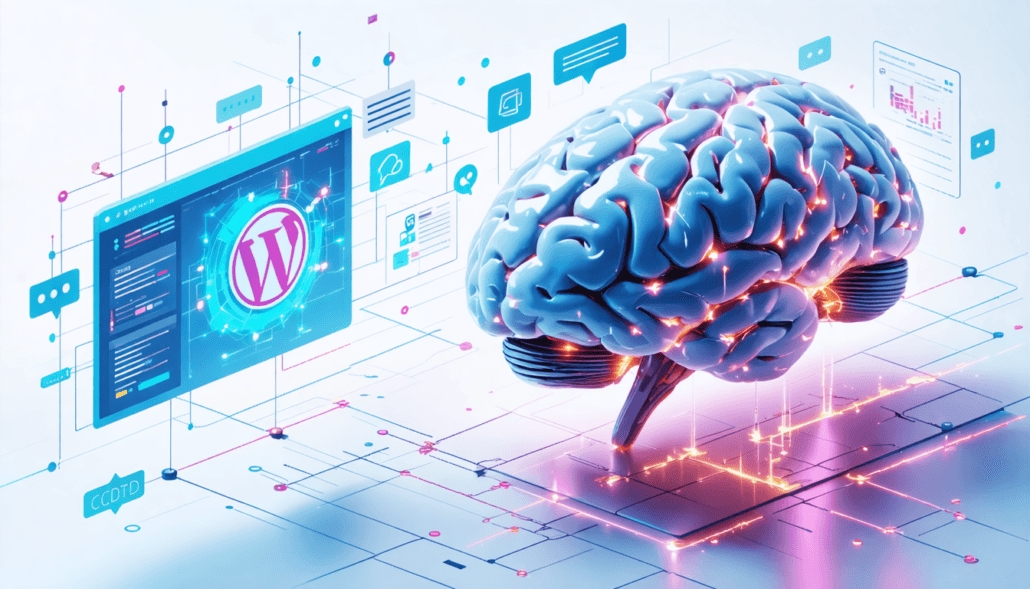
The landscape of web management and content architecture has undergone a radical transformation. What was once a manual, labor-intensive process of writing metadata, sourcing images, and building internal links has evolved into a highly automated, intelligent ecosystem. For businesses looking to maintain a competitive edge, leveraging the best AI WordPress plugins 2026 has to offer is no longer a luxury—it is a foundational requirement for digital survival.
The integration of agentic artificial intelligence into content management systems has bridged the gap between basic task automation and true contextual decision-making. Modern plugins do not just fill in blanks; they analyze user intent, generate visually cohesive media, predict search engine algorithm shifts, and converse dynamically with site visitors. However, with thousands of tools flooding the market, identifying the optimal stack that balances cost, performance, and scalability is a complex challenge for any organization.
As software architectures become more sophisticated, off-the-shelf solutions must often be paired with custom backend logic. At Tool1.app, we specialize in bridging this exact gap, integrating high-level WordPress plugins with custom Python automations and AI-driven solutions to drive unparalleled business efficiency. This comprehensive guide dissects the top-rated AI plugins for auto-tagging, meta descriptions, image generation, and chat, while offering advanced technical implementation strategies for modern businesses.
The Paradigm Shift in WordPress Automation
The year 2026 marks the era of “agentic” AI in web development. Previous iterations of artificial intelligence required heavy human prompting, constant supervision, and rigid rule-based triggers. Today’s tools operate autonomously within predefined strategic boundaries. They can evaluate a newly drafted blog post, instantly generate a semantically relevant featured image, apply highly targeted category tags, weave in contextual internal links, and publish the piece at an optimized time based on audience analytics.
This shift directly impacts the bottom line. Operational costs associated with routine web maintenance, customer support triage, and basic technical SEO have plummeted. By adopting a well-architected AI stack, businesses are reallocating human capital toward high-level strategy and relationship-building rather than data entry. The modern WordPress backend is no longer just a repository for content; it is an active participant in marketing, sales, and customer retention.
Dominating Search Rankings with AI-Powered SEO Plugins
Search Engine Optimization (SEO) has evolved from simple keyword density checks to complex semantic relationship mapping. The best AI plugins in 2026 act as your resident SEO expert, analyzing content against top-ranking search engine results pages (SERPs) in real-time and adjusting metadata to meet the exact intent of the searcher.
Rank Math AI: The Developer’s Choice for Precision
Rank Math has solidified its position as the premier SEO plugin for advanced users, agencies, and developers wanting granular control over their search presence. Serving millions of websites, its AI-powered module, Content AI, integrates deeply with the WordPress block editor to provide unparalleled analytical depth.
Rank Math distinguishes itself by providing real-time, dynamic suggestions for optimal keyword placement, auto-tagging, and link building based on actual competitor SERP data. Instead of generic advice, the AI analyzes competing articles and dictates the exact word count, heading structure, and media density required to rank for a specific query.
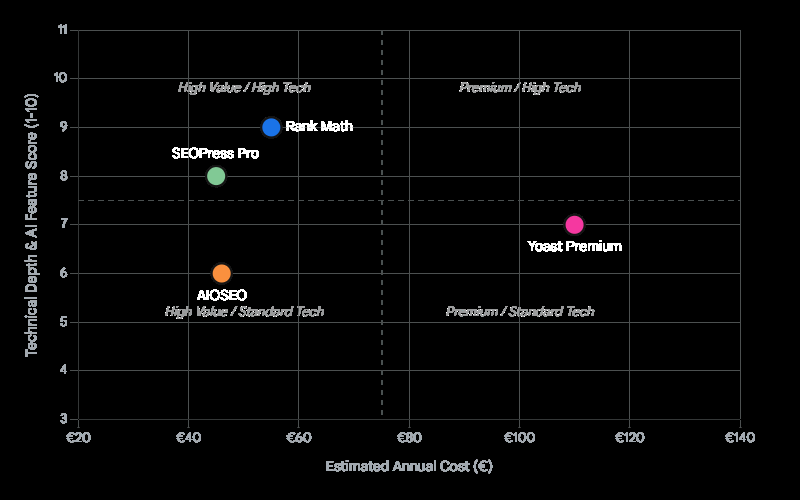
From a financial perspective, Rank Math operates on a highly competitive model. The Pro tier begins at approximately €55 per year, providing a generous allocation of AI credits that replenish automatically. For developers, Rank Math exposes a robust architecture of PHP filters and hooks. You can programmatically alter meta descriptions or titles before they hit the database, making it exceptionally friendly for custom workflow integrations.
Yoast SEO Premium: The Trusted Standard with Generative Capabilities
With over 13 million active installations, Yoast SEO remains the industry standard for general users and content creators. In 2026, Yoast has fully integrated generative AI into its Premium offering, which is priced at approximately €109 per year.
Yoast’s AI excels in its user-friendly generative features. It can instantly read a lengthy, complex article and auto-generate highly clickable meta titles and concise meta descriptions that adhere perfectly to character limits. Furthermore, Yoast has perfected its e-commerce integration. For WooCommerce users, the AI generates product-specific metadata, optimizing SKUs and short descriptions automatically—a feature that saves e-commerce managers hundreds of hours per quarter when onboarding new product catalogs.
Under the hood, Yoast offers the Surfaces API. This allows developers working on headless WordPress architectures or custom front-ends to pull AI-generated schema and meta tags effortlessly into bespoke applications. Using simple calls, developers can expose every bit of SEO data for a current page, ensuring that modern JavaScript frameworks receive fully optimized metadata without complex database querying.
All in One SEO (AIOSEO): Best for Growing Agencies
AIOSEO sits comfortably between the extreme technicality of Rank Math and the beginner-friendly nature of Yoast. Starting at roughly €45 per year for a single site, AIOSEO integrates directly with ChatGPT tools to offer automated meta titles and descriptions. Its standout feature is its TruSEO analysis, which grades content in real-time and provides highly actionable suggestions for improvement.
For agencies managing multiple clients, AIOSEO’s higher tiers offer exceptional value. The Elite plan provides a massive allocation of 200,000 AI credits, allowing agencies to automate content optimization across a network of up to 100 websites seamlessly.
A Comparative Overview of Top SEO Plugins
To assist in decision-making, the following table breaks down the core offerings of the leading AI-enhanced SEO plugins available in 2026.
| Plugin Name | Target Audience | Key AI Features | Starting Price (Estimated EUR) |
| Rank Math Pro | Power Users & Developers | Real-time SERP analysis, auto-tagging, robust PHP hooks | €55 / year |
| Yoast SEO Premium | Beginners & Content Teams | Generative titles/descriptions, e-commerce SKU optimization | €109 / year |
| AIOSEO | Agencies & Growing Sites | TruSEO scoring, ChatGPT integration, bulk agency credits | €45 / year |
| SEOPress Pro | Privacy-Focused Multi-sites | Multi-provider AI advantage, lightweight architecture | €45 / year |
| Mass Meta Creator AI | Bulk SEO Operations | CSV URL import, BYOK Google Gemini/OpenAI integration | Free (API usage billed separately) |
Mass Meta Creator AI: The Bulk Optimization Powerhouse
For websites with massive backlogs of unoptimized content, manual AI generation on a post-by-post basis is still too slow. Mass Meta Creator AI solves this by allowing bulk operations. Operating via a Bring-Your-Own-Key (BYOK) model connected to Google Gemini or OpenAI, this plugin allows site owners to upload a CSV of URLs. The system acts autonomously to scan the existing page content, auto-generate SEO-optimized meta tags, assign accurate auto-tags for WordPress taxonomy, and push the data directly into the database with a single click. This tool is indispensable for site migrations or massive archival updates.
Link Whisper: The Architect of Internal Linking
SEO is heavily dependent on site architecture and how link equity flows between pages. Link Whisper (starting around €89 per year for a single site) utilizes natural language processing (NLP) to read your content as you write it. It then cross-references your entire WordPress database to suggest highly relevant internal links based on semantic contextual matches.
In 2026, the AI has become incredibly adept at finding “orphan pages”—valuable content with no incoming links that search engines often ignore. Link Whisper automatically suggests anchor text from high-authority pages on your site to boost the ranking of these orphaned posts, creating a tightly woven semantic web that search engine crawlers favor.
Elevating Visuals with AI Image Generation
Stock photography is increasingly penalized by users who demand authentic, highly specific visual content. Furthermore, generic stock photos rarely align perfectly with the nuanced text generated by modern AI writers. AI image generation plugins have moved directly into the WordPress ecosystem, allowing creators to prompt, refine, and insert unique graphics without ever leaving the editor.
AI Engine (Meow Apps): The Ultimate Standalone Toolkit
AI Engine is widely considered the “Swiss Army Knife” of WordPress AI. Operating on a BYOK model, the Pro version costs approximately €54 per year. Users connect the plugin directly to providers like OpenAI, Anthropic, or Google, paying only for the raw API usage (typically €4 to €18 per month for moderate usage).
AI Engine features a robust image generation module that goes beyond basic prompting. It includes an AI Copilot within the WordPress editor that can read the surrounding paragraphs and automatically suggest optimized prompts for the featured image. Because it connects directly to advanced models like DALL-E 3, the output quality is exceptional. Furthermore, the tool automatically handles the SEO metadata of the generated image, creating descriptive alt text and file names that boost Google Image search rankings.
Builder-Integrated AI: Elementor, Divi, and SeedProd
For users relying on visual page builders, standalone plugins can sometimes interrupt the design workflow. Major page builders have completely internalized their AI capabilities.
Elementor AI is a subscription-based add-on starting at roughly €44 per year for the basic tier. It works directly inside an image widget in the Elementor editor. It features powerful built-in editing capabilities, such as generative fill, background removal, and resolution upscaling. The AI analyzes the color palette of your existing web page and ensures the newly generated image perfectly matches the site’s aesthetic.
Similarly, Divi AI (priced at approximately €177 per year for unlimited text, image, and code generation) acts as a built-in photographer and web developer. Divi’s contextual intelligence is particularly strong; it utilizes the website’s global brand settings, storing your primary brand colors and typography, to generate entirely on-brand layouts and images that feel custom-made rather than generated.
SeedProd offers an impressive AI website generation tool. Known for its landing page capabilities, its 2026 AI update allows users to build an entire WordPress site—complete with tailored copy, structural layouts, and contextually appropriate images—in under 60 seconds simply by providing a brief description of the business.
Imajinn and AI Power: Specialized Creative Workflows
For websites requiring artistic, non-corporate visual styles, Imajinn offers a distinct approach. Built on Stable Diffusion models, this plugin (starting at €23 per month) provides advanced controls like “CFG Scale” and negative prompting directly within WordPress. It functions as a dedicated creative workshop for users who need hyper-specific artistic illustrations or photorealistic elements that standard LLMs often struggle to produce with nuanced control.
AI Power offers another comprehensive suite. In addition to text and chatbot tools, it integrates image generation across multiple models. It is particularly valuable for users who want to experiment with different image generation engines without installing multiple plugins, offering connections to various APIs from a single, unified dashboard.
Comparing the Top AI Image Generators for WordPress
| Plugin / Tool | Best Use Case | Native Integration | Estimated Starting Price (EUR) |
| AI Engine | All-in-one AI workflows | Standard WordPress Editor | €54 / year (plus API costs) |
| Elementor AI | Elementor design workflows | Elementor Page Builder | €44 / year |
| Divi AI | Unlimited layout & visual design | Divi Theme Builder | €177 / year |
| SeedProd AI | Rapid landing page creation | SeedProd Builder | €36 / year |
| Imajinn | Artistic & custom style generation | Separate custom dashboard | €23 / month |
| AIOSEO | Image SEO and basic generation | Standard Image Block | €45 / year |
Transforming Engagement: AI Chatbots and Customer Assistants
The static “Contact Us” form is being rapidly replaced by dynamic, AI-driven conversational agents. These are not the rigid, frustrating decision-tree bots of the past; they are intelligent agents trained on your site’s specific data to provide nuanced, accurate, and highly contextual support.
Tidio (Lyro AI): The E-commerce Support Specialist
Tidio has emerged as a leader in merging live chat with AI automation. Its Lyro AI chatbot utilizes NLP to provide a natural conversational flow. Priced at around €22 per month for the starter tier, Tidio is particularly powerful for WooCommerce environments.
The AI can preview customer shopping carts, handle routine inquiries regarding shipping times based on the user’s location, and autonomously resolve up to 70% of standard customer support queries. Crucially, it features a seamless live handover function, smoothly transferring complex issues to human agents through an integrated ticketing system, ensuring that high-value sales or sensitive support tickets are never lost in an automated loop.
AI Power: The Multi-Model Communicator
AI Power is an all-in-one toolkit that excels in its chatbot routing capabilities. It allows site administrators to deploy multiple AI models depending on the task. Advanced plugins like AI Power act as a central hub, intelligently analyzing incoming chat requests and routing them to the most appropriate AI model. Routine queries are handled by fast, low-cost models, while complex tasks are escalated to advanced reasoning engines.
For instance, a business might route simple FAQ queries regarding store hours to a fast, highly economical model, while directing complex technical support questions to a deeply analytical model like OpenAI’s GPT-4o or Anthropic’s Claude 3.5 Sonnet. AI Power bots can also read PDFs uploaded to the site, search the web in real-time to provide up-to-date answers, and utilize long-term memory to remember returning customers, drastically improving the personalization of the user experience.

Jotform AI Chatbot and REVE Chat: Data Collection and Omnichannel Support
Jotform’s AI Chatbot represents the fusion of conversational AI with structured data collection. It automatically trains itself on your website content to answer FAQs, but its true power lies in guiding users through complex forms conversationally, drastically reducing form abandonment rates.
REVE Chat is built for true omnichannel enterprise support. While it offers a robust AI copilot for agents, its integration capabilities across WordPress, WhatsApp, Facebook Messenger, and Instagram make it indispensable for brands that communicate with customers across diverse platforms. It centralizes all communication into a single inbox, with the AI handling initial triage across every channel simultaneously.
Beyond Plugins: Custom AI Automation and Development
While commercial WordPress plugins offer incredible value out of the box, growing enterprises often hit scaling limitations. An off-the-shelf plugin might not integrate with a highly customized, proprietary CRM, or the costs of generating tens of thousands of auto-tags via a plugin’s UI might become financially prohibitive.
This is where true technical scalability comes into play. At Tool1.app, we frequently architect custom solutions that bypass frontend plugin limitations, utilizing direct API integrations, serverless functions, and backend scripting to achieve absolute workflow automation that perfectly matches a company’s operational rhythm.
Automating Content and Auto-Tagging via Python
For media publishers, news aggregators, or massive e-commerce sites, creating posts manually through the WordPress dashboard—even with the assistance of an AI plugin—is fundamentally inefficient. By utilizing Python and the WordPress REST API, businesses can automate the entire lifecycle of content generation.
A custom Python script can run on a schedule, pull data from an external API (such as stock market fluctuations, real estate listings, or raw product specs), send that data to an LLM to draft a comprehensive, human-like article, and automatically assign taxonomy terms (auto-tagging) based on the content’s semantic meaning.
Below is an architectural example of how a custom Python automation script interfaces with WordPress to create a fully optimized, auto-tagged post without any human intervention:
Python
import requests
import json
import os
from openai import OpenAI

# Initialize API Keys and WordPress Credentials securely
client = OpenAI(api_key=os.getenv("OPENAI_API_KEY"))
WP_BASE_URL = "https://your-enterprise-site.com/wp-json/wp/v2"
WP_USER = os.getenv("WP_USERNAME")
WP_APP_PASSWORD = os.getenv("WP_APP_PASSWORD")

def generate_content_and_tags(topic_data):
    # Prompt the LLM to generate content and extract strictly formatted metadata
    prompt = f"""You are an expert industry analyst. Write a professional 800-word report on {topic_data}.
    At the end of the report, provide a strictly formatted JSON object containing:
    1. A highly optimized SEO meta description (under 155 characters).
    2. A list of 5 highly relevant taxonomy tags for WordPress auto-tagging.
    Format your response exactly as follows:

    ---
    {{"meta_desc": "...", "tags": ["tag1", "tag2", "tag3", "tag4", "tag5"]}}
    """

    response = client.chat.completions.create(
        model="gpt-4o",
        messages=[{"role": "user", "content": prompt}],
        temperature=0.7
    )

    raw_output = response.choices.message.content
    content_part, json_part = raw_output.split("---")
    metadata = json.loads(json_part.strip())

    return content_part.strip(), metadata

def publish_to_wordpress(title, content, metadata):
    # Step 1: Query existing tags or create new ones to retrieve their integer IDs
    tag_ids =
    for tag in metadata["tags"]:
        tag_response = requests.post(
            f"{WP_BASE_URL}/tags",
            auth=(WP_USER, WP_APP_PASSWORD),
            json={"name": tag}
        )
        if tag_response.status_code == 201:
            tag_ids.append(tag_response.json()["id"])
        elif tag_response.status_code == 400: # The tag already exists in the database
            existing_tag = requests.get(f"{WP_BASE_URL}/tags?search={tag}").json()
            if existing_tag:
                tag_ids.append(existing_tag["id"])

    # Step 2: Construct the payload and publish the post with assigned auto-tags
    post_data = {
        "title": title,
        "content": content,
        "status": "publish",
        "tags": tag_ids,
        "meta": {
            "rank_math_description": metadata["meta_desc"] # Interfacing directly with Rank Math's custom fields
        }
    }

    response = requests.post(
        f"{WP_BASE_URL}/posts",
        auth=(WP_USER, WP_APP_PASSWORD),
        json=post_data
    )
    return response.json()

# Execute the daily automation pipeline
topic = "The Impact of Agentic AI on Enterprise Scalability in 2026"
article_text, seo_data = generate_content_and_tags(topic)
publish_to_wordpress(topic, article_text, seo_data)
This level of automation ensures that a business can scale its content operations infinitely without adding headcount. It ensures perfect consistency in auto-tagging structures, eliminating the human error of misspelled or duplicate tags that damage SEO architecture and create canonicalization errors. Tool1.app has deployed similar architectures for clients, turning stagnant web properties into highly active, traffic-generating assets.
Developer Hooks: Customizing AI Engine and Rank Math via PHP
For businesses that prefer to keep operations inside the WordPress ecosystem but need highly specific logic, plugins like AI Engine and Rank Math offer extensive PHP hooks.
If you are running a highly specialized medical, financial, or legal site, you cannot risk an AI chatbot hallucinating answers, violating compliance protocols, or giving incorrect advice. By tapping into AI Engine’s API via the functions.php file or a custom plugin (using tools like Code Snippets Pro, which costs roughly €54 per year), developers can intercept the prompt before it is sent to OpenAI. They can automatically inject a rigid system prompt, mandate the inclusion of specific legal disclaimers, or filter out restricted keywords entirely.
Similarly, Rank Math allows developers to dynamically update SEO meta properties using REST API endpoints or PHP filters. If you manage a headless WordPress installation, or if you run a real estate directory with thousands of programmatic pages, you can update metadata seamlessly. Here is an example of intercepting Rank Math’s title generation to automatically append dynamic, localized data based on the specific region of the property:
PHP
/**
 * Programmatically alter the Rank Math Focus Keyword and Title before rendering.
 * Essential for automating programmatic SEO across thousands of localized pages.
 */
add_filter( 'rank_math/frontend/title', function( $title ) {
    if ( is_singular( 'real_estate_listing' ) ) {
        global $post;
        // Retrieve custom field data unique to this specific post
        $city = get_post_meta( $post->ID, 'property_city', true );
        $price = get_post_meta( $post->ID, 'property_price', true );

        // Append localized data and pricing to the generated AI title dynamically
        if (! empty( $city ) &&! empty( $price ) ) {
            $title = $title. ' | Premium Properties in '. esc_attr( $city ). ' | €'. number_format( $price );
        }
    }
    return $title;
});
These developer integrations highlight the fundamental difference between simply installing a plugin and truly engineering a business solution. By customizing how the AI interacts with the underlying database, businesses can create proprietary workflows that competitors utilizing default plugin settings simply cannot replicate.
Industry-Specific Business Use Cases
Theoretical capabilities are impressive, but the actual value of the best AI WordPress plugins is proven in their operational deployment across various industries. The following use cases demonstrate how specific combinations of plugins and custom code drive measurable business efficiency.
E-commerce: Bulk Merchandising and Multilingual Translation
Consider an online retailer utilizing WooCommerce with a fluctuating inventory of 15,000 SKUs. When new supplier catalogs are uploaded, the provided product descriptions are often thin, lack SEO value, and miss proper meta tags.
By implementing a combination of a bulk importer, an AI generation plugin (like AI Engine or AI Product Tools), and custom backend logic, the business can trigger an autonomous workflow that detects newly imported products. The AI instantly rewrites the generic supplier text into persuasive, brand-aligned sales copy. It generates a TruSEO-compliant meta description for Rank Math, applies WooCommerce product tags autonomously based on the text’s semantic content, and builds an FAQ section for the product page.
To expand into international markets, the retailer can layer on TranslatePress (starting at roughly €90 per year). The AI-generated copy is immediately passed through a neural machine translation engine, instantly creating perfectly localized Spanish, French, and German versions of the product page. What previously took a team of merchandisers and translators weeks to accomplish is completed over a single weekend.
Real Estate: Lead Qualification and Auto-Tagging Properties
Real estate agencies operate in a highly dynamic, time-sensitive environment where speed to lead is critical. By deploying Tidio’s Lyro AI on a WordPress property portal, agencies can engage nocturnal browsers and international investors working in different time zones. The chatbot asks qualifying questions regarding budget, preferred locations, and financing status. It then creates a ticket in the CRM, alerting a human agent the next morning with a fully qualified lead.
Simultaneously, content management is streamlined. When agents upload new property listings, custom Python scripts or Uncanny Automator workflows (costing roughly €136 per year for workflow automation) can analyze the raw property description to automatically apply WordPress taxonomy tags (e.g., “Pool”, “Under €500k”, “School District”). This ensures the internal search engine is perfectly categorized and filterable without requiring the agent to manually check dozens of taxonomy boxes during the upload process.
Enterprise B2B: Programmatic SEO and Content Personalization
B2B software companies often rely on programmatic SEO—creating hundreds of highly specific landing pages targeting unique keyword combinations (e.g., “AI accounting software for construction companies in Berlin”, “AI accounting software for retail chains in Munich”).
Using tools like Mass Meta Creator AI alongside customized Elementor AI templates, marketing teams can generate targeted, high-quality landing pages at scale. The AI handles the heavy lifting of writing about specific industry pain points, while the automated meta description and auto-tagging ensure search engines accurately index and understand the specific niche of every single URL.
Healthcare and Finance: Navigating Compliance with AI
In highly regulated industries like healthcare and finance, utilizing generic, public AI models poses significant data privacy risks. Standard plugins that send user data back to public LLM training pools are often non-compliant with stringent data protection regulations.
In these scenarios, BYOK plugins like AI Engine are critical. Businesses can connect their WordPress installation to private, secure instances of Azure OpenAI or enterprise-tier Anthropic endpoints. This ensures that patient triage queries handled by the site’s chatbot, or sensitive financial data processed by an AI form builder like WPForms (starting around €45 per year), are never used to train external models, maintaining strict compliance while still leveraging the efficiency of artificial intelligence.
The Productivity Paradox and Strategic Implementation
Despite the incredible power of these tools, a 2026 industry report highlights a surprising “productivity paradox.” Many companies invest heavily in AI tools but see negative returns. This occurs due to software bloat, lack of a unified strategy, and integration failures.
The implementation of AI on a WordPress site should not be a haphazard collection of tools. Website bloat is a real danger; installing too many plugins—especially those running heavy backend tasks, querying databases, and making continuous external API calls—can cripple site speed, destroy Core Web Vitals, and ultimately harm your search engine rankings.
A strategic approach involves auditing your current operational bottlenecks before making software decisions.
- If your primary issue is scaling content creation, invest heavily in an API-driven tool like AI Engine and pair it with strict Python automation.
- If your customer service desk is overwhelmed with repetitive queries, prioritize a robust chatbot integration like Tidio or AI Power.
- If your site structure is failing in search engines, implement Rank Math and Link Whisper to build a cohesive, logically mapped semantic web.
Crucially, focus on integrated platforms rather than isolated point solutions. Ensure that the AI chatbot you choose can seamlessly pass data to your CRM, and that your AI SEO plugin can read the custom fields generated by your page builder.
Architecting Your AI-Powered Digital Future
The transition to an AI-driven WordPress ecosystem in 2026 is an absolute necessity for businesses aiming to scale efficiently and dominate their respective markets. The plugins detailed in this report—from the SEO dominance of Rank Math and the generative power of Yoast, to the creative prowess of Elementor AI and the conversational agility of Tidio—represent the absolute pinnacle of current web technology. They offer the unprecedented ability to automate mundane tasks, enforce perfect SEO architecture through auto-tagging and dynamic meta descriptions, and engage customers instantly.
However, realizing the full potential of these technologies often requires looking beyond standard plugin configurations. True operational dominance is achieved when off-the-shelf tools are intelligently combined with custom development, programmatic workflows, and secure software architecture.
Integrate AI into your website seamlessly and architect a digital presence built for the future. Contact us at Tool1.app to discuss how our expert team can develop custom software, design sophisticated Python automations, and deploy advanced AI solutions tailored exactly to your unique business objectives. Let us transform your web operations from a system of manual upkeep into a highly scalable, automated engine of growth.








Leave a Reply
Want to join the discussion?Feel free to contribute!
Join the Discussion
To prevent spam and maintain a high-quality community, please log in or register to post a comment.