

Best VPS Hosting Providers for Magento and WooCommerce in 2026
Table of Contents
- The Architectural Demands of Modern E-Commerce
- Deep Dive: WooCommerce Infrastructure Dynamics in 2026
- Deep Dive: Magento 2.4.8 Infrastructure Requirements
- Evaluating the Best VPS Providers in 2026
- Navigating European Markets and GDPR Compliance
- Server Setup Complexity: CLI versus Modern Control Panels
- Performance Masterclass: Nginx and Database Tuning
- The Role of AI and Automation in Server Management
- Securing Your Competitive Advantage
- Show all

Advanced E-Commerce Infrastructure: The Best VPS for WooCommerce and Magento in 2026
The e-commerce landscape in 2026 is unforgiving. As consumer expectations for instantaneous page loads collide with increasingly complex, dynamic storefronts, the foundational infrastructure powering these experiences has never been more critical. For growing merchants, the debate between shared hosting and virtual private servers (VPS) is effectively over. Shared infrastructure, fundamentally designed for static or low-traffic sites, buckles under the weight of concurrent checkouts, complex database queries, and dynamic pricing rules.
When a store scales, basic managed hosting fails. Merchants are actively abandoning overcrowded shared servers in search of reliable, isolated VPS infrastructure capable of handling heavy database transactions without latency spikes. Finding the best VPS for WooCommerce or Magento requires looking beyond basic CPU and RAM allocations. It demands an understanding of processor clock speeds, caching mechanisms, geographic data compliance, and the technical overhead required to maintain the stack.
Whether you are migrating a legacy Magento monolith or optimizing a high-traffic WooCommerce catalog, this report provides an exhaustive analysis of the top cloud infrastructure providers in 2026, alongside advanced optimization techniques to extract maximum performance from your server.
The Architectural Demands of Modern E-Commerce
To understand why standard hosting environments fail, one must first understand how modern e-commerce applications process requests. Unlike static websites, online stores are highly dynamic. When a customer adds an item to their cart, filters products by specific attributes, or enters the checkout flow, they are generating unique, uncached database queries. Furthermore, PHP—the underlying language for both WordPress (WooCommerce) and Adobe Commerce (Magento)—operates on a single-threaded execution model.
When a customer hits a checkout page with dozens of product variations and dynamic shipping calculations, the application cannot split that request across multiple processor cores. It runs the entire request on one core in sequence. Therefore, a VPS advertising a high number of virtual CPUs built on older, slower server processors will routinely be outperformed by a VPS with fewer virtual CPUs built on high-frequency, modern processors like the AMD EPYC Turin or Intel Xeon Scalable architectures.
A modern 2026 e-commerce stack isolates static content via edge networks while reserving core VPS compute resources strictly for dynamic cart and checkout operations. Traffic typically flows from the user through a Content Delivery Network (CDN) and Web Application Firewall (WAF), then enters the VPS boundary where an Nginx web server routes the requests. Cache hits are served instantly by Varnish or Nginx FastCGI cache, while cache misses are passed to the PHP 8.4 FPM application layer. From there, the application queries MariaDB 11+ for persistent data, utilizes Redis as a sidecar for session and object caching, and leverages OpenSearch for complex catalog queries. Understanding this interplay between caching layers and the database is critical for merchants upgrading to a VPS, highlighting why components like Redis and Varnish are necessary to protect the database from overload.
At Tool1.app, we frequently architect these complex data flows for our enterprise clients, ensuring that every layer of the stack is optimized to reduce the Time to First Byte (TTFB) and secure a competitive advantage in page speed.
Deep Dive: WooCommerce Infrastructure Dynamics in 2026
WooCommerce is globally ubiquitous, but its reliance on the WordPress database structure presents unique scaling challenges. Historically, WooCommerce stored orders as custom post types within the wp_posts and wp_postmeta tables. As a store scaled to tens of thousands of orders, the database became severely bottlenecked.
The introduction and refinement of High-Performance Order Storage (HPOS) in the WooCommerce 10.5+ ecosystem has fundamentally altered this paradigm. HPOS moves order data into dedicated, custom tables, significantly reducing the payload on the core WordPress database structure. Early testing of this architecture demonstrated up to a five-fold increase in order processing speeds and noticeably faster checkout experiences. However, this shift means that the underlying VPS must be provisioned with a modern database engine, preferably MariaDB 11+, which features a superior query optimizer capable of handling the complex joins required by a bustling e-commerce storefront.
The wp_options Autoload Bottleneck
Even with HPOS, WooCommerce performance relies heavily on the wp_options table. This table stores essential settings and site data, including active extensions, widget settings, and cached information. When an option has its autoload setting toggled to ‘yes’, WordPress retrieves this data every single time a page loads.
As merchants install various marketing, shipping, and payment plugins, the wp_options table becomes bloated. If the total autoloaded data exceeds a megabyte, the server’s RAM and CPU are heavily taxed on every uncached page load. Optimizing this requires direct database intervention. System administrators must routinely query the database to identify the largest autoloaded options:
SQL
SELECT option_name, length(option_value) AS size
FROM wp_options
WHERE autoload = 'yes'
ORDER BY size DESC;
By identifying and pruning unnecessary data, or changing the autoload value to ‘no’ for non-essential plugin data, the database query times can drop dramatically, allowing the VPS to handle a significantly higher volume of concurrent traffic without upgrading hardware resources.
Managing WooCommerce Bloat and Transients
Another critical optimization vector involves limiting where WooCommerce scripts execute. By default, WooCommerce loads its cart, checkout, and variation scripts site-wide, even on informational pages like blog posts. Disabling these scripts on non-shop pages using lightweight server-side rules or specialized optimization plugins can reduce the total page payload by several hundred kilobytes.
Furthermore, WooCommerce 10.5 has introduced scheduled batch processing for analytics data. Instead of processing order data for analytics synchronously during high-traffic periods, new installations utilize scheduled imports that batch-process data every twelve hours. This approach dramatically reduces server load while keeping reports accurate, preventing the database from being flooded with transient data cache that degrades the performance of large catalogs.
Deep Dive: Magento 2.4.8 Infrastructure Requirements
While WooCommerce scales upward from a blogging platform, Adobe Commerce (Magento) is an enterprise-grade monolith designed exclusively for complex B2B and B2C transactions. Magento utilizes an Entity-Attribute-Value (EAV) data model. This model allows merchants to add infinite custom attributes to products without altering the core database schema. However, rendering a single product page might require joining dozens of tables to aggregate the product’s name, price, stock status, and custom attributes.
Because of this architectural complexity, Magento’s infrastructure requirements are steep. Shared hosting is fundamentally inadequate. Deploying Magento 2.4.8 in 2026 requires strict adherence to the latest software stacks to maintain security and achieve acceptable loading speeds.
| Component | Minimum Production Requirement | Recommended 2026 Stack for Magento 2.4.8 |
| Operating System | Linux (Ubuntu 24.04 LTS, Debian) | Linux (Ubuntu 24.04 LTS) |
| Web Server | Nginx 1.24+ or Apache 2.4+ | Nginx 1.28+ |
| PHP Version | PHP 8.3 | PHP 8.4 |
| Database | MySQL 8.0 or MariaDB 10.6 | MariaDB 11.4 |
| Search Engine | OpenSearch 2.x | OpenSearch 3.x |
| Cache & Sessions | Redis 7.2+ | Redis 7.2+ or Valkey 8 |
| Full Page Cache | Varnish 7.x | Varnish 7.x |
| Message Queue | RabbitMQ 3.13+ | RabbitMQ 4.x |
| Hardware | 4GB RAM, 2 vCPUs | 8GB+ RAM, 4+ vCPUs, NVMe SSD |
Data sourced from official Adobe Commerce deployment guidelines and 2026 benchmark standards.
A critical shift in recent years is the complete deprecation of older Elasticsearch versions in favor of OpenSearch for catalog routing and product discovery. OpenSearch must be finely tuned to ensure that search functionality does not consume excessive server RAM, which is common in stores holding thousands of catalog attributes.
Furthermore, Magento relies heavily on asynchronous operations. Background tasks, such as sending order confirmation emails, updating inventory, and applying catalog price rules, are handled by cron jobs and RabbitMQ message queues. If the underlying VPS lacks sufficient memory, these background processes can stall, leading to outdated inventory displays and delayed customer communications. NVMe solid-state storage is mandatory; standard SSDs or legacy rotational drives simply cannot match the read/write Input/Output Operations Per Second (IOPS) required by Magento’s extensive file system and database footprint.
Evaluating the Best VPS Providers in 2026
With the baseline requirements established, merchants must navigate a dense market of Infrastructure-as-a-Service (IaaS) providers. The search for the best VPS for WooCommerce or Magento is heavily influenced by budget, geographic audience location, and the merchant’s in-house technical capabilities.
Below is an exhaustive comparative analysis of the industry leaders dominating the infrastructure landscape in 2026.
1. Hetzner Cloud: The Unrivaled European Powerhouse
For raw price-to-performance ratio, Hetzner remains practically unchallenged in the global developer community. Operating highly efficient data centers primarily in Germany and Finland, with expanding footprints in North America and Asia, Hetzner provides massive resource allocations for a fraction of the cost of its American competitors.
In early 2026, Hetzner announced a necessary price adjustment effective April 1, 2026, driven by surging global hardware costs, exploding demand for AI-related computing power, and a dramatic 500% increase in DRAM memory costs. Despite these increases, their value proposition remains exceptionally strong.
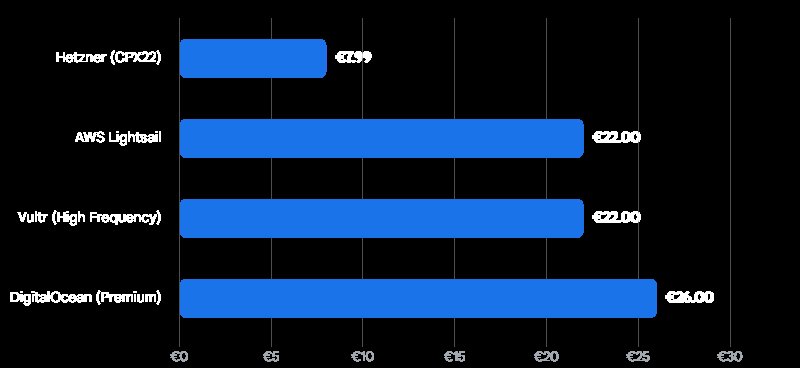
For example, their popular CPX22 plan—featuring 2 vCPUs, 4GB of RAM, and 80GB of NVMe SSD storage—adjusted from €5.99 to roughly €7.99 per month. A dedicated server like the EX42-NVMe adjusted to approximately €51.13 per month. When comparing these figures to equivalent specifications on AWS or Google Cloud, Hetzner is frequently ten to twelve times more cost-effective.
Strategic Advantages:
- Unmatched compute and RAM per Euro spent, making it an ideal environment for memory-hungry Magento deployments.
- Native GDPR compliance with European data sovereignty, running on 100% renewable energy in German data centers.
- High-performance AMD EPYC and Intel processors with generous unmetered bandwidth limits.
Critical Considerations:
- Hetzner is strictly an unmanaged infrastructure provider. You are handed root access and an IP address; there is no application-level support, no managed database service, and no hand-holding.
- If a production server goes down at critical hours due to a misconfigured PHP file, the merchant is entirely responsible for the recovery.
- Features like volume snapshots and private network firewalls have historically faced implementation quirks, requiring deep Linux administration knowledge.
2. DigitalOcean: The Developer’s Standard
DigitalOcean revolutionized the cloud industry by democratizing virtual machines with their simple interface and affordable Droplets. In 2026, they continue to offer a highly polished ecosystem that balances reliable performance with an intuitive user experience.
DigitalOcean’s pricing is transparent, predictable, and has recently evolved. Effective January 2026, the company moved to a highly granular per-second billing model, which is highly advantageous for scaling temporary workloads during flash sales. A standard Droplet with 2 vCPUs and 4GB of RAM costs approximately €22.00 per month (converted from $24.00). However, for e-commerce applications, their Premium Droplets—featuring newer generation Intel Xeon or AMD EPYC Milan/Rome processors and faster NVMe storage—are highly recommended, starting around €26.00 per month for similar specifications.
Strategic Advantages:
- An incredibly user-friendly control panel and an API-first approach that seamlessly integrates with deployment pipelines.
- Built-in cloud firewalls and free basic DDoS protection, which is a crucial advantage over some budget competitors.
- A vast, unparalleled library of high-quality documentation and tutorials that have become the industry standard for learning server administration.
- A comprehensive managed product ecosystem, including managed databases and Kubernetes, allowing merchants to effortlessly scale horizontally as their store grows.
Critical Considerations:
- The CPU credit model on lower-tier droplets can create performance bottlenecks if a sudden traffic spike exhausts the allocated CPU credits, throttling performance right when it is needed most.
- While they offer robust global coverage across 15+ data centers, their base pricing has crept up over the years, making them less competitive on raw price-to-performance against Hetzner.
3. Vultr: The High-Frequency Contender
Vultr positions itself aggressively against DigitalOcean by offering a wider variety of compute architectures and a more expansive global footprint. For resource-intensive platforms like Magento and WooCommerce, Vultr’s “High Frequency” instances are particularly compelling.
Because PHP is fundamentally single-threaded, a processor with a higher base clock speed will execute database queries and render dynamic pages noticeably faster. Vultr’s High Frequency compute instances are backed by 3GHz+ processors and NVMe solid-state drives, specifically engineered to deliver low latency and high throughput. A comparable 2 vCPU, 4GB RAM High Frequency instance runs approximately €22.00 per month.
Strategic Advantages:


- Exceptional single-core CPU performance, which is ideal for processing complex WooCommerce cart calculations and dynamic pricing rules rapidly.
- A massive global footprint with over 32 data center locations, reaching the vast majority of the world’s population with ultra-low latency (2-40ms).
- Flexible, composable architecture options, ranging from basic cloud compute to specialized cloud GPUs and bare metal servers for enterprise-scale deployments.
Critical Considerations:
- Unlike DigitalOcean, Vultr charges an additional monthly fee (roughly €9.00 converted from $10.00) for robust DDoS protection. When factoring in the need for comprehensive security, the overall cost dynamics shift, potentially making Vultr more expensive than its direct competitors.
4. AWS Lightsail: The Enterprise Gateway
Amazon Web Services (AWS) is the undisputed behemoth of cloud computing, offering unparalleled reliability and scale. However, navigating raw EC2 instances, configuring VPCs, and managing IAM roles is incredibly daunting for most mid-market merchants.
AWS Lightsail serves as a simplified, bundled VPS service that offers the reliability of the AWS backbone with the predictable pricing of a standard VPS provider. For approximately €22.00 per month (converted from $24.00), merchants can deploy a Lightsail instance with 2 vCPUs and 4GB of RAM, complete with a static IP address, DNS management, and SSD storage.
Strategic Advantages:
- Predictable monthly pricing utilizing the world’s most robust and redundant cloud network.
- A seamless integration path into the broader AWS ecosystem. If a store outgrows a single VPS, it is trivial to connect the Lightsail instance to Amazon S3 for media offloading, CloudFront for global CDN distribution, or RDS for highly available managed databases.
Critical Considerations:
- Compute performance on standard Lightsail instances can sometimes lag behind the specialized high-frequency offerings of Vultr or the raw, dedicated power of Hetzner.
- While Lightsail bundles bandwidth, exceeding those limits can introduce steep data transfer overage charges unique to the AWS billing structure.
European Market Alternatives: Scaleway, OVHcloud, and MassiveGRID
For merchants operating heavily within the European Union, geographic proximity and regional corporate governance play major roles in vendor selection.
OVHcloud, headquartered in France, is highly regarded for its enterprise-grade IaaS flexibility. Crucially, OVHcloud includes aggressive, built-in anti-DDoS mitigation across all VPS tiers, automatically filtering malicious traffic without impacting service. Their VPS instances utilize NVMe storage and feature daily automatic backups, representing a formidable alternative for merchants who require strict EU data sovereignty combined with advanced threat mitigation.
MassiveGRID offers an compelling proposition focused on High Availability (HA). While traditional VPS providers host instances on single physical nodes—meaning hardware failure results in downtime—MassiveGRID’s architecture is built for redundancy. They rank highly for overall uptime and support, offering built-in HA that automatically migrates workloads if a hardware fault is detected, providing peace of mind for mission-critical e-commerce operations.
Navigating European Markets and GDPR Compliance
Selecting a VPS provider in the modern era is not solely a technical decision; it is fundamentally a legal one. The General Data Protection Regulation (GDPR) mandates strict controls over where consumer data is processed, how it is secured, and who has access to it.
When an online store captures names, addresses, phone numbers, and purchasing histories, that data must be handled in compliance with privacy-by-design principles. Hosting infrastructure with a provider that guarantees data residency strictly within the EU significantly simplifies compliance audits and mitigates the complex legal challenges associated with international data transfer mechanisms.
| GDPR Compliance Area | Implementation Complexity | Key Resource Requirements | Expected Outcomes for E-Commerce |
| Data Subject Rights | High (Complex technical setup) | Verification systems, staff training | Enhanced transparency and user trust. |
| Privacy by Design | Moderate to High | Integration during the infrastructure design phase | Reduced privacy risks, cost-effective mitigation. |
| International Transfers | High (Complex legal/contractual) | Legal counsel, technical transfer controls | Ensures lawful cross-border data flows, avoiding steep fines. |
| Data Breach Notification | High (Tight 72-hour deadlines) | Investigation teams, automated log monitoring | Rapid risk mitigation and strict regulatory compliance. |
Merchants must ensure that their VPS provider offers compliant backup solutions. If a customer exercises their “Right to be Forgotten,” deleting their record from the active MariaDB database is insufficient if their personal data persists in easily accessible, unencrypted daily snapshots. Providers like Hetzner and OVHcloud, bound tightly by EU regulations, offer compliant data center environments that serve as a strong foundation for a comprehensive data protection strategy.
Server Setup Complexity: CLI versus Modern Control Panels
Purchasing a high-performance VPS is only the first step. The bare server must be provisioned with an operating system, a web server suite (Nginx or Apache), a database engine, PHP, and various caching daemons. Historically, developers managed this entire lifecycle via the Command Line Interface (CLI).
While CLI management via SSH offers the ultimate level of granular control and requires fewer system resources, it introduces significant risk. A single syntax error in an Nginx configuration file, or an improperly handled package upgrade, can take a high-revenue store offline instantaneously. Consequently, the industry has seen a massive paradigm shift toward modern, cloud-focused control panels designed specifically for VPS environments.
Tools like CloudPanel, RunCloud, xCloud, and aaPanel act as an intelligent abstraction layer over unmanaged VPS instances. A systems administrator simply connects their Hetzner, DigitalOcean, or Vultr server to these panels via an API key or an installation script, and the panel automatically deploys a highly optimized, secure software stack.
These modern control panels offer distinct, measurable advantages over legacy systems like cPanel or Plesk:
- Lightweight Footprint: Traditional panels load dozens of background services (mail servers, DNS clusters) that consume valuable RAM. Modern cloud panels are highly modular, leaving the vast majority of compute resources available strictly for WooCommerce and Magento operations.
- Modern Architectural Stacks: They default to high-performance, edge-case configurations, such as Nginx paired with PHP-FPM or OpenLiteSpeed, rather than the slower, traditional Apache setups.
- Automated Security & Maintenance: They handle Let’s Encrypt SSL certificate provisioning, complex firewall configuration, and automated off-site backups seamlessly, turning infrastructure management from a high-risk cost center into a repeatable competitive advantage.
For businesses that lack an extensive in-house systems administration team, leveraging a modern control panel on top of an unmanaged Hetzner or Vultr VPS provides the perfect middle ground between top-tier performance, aggressive cost savings, and operational ease of use. At Tool1.app, we specialize in bridging this exact gap, setting up robust automation pipelines for our clients that handle zero-downtime deployments and continuous, proactive server monitoring.
Performance Masterclass: Nginx and Database Tuning
A powerful, expensive VPS running default software configurations will still struggle under heavy e-commerce traffic. True performance—the kind that lowers bounce rates and drives conversions—is unlocked exclusively at the application and database layers. Below are the definitive optimization strategies required for production environments in 2026.
Nginx FastCGI Cache Configuration for WooCommerce
Server-level full-page caching is the single most impactful optimization a merchant can deploy. By serving fully rendered, static HTML directly from the server’s memory, you completely bypass PHP processing and database queries for the vast majority of your visitors. This reduces latency from several hundred milliseconds down to 10–50 milliseconds.
However, e-commerce sites present a unique, dangerous challenge: you absolutely cannot cache the cart page, the checkout flow, or the “My Account” area. Doing so would result in severe privacy breaches, with customers seeing each other’s private data, cart contents, and shipping addresses.
When configuring Nginx FastCGI cache on a VPS, the administrator must implement strict, logic-based bypass rules. The following Nginx configuration snippet demonstrates how to instruct the web server to immediately skip the cache when critical WooCommerce cookies are present, or when specific dynamic URIs are requested by the browser :
Nginx
# Skip cache for WooCommerce dynamic transactional pages
if ($request_uri ~* "/store.*|/cart.*|/my-account.*|/checkout.*|/addons.*") {
    set $skip_cache 1;
}

# Skip cache if a query string is present (e.g., actively adding a product to the cart)
if ( $arg_add-to-cart!= "" ) {
    set $skip_cache 1;
}

# Skip cache if the user has active items in their WooCommerce cart session
if ( $cookie_woocommerce_items_in_cart!= "0" ) {
    set $skip_cache 1;
}

# Skip cache entirely for logged-in users or authenticated administrative sessions
if ($http_cookie ~* "wc_session_cookie_[^=]*=([^%]+)%7C|wordpress_logged_in_") {
    set $skip_cache 1;
}
This configuration ensures that anonymous visitors browsing the product catalog experience blindingly fast page loads (served directly from Nginx memory), while the transactional elements of the site remain securely dynamic, querying the database only when absolutely necessary.
MariaDB and MySQL Tuning for E-Commerce
The default configurations for MySQL and MariaDB are designed for shared servers with limited resources (often optimized for as little as 512MB of RAM). Running a 16GB VPS without modifying the database configuration means leaving massive amounts of performance on the table.
For WooCommerce and Magento platforms, the database engine must be permitted to cache larger datasets in memory to prevent slow disk I/O operations.
| MySQL/MariaDB Setting | Optimal Configuration Strategy | E-Commerce Impact |
innodb_buffer_pool_size | Set to 50% – 70% of total VPS RAM. | Allows the database to cache entire tables and indexes in memory, drastically speeding up catalog queries. |
max_connections | Increase based on expected peak concurrent traffic (e.g., 200 – 500). | Prevents “Database Connection Refused” errors during critical flash sales or holiday traffic spikes. |
tmp_table_size & max_heap_table_size | Increase to 128M or 256M. | Improves performance for complex product filtering and detailed administrative reporting that rely on temporary tables. |
innodb_thread_concurrency | Correlate to CPU cores (e.g., 2 * number of vCPUs + 2). | Optimizes how the database engine distributes concurrent queries across the available CPU architecture. |
innodb_flush_log_at_trx_commit | Set to 2 for optimal balance. | Improves disk I/O performance for transaction commits, significantly speeding up order processing and Magento indexing. |
Furthermore, configuring a secondary memory data store like Redis is not optional for production environments; it is mandatory. Redis must be utilized for both object caching (storing the results of complex, repeated database queries) AND PHP session handling. Relying on default file-based PHP sessions on a busy WooCommerce store creates a severe I/O bottleneck as the server attempts to read and write thousands of small session files to the disk simultaneously.
The Role of AI and Automation in Server Management
As we navigate through 2026, the intersection of cybersecurity, server management, and Artificial Intelligence has fundamentally altered how e-commerce infrastructure is maintained. Managing a high-performance VPS is no longer a strictly manual, reactive endeavor.
Threat actors are increasingly utilizing generative AI to automate vulnerability scanning, orchestrate phishing campaigns, and execute sophisticated supply chain attacks. In response, modern VPS environments must incorporate AI-driven log analysis and predictive threat detection. Automated Python scripts running quietly on your VPS can continuously parse Nginx access logs, PHP error logs, and system authentication logs.
These custom scripts can identify anomalous behavioral patterns—such as a sudden, distributed spike in dynamic query requests indicative of an application-layer (Layer 7) DDoS attack or a coordinated credential stuffing attempt. Upon detecting these patterns, the automation pipeline can instantly update server-level firewall rules (iptables or ufw) or interface directly with Cloudflare’s API to dynamically block the offending IP ranges before the database is overwhelmed.
Moreover, infrastructure scaling is becoming highly automated. Using custom Python automations, servers can monitor their own CPU utilization and memory thresholds in real-time. When a marketing campaign drives an unexpected traffic surge, the system can automatically allocate more PHP-FPM workers to process the queue, or alert an external load balancer to spin up a secondary cloud node seamlessly.
At Tool1.app, we specialize in building these exact Python automations and advanced AI/LLM solutions for business efficiency. We recognize that merchants want to focus on merchandising, marketing, and revenue growth, not on actively monitoring system processes in a terminal window. By integrating intelligent, automated server management, we ensure that your e-commerce infrastructure is not only incredibly fast but resilient, highly secure, and self-healing.
Securing Your Competitive Advantage
The speed and reliability of your online store are directly correlated with your conversion rate, your search engine visibility, and your overall customer retention metrics. Migrating from a sluggish, shared hosting plan to a properly architected Virtual Private Server is the single most impactful technological upgrade a growing e-commerce business can make.
Whether you opt for the raw, highly cost-effective compute power of Hetzner, the aggressive high-frequency infrastructure of Vultr, or the expansive, developer-friendly ecosystem of DigitalOcean, the hardware is only half the battle. Success in 2026 demands a deeply optimized software stack—featuring Nginx FastCGI caching, Redis object stores, MariaDB 11, and PHP 8.4—meticulously tuned to handle the unique, heavy transactional weight of WooCommerce and Magento applications.
Ready to migrate to a faster server and leave performance bottlenecks behind? Let Tool1.app handle your seamless VPS setup and migration. Our infrastructure engineering team specializes in custom software development, advanced Python automations, and enterprise-grade server tuning. Contact us today via Tool1.app to discuss how we can engineer a bespoke, lightning-fast hosting environment that scales effortlessly with your business.
SEO






Leave a Reply
Want to join the discussion?Feel free to contribute!
Join the Discussion
To prevent spam and maintain a high-quality community, please log in or register to post a comment.