Beyond the Hype: Why Python is the Absolute King of Data, Finance, and Medicine
Table of Contents
- Introduction: Setting the Stage Beyond the Python Hype
- Python's Reign in Data Science: Libraries, Ecosystem, and Analytics
- Revolutionizing Finance: From Algorithmic Trading to Risk Management
- Advancing Medicine: Research, Diagnostics, and Drug Discovery
- The Unifying Strengths: Versatility, Community, and Future-Proofing
- Conclusion: Unlock the Power of Python for Your Business Today
- Show all
Introduction: Setting the Stage Beyond the Python Hype
For the better part of the last decade, the technology sector has been flooded with headlines proclaiming Python as the programming language of the future. It is easy to dismiss this as mere industry hype, a cyclical trend where a new tool temporarily captures the imagination of developers before fading into obscurity. However, looking closely at enterprise applications, research laboratories, and trading floors reveals a very different reality. Python is not a passing trend; it is the fundamental infrastructure powering modern innovation.
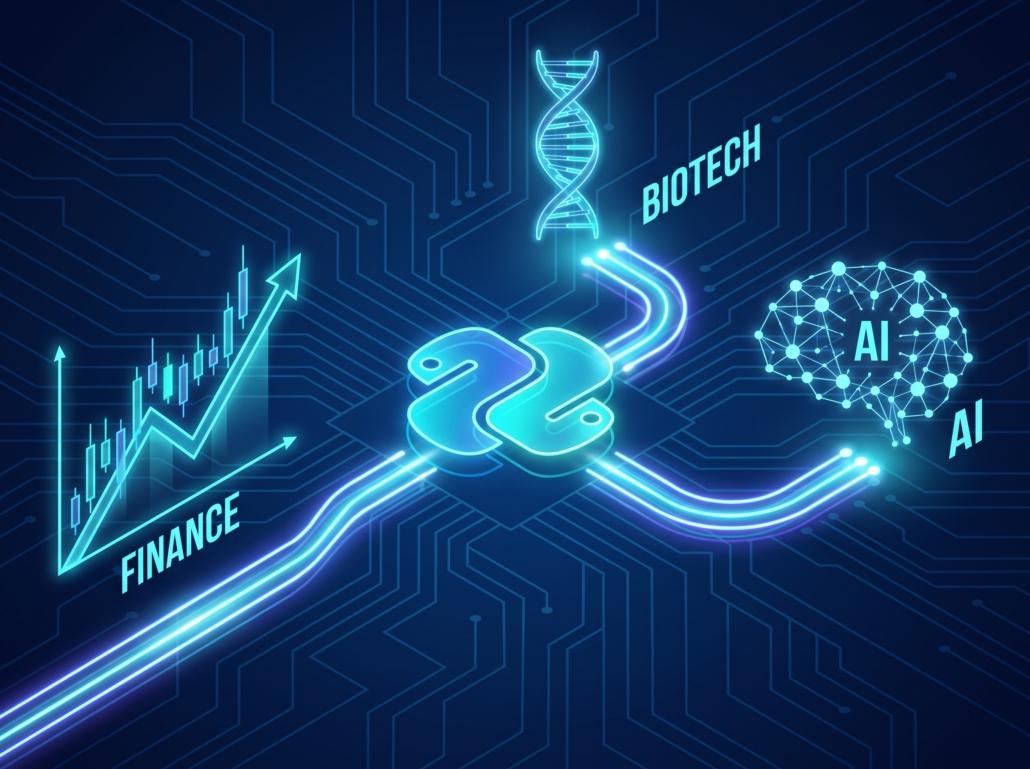
To truly understand this phenomenon, we must move beyond the superficial metrics of language popularity and examine the foundational strengths that cement Python’s position as a kingpin in the most data-intensive and mission-critical fields of our time. The convergence of Python data finance medicine represents a paradigm shift in how professionals solve complex, real-world problems. By providing an elegant syntax combined with unparalleled computational power, Python has democratized advanced analytics, allowing domain experts—rather than just computer scientists—to build systems that automate workflows, predict market movements, and even discover life-saving drugs.
The goal of this exploration is to dissect exactly how Python has achieved its dominance. We will look at practical business applications, explore code-level efficiencies, and demonstrate why investing in Python-based architecture is the most secure, scalable, and lucrative decision a business can make today.
Python’s Reign in Data Science: Libraries, Ecosystem, and Analytics
In the realm of data science, Python is not just a tool; it is the entire workshop. The language’s dominance in analytics and artificial intelligence stems from an open-source ecosystem that has been meticulously refined by millions of contributors. For businesses attempting to extract actionable insights from terabytes of unstructured information, Python offers an unbroken pipeline from data ingestion to predictive deployment.
The Foundation of Advanced Data Manipulation
Before any machine learning model can be trained, data must be cleaned, transformed, and understood. This is where Python’s foundational libraries—Pandas and NumPy—shine. NumPy introduces high-performance, multidimensional arrays, executing complex mathematical operations with speeds akin to C or Fortran. Pandas builds upon this by offering DataFrames, a highly intuitive structure for manipulating tabular data.
Consider a scenario where a mid-sized retail chain needs to analyze point-of-sale data across hundreds of locations to optimize inventory. Doing this in traditional spreadsheet software would lead to instant crashes. With Python, processing millions of rows takes mere seconds.
Python
import pandas as pd
import numpy as np

# Simulating the loading of a massive retail dataset
# In a real-world scenario, this could be a direct database connection
df = pd.read_csv('retail_sales_data.csv')

# Instantly aggregating total sales (in EURO) per region and product category
regional_sales = df.groupby(['Region', 'Category'])['Revenue_Euro'].sum().reset_index()

# Filtering for high-performing regions generating over €500,000
top_performers = regional_sales[regional_sales['Revenue_Euro'] > 500000]

print(top_performers)
By utilizing scripts like this, businesses can automate daily reporting, instantly spotting inventory shortages or regional trends. At Tool1.app, we frequently leverage these exact Python libraries to build bespoke analytics dashboards and automated reporting systems, turning raw data into strategic assets for our clients without the overhead of massive, bloated enterprise software.
Driving Machine Learning and Artificial Intelligence
Once data is structured, Python unleashes its true power through machine learning libraries like Scikit-learn, TensorFlow, and PyTorch. Scikit-learn provides accessible tools for traditional machine learning algorithms—such as clustering, regression, and random forests. For deep learning, TensorFlow and PyTorch offer the infrastructure to build neural networks capable of natural language processing and computer vision.
Businesses are using these tools to build recommendation engines, forecast demand, and automate customer service. A company implementing a Python-based machine learning model to predict customer churn can easily save tens of thousands of Euros by proactively retaining at-risk clients. The rich ecosystem means developers do not have to reinvent the wheel; they simply integrate the best existing models and fine-tune them for specific business needs.
Real-World Business Analytics Use Cases
The practical applications of Python in data science span every industry. Logistics companies use Python to optimize delivery routes, reducing fuel costs by hundreds of thousands of Euros annually. Marketing agencies deploy Natural Language Processing (NLP) to perform sentiment analysis on social media, instantly gauging public reaction to brand campaigns. The return on investment for Python-based automation is immediate and measurable, driving efficiency and significantly reducing human error in repetitive tasks.
Revolutionizing Finance: From Algorithmic Trading to Risk Management
Nowhere is the demand for accuracy and speed higher than in the financial sector. Historically reliant on rigid legacy systems, Excel spreadsheets, and complex VBA macros, modern finance has undergone a massive migration toward Python. Today, the world’s largest hedge funds, investment banks, and fintech startups rely on Python to navigate volatile markets, manage billions of Euros, and strictly adhere to regulatory compliance.
Quantitative Analysis and Financial Modeling
Quantitative analysts (quants) use Python to build complex financial models that evaluate asset pricing and market behavior. One of the most common applications is the Monte Carlo simulation, a mathematical technique used to understand the impact of risk and uncertainty in financial forecasting. Instead of relying on static averages, Python can run thousands of simulated market scenarios in milliseconds to predict the probability of different outcomes.
Python
import numpy as np
import matplotlib.pyplot as plt

# Simulating future stock prices using a Random Walk model
days = 252 # Trading days in a year
starting_price = 150.00 # Price in Euros
volatility = 0.02

# Running 1000 different simulated scenarios
simulations = np.zeros((days, 1000))
simulations[0] = starting_price

for t in range(1, days):
    random_shocks = np.random.normal(0, volatility, 1000)
    simulations[t] = simulations[t-1] * (1 + random_shocks)

# The result is a matrix of potential future prices to assess risk
expected_price = np.mean(simulations[-1])
print(f"Expected average price after one year: €{expected_price:.2f}")
This capability allows financial institutions to model everything from retirement fund growth to the pricing of exotic derivatives. Developing robust financial software requires this exact level of precision, which is why our team at Tool1.app relies on Python to engineer secure, high-performance fintech applications and automated trading bots for our clients.
High-Frequency Trading Systems
While languages like C++ are often used for the final execution of high-frequency trades due to their microscopic latency advantages, Python dominates the strategy development, backtesting, and algorithmic design phases. Libraries like Zipline and Backtrader allow financial engineers to code a trading strategy and instantly test it against decades of historical market data.
If an algorithm relies on a moving average crossover strategy—buying when a short-term average crosses above a long-term average—Python can backtest this against 20 years of tick-by-tick data to ensure the strategy is profitable before risking a single Euro in the live market.


Modern Portfolio Optimization and Risk Assessment
Risk management is a critical function for any financial entity. Calculating the Value at Risk (VaR) of a €50,000,000 portfolio requires analyzing the covariance of hundreds of individual assets. Python automates these massive matrix multiplications flawlessly. Furthermore, integration with APIs allows Python scripts to pull live data from Bloomberg, Yahoo Finance, or crypto exchanges, instantly updating risk metrics and alerting portfolio managers via automated SMS or email if a portfolio’s risk profile exceeds acceptable thresholds.
Advancing Medicine: Research, Diagnostics, and Drug Discovery
The intersection of technology and healthcare is quite possibly the most impactful area of modern software development. In medicine, data is inherently complex: massive genomic sequences, high-resolution 3D imaging, and vast repositories of unstructured clinical trial notes. Python has emerged as the lingua franca of medical research, dramatically accelerating the pace of scientific discovery and improving patient outcomes.
Bioinformatics and Genomic Sequencing
The human genome consists of roughly 3 billion base pairs. Analyzing this data to find genetic mutations responsible for diseases is a computational nightmare. Python libraries such as Biopython provide specialized data structures and algorithms specifically designed for biological computation.
Researchers use Python to align DNA sequences, parse specialized bioinformatics file formats, and query major biological databases. What used to take teams of scientists months of manual labor can now be processed by Python scripts running on cloud servers in a matter of hours, significantly reducing the cost of genetic research and bringing personalized medicine closer to reality.
Medical Imaging Analysis
Medical imaging—such as MRI, CT, and PET scans—relies on the DICOM standard. Python bridges the gap between raw medical images and advanced artificial intelligence diagnostics. Libraries like pydicom allow developers to read, modify, and anonymize medical images seamlessly, which is vital for patient privacy and regulatory compliance.
Once the data is processed, libraries like SimpleITK apply advanced filtering and segmentation. Today, Python-powered AI models can analyze X-rays to detect early signs of pneumonia or tumors with an accuracy rate that frequently matches or exceeds that of human radiologists.
Python
import pydicom
import matplotlib.pyplot as plt

# Loading a DICOM medical image file
# Anonymizing patient data for compliance before analysis
dataset = pydicom.dcmread('patient_mri_scan.dcm')
dataset.PatientName = "ANONYMOUS"
dataset.PatientID = "000000"

# Accessing the pixel array for AI image processing
image_data = dataset.pixel_array

# At this stage, the image_data matrix would be fed into a PyTorch model
# to detect anomalies, lesions, or tumors automatically.
When Tool1.app develops AI/LLM solutions for the healthcare sector, we prioritize this exact blend of data privacy, compliance, and cutting-edge machine learning. Building custom medical applications requires an intimate knowledge of how Python processes these sensitive, life-saving datasets efficiently and securely.
AI-Driven Drug Discovery and Clinical Data Processing
The traditional drug discovery process is notoriously slow and expensive, often costing upwards of €2,000,000,000 and taking over a decade to bring a single new medication to market. Python is revolutionizing this by simulating molecular interactions in a virtual environment.
Using deep learning models, researchers can predict how a new synthetic compound will bind to a specific disease-causing protein. By screening millions of chemical compounds virtually, Python dramatically narrows down the list of candidates that require actual physical testing in a laboratory. Moreover, Python’s Natural Language Processing capabilities are used to rapidly process decades of clinical trial literature, instantly extracting relevant data about drug side effects and efficacy, ensuring safer trials and faster regulatory approvals.
The Unifying Strengths: Versatility, Community, and Future-Proofing
The profound success of Python across data, finance, and medicine is not a coincidence. It is the result of several unifying strengths that make the language inherently suited for complex, cross-disciplinary problem-solving.
First is its unparalleled readability. Python’s syntax closely mirrors human language, meaning a financial analyst or a medical researcher can read and understand a script without needing a degree in computer science. This bridges the gap between domain experts and software engineers, fostering rapid collaboration.
Second is the vast, open-source community. Whenever a new mathematical challenge or data format arises, the global community quickly develops and rigorously tests a Python package to handle it. A company does not need to build complex matrix calculation algorithms from scratch; they simply import NumPy. This dramatically lowers the cost of software development and accelerates the time-to-market for new enterprise solutions.
Finally, Python is uniquely future-proof. Because it serves as the primary interface for the latest advancements in Artificial Intelligence and Large Language Models, any business infrastructure built on Python is natively ready to integrate tomorrow’s AI breakthroughs. Whether it is a chatbot powered by an LLM or a predictive model forecasting stock prices, a Python backend ensures that a business remains at the cutting edge of technological innovation.
Conclusion: Unlock the Power of Python for Your Business Today
The landscape of modern business is unequivocally data-driven, and those who harness the computational capabilities of Python hold a distinct competitive advantage. As we have seen, the synergy of Python data finance medicine is not just academic theory; it is actively generating millions of Euros in optimized portfolios, streamlining massive supply chains, and saving lives through accelerated medical diagnostics. Refusing to modernize and integrate these tools means falling behind competitors who are already automating their workflows and leveraging AI for strategic growth.
You do not need to build an internal data science team from scratch to reap these benefits. Partnering with an expert development team allows you to rapidly integrate custom automations and AI solutions tailored specifically to your operational needs.
Unlock the power of Python for your business today! If you are ready to modernize your operations, build highly secure financial applications, or integrate cutting-edge AI into your workflow, contact us at Tool1.app. Let our team of expert developers design and implement the custom software, Python automations, and LLM solutions that will drive your business efficiency to the next level. Reach out to Tool1.app for a consultation, and let’s build the future of your company together.





Leave a Reply
Want to join the discussion?Feel free to contribute!
Join the Discussion
To prevent spam and maintain a high-quality community, please log in or register to post a comment.