

Cost Analysis: Gemini 1.5 Flash vs. GPT-4o Mini for Bulk Text Processing
Table of Contents
- The Strategic Shift to Cost-Efficient AI Models
- Core Architectural Specifications and Capabilities
- Exhaustive Synchronous Pricing Analysis
- The Batch API Paradigm for Asynchronous Cost Optimization
- Context Caching Mechanisms and Financial Implications
- Simulating a High-Volume Enterprise Workload
- Throughput and Latency Benchmarks
- The Context Window Divide: Strategic Implications
- Enterprise Quotas, Rate Limits, and SLA Guarantees
- Real-World Business Use Cases for Bulk Processing
- Implementation: Python Automation for Batch Processing
- Total Cost of Ownership and Ecosystem Integration
- Strategic Model Routing
- Optimize Your Infrastructure with Expert Automation
- Show all

The transition from localized artificial intelligence experimentation to global enterprise production represents a fundamental shift in how organizations evaluate large language models. In the early phases of generative AI adoption, engineering teams and product managers prioritized raw reasoning power and emergent capabilities, often relying on massive, trillion-parameter flagship models to demonstrate proof-of-concept workflows. However, as these applications scale from processing hundreds of interactions per day to analyzing millions of discrete data points, the financial realities of application programming interface (API) consumption become the primary bottleneck to profitability. When a business workflow requires the extraction of metadata from decades of unstructured legal archives, the generation of localized product descriptions for vast e-commerce catalogs, or the semantic routing of high-volume customer support tickets, token ingestion volume explodes exponentially. In these high-throughput, latency-tolerant scenarios, the choice of the underlying foundational model dictates the viability of the entire data pipeline.
The artificial intelligence industry has recognized this shift in enterprise priorities, pivoting aggressively toward the development of highly optimized, cost-efficient small language models. Within this highly competitive tier, two undeniable leaders have captured the market: Google’s Gemini 1.5 Flash and OpenAI’s GPT-4o Mini. Both architectures are explicitly designed for speed, affordability, and high-throughput workloads, making them the default routing destinations for bulk text processing pipelines. Objective benchmarks between these fast, affordable models are heavily researched by engineering leaders seeking to minimize infrastructure spend without sacrificing output quality. At Tool1.app, we specialize in building enterprise-grade Python automations and custom artificial intelligence architectures. We continuously evaluate and benchmark these foundational models to ensure our clients receive the maximum possible return on their infrastructure investments. This comprehensive research report provides an exhaustive cost and performance analysis of Gemini 1.5 Flash and GPT-4o Mini, evaluating their pricing structures, batch processing capabilities, latency benchmarks, and enterprise rate limits to equip technical decision-makers with the data required to architect highly profitable automation pipelines.
The Strategic Shift to Cost-Efficient AI Models
Historically, the default instinct for software engineering teams building artificial intelligence applications was to route all requests through the most intelligent flagship models available. However, employing top-tier reasoning engines for routine text classification, summarization, entity extraction, or structured data formatting is an inefficient allocation of computational resources. The compute cost is fundamentally disproportionate to the complexity of the task. Bulk text processing typically involves repetitive, strictly defined programmatic tasks where the necessary context is provided directly within the prompt through retrieval-augmented generation pipelines, meaning the required reasoning depth from the model itself is relatively moderate. For these specific workloads, the performance delta between a flagship model and a highly optimized small language model is statistically negligible in terms of output quality, yet the financial cost difference is staggering.
OpenAI engineered GPT-4o Mini and Google developed Gemini 1.5 Flash specifically to dominate this high-volume enterprise segment. These models boast remarkable reasoning capabilities that frequently outperform the massive flagship models released just a year prior, while operating at a tiny fraction of the inference cost. Understanding the nuanced pricing models, rate limits, and contextual boundaries of these two application programming interfaces is the foundational first step in architecting a sustainable and scalable artificial intelligence strategy.
Core Architectural Specifications and Capabilities
Before dissecting the financial implications of token consumption, it is critical to understand the technical boundaries and architectural capabilities of each model, as these parameters directly dictate which model is appropriate for a specific data workload. Both models represent significant leaps in efficiency, but they achieve their performance through different architectural philosophies and infrastructure optimizations.
OpenAI introduced GPT-4o Mini as the direct successor to its previous high-volume models, bringing native multimodal capabilities and vastly improved reasoning to the budget tier. Operating with a context window of 128,000 tokens, which equates to roughly three hundred pages of standard text, the model supports an output limit of up to 16,384 tokens per request. GPT-4o Mini exhibits exceptional instruction following and deep integration within the broader OpenAI ecosystem, showcasing robust performance on coding tasks and the generation of structured data, such as strictly formatted JavaScript Object Notation (JSON). The model relies on an improved tokenizer that significantly reduces the cost of processing non-English text, and it benefits from an advanced instruction hierarchy method designed to resist prompt injections and system prompt extractions, rendering it highly reliable for enterprise applications operating at scale.
Conversely, Google engineered Gemini 1.5 Flash utilizing a novel Mixture-of-Experts architecture, prioritizing blistering inference speed and unparalleled context retention. The most defining characteristic of Gemini 1.5 Flash is its colossal context window, capable of ingesting up to 1,000,000 tokens simultaneously. This massive capacity allows the model to process entire enterprise codebases, multiple comprehensive financial reports, or hours of transcribed audio in a single prompt. While its maximum output limit per request typically caps at 8,192 tokens, its native multimodality and industry-leading throughput speeds make it an unparalleled tool for massive data ingestion pipelines.
When analyzing raw intelligence through standardized industry benchmarks, both models exhibit formidable capabilities. On the Massive Multitask Language Understanding (MMLU) benchmark, which evaluates textual intelligence and reasoning across numerous academic and professional domains, GPT-4o Mini achieves a score of 82.0%, while Gemini 1.5 Flash scores a highly competitive 77.9%. Similarly, in the massive multi-discipline multimodal understanding (MMMU) evaluations, GPT-4o Mini leads slightly with a 59.4% score compared to Gemini 1.5 Flash’s 56.1%. While GPT-4o Mini maintains a slight edge in these specific standardized testing environments, practical application in bulk processing often reveals that both models comfortably exceed the reasoning thresholds required for enterprise automation tasks.
Exhaustive Synchronous Pricing Analysis
When analyzing application programming interface costs for bulk text processing, financial architects must account for two distinct variables: input tokens, which comprise the prompt and any provided context, and output tokens, which represent the generated response. Because output tokens require sequential, autoregressive generation and significantly greater computational overhead, they are consistently priced higher than input tokens across the entire industry. For enterprise applications requiring immediate, real-time responses—such as customer-facing conversational agents, live data extraction interfaces, or synchronous validation pipelines—standard synchronous API calls are mandatory.
To provide accurate localization and actionable financial intelligence for European businesses, all cost analysis figures in this report have been standardized to Euros (€), utilizing an approximate enterprise conversion rate of 0.95 from the original United States Dollar pricing.
| Model Specification | Input Cost (per 1M tokens) | Output Cost (per 1M tokens) | Context Window Limit |
| GPT-4o Mini | €0.14 | €0.57 | 128,000 Tokens |
| Gemini 1.5 Flash | €0.07 | €0.28 | 1,000,000 Tokens |
| Gemini 1.5 Flash-8B | €0.035 | €0.14 | 1,000,000 Tokens |
The empirical data indicates a notable 50% cost advantage for Google’s model in standard synchronous API workloads. In a standard synchronous deployment, Gemini 1.5 Flash is exactly half the cost of GPT-4o Mini across both the input and output dimensions. For an engineering team processing a modest volume of text during a development sprint, this variance might appear financially immaterial. However, at a true enterprise scale involving the ingestion and generation of billions of tokens per month, this financial divergence becomes a critical determinant of gross margin profitability. Furthermore, Google offers an even lighter variant, Gemini 1.5 Flash-8B, which drives the cost down further to just €0.035 per million input tokens, establishing it as the absolute lowest-cost option for high-volume, low-complexity classification tasks.
Beyond text, multimodal tokenization costs introduce an additional layer of financial complexity. Bulk processing pipelines increasingly ingest screenshots, scanned portable document formats, and audio files. OpenAI calculates image costs based on the resolution of the image, breaking it down into a base token charge plus additional tile tokens. For a standard low-resolution image, GPT-4o Mini charges a fixed rate that generally translates to a negligible fraction of a cent per image. Google’s Gemini calculates multimodal inputs dynamically based on the specific media type, with video and audio inputs billed at distinct rates per second or per image. Understanding these granular multimodal pricing structures is essential when designing OCR-replacement pipelines or automated video tagging systems.
The Batch API Paradigm for Asynchronous Cost Optimization
The fundamental secret to unlocking extreme cost efficiency in bulk text processing lies in the utilization of asynchronous Batch APIs. In the vast majority of enterprise data workflows—such as analyzing decades of historical support tickets, tagging massive product catalogs, or summarizing daily global news feeds for sentiment analysis—immediate, sub-second responses are entirely unnecessary.
Recognizing this architectural pattern, both OpenAI and Google offer dedicated Batch API endpoints that allow developers to submit massive files containing tens of thousands of individual requests. These requests are queued and processed asynchronously utilizing the providers’ off-peak global server capacity. The target turnaround time for these batch jobs is guaranteed within a twenty-four-hour window, although empirical evidence shows they frequently complete much faster. In exchange for this latency flexibility, both providers offer an aggressive 50% discount on their already low standard token rates.
| Model (Batch Pricing) | Batch Input (per 1M tokens) | Batch Output (per 1M tokens) | Turnaround SLA |
| GPT-4o Mini Batch | €0.07 | €0.285 | 24 Hours |
| Gemini 1.5 Flash Batch | €0.035 | €0.14 | 24 Hours |
By routing non-urgent, high-volume workloads through the Google Batch API, an organization utilizing Gemini 1.5 Flash can process one million input tokens for roughly three and a half cents. This extreme cost reduction fundamentally alters the return on investment calculation for data enrichment projects that were previously deemed too expensive to execute. At Tool1.app, we frequently transition our clients’ legacy synchronous pipelines to asynchronous batch architectures, routinely achieving immediate 50% reductions in their monthly cloud infrastructure invoices without altering the underlying application logic.
However, engineering teams must navigate specific structural constraints when utilizing these batch endpoints. OpenAI restricts the upload size of the JSON Lines input files to 200 megabytes per batch, requiring developers to implement intelligent file chunking and orchestration logic for massive datasets. Additionally, the output files generated by the batch process are automatically purged from the provider’s servers after a thirty-day retention period, necessitating automated download and ingestion scripts to ensure data preservation.
Context Caching Mechanisms and Financial Implications
When processing bulk text, artificial intelligence applications frequently rely on massive system instructions, few-shot classification examples, or large reference documents that must be passed to the language model with every single request. Resending this identical contextual data millions of times across a batch job is highly inefficient, increasing both latency and financial cost. To mitigate this, both platforms have introduced sophisticated Context Caching mechanisms, which allow developers to store large blocks of text on the provider’s servers and reference them across multiple API calls for a fraction of the standard input cost.
OpenAI approaches this optimization through an elegant, implicit caching system. Developers do not need to purposefully create or manage cache objects; the OpenAI infrastructure automatically detects when a prompt shares a substantial prefix with a recently processed prompt and applies the discount. For GPT-4o Mini, cached inputs are billed at €0.07 per million tokens, representing a 50% discount from the standard synchronous input rate. This implicit system is incredibly developer-friendly, requiring zero architectural changes to existing codebases to reap the financial benefits.
Conversely, Google requires an explicit caching architecture for certain deployments, though it has recently introduced implicit caching by default for the Gemini 1.5 family. Under the implicit system, Gemini provides a massive 90% discount on cached tokens compared to standard input tokens. However, financial architects must be aware of a critical caveat: the discounts for cache and batch processing do not stack. If a workload triggers both, the larger 90% cache hit discount takes precedence over the 50% batch discount. Furthermore, when utilizing explicit caching for long-term storage of persistent context, Google charges a persistent hourly storage fee—approximately €0.95 per one million tokens per hour—to keep the context warm in memory.
For bulk processing where millions of rows are processed within a tight, continuous timeframe, OpenAI’s implicit caching is remarkably straightforward. However, Google’s aggressive 90% implicit cache discount makes it mathematically superior if an enterprise is repeatedly pinging a massive, static knowledge base, provided the workload is structured to maximize cache hits without incurring unnecessary persistent storage fees.
Simulating a High-Volume Enterprise Workload
To illustrate the concrete financial impact of these varied pricing structures, we can simulate a real-world bulk processing scenario. Consider a global financial compliance firm that needs to orchestrate the analysis of a decade’s worth of corporate filings. The data engineering team determines the job consists of processing one billion input tokens of raw legal text and generating one hundred million output tokens of extracted metadata, risk scores, and summarized abstracts.
If the firm executes this workload using GPT-4o Mini through standard synchronous API calls, the input cost would total €140,000, and the output cost would total €57,000, resulting in a total pipeline cost of €197,000.
If the engineering team refactors the pipeline to utilize the GPT-4o Mini Batch API, the input cost drops to €70,000, and the output cost drops to €28,500, yielding a total cost of €98,500.
Alternatively, if the firm selects Gemini 1.5 Flash via standard synchronous calls, the input cost is €70,000, and the output cost is €28,000, totaling €98,000.
Finally, by executing the optimal architecture—utilizing Gemini 1.5 Flash through the Batch API—the input cost plummets to €35,000, and the output cost drops to €14,000, resulting in a total project cost of just €49,000.
The simulated data reveals a stark operational reality: executing this exact same massive workload using Gemini 1.5 Flash via the Batch API is nearly 75% cheaper than using GPT-4o Mini synchronously, and exactly half the cost of utilizing GPT-4o Mini’s own Batch API. For enterprise organizations running these data extraction jobs on a daily or weekly cadence, the compounded structural savings amount to hundreds of thousands of Euros annually, directly impacting the bottom line.
Throughput and Latency Benchmarks
While cost is a primary driver in architectural decision-making, raw throughput represents the other critical half of the engineering equation. In the context of bulk text processing, the speed at which a language model ingests prompts and outputs tokens determines the operational bottleneck of the entire data pipeline. Model latency is typically measured using two distinct metrics: Time to First Token, which is crucial for real-time customer-facing chatbots, and Tokens Per Second, which is the defining metric for high-volume bulk processing throughput.


Recent empirical benchmarks monitoring sustained API usage demonstrate that Gemini 1.5 Flash possesses a significant speed advantage in raw token generation. Google’s infrastructure, deeply optimized by custom Tensor Processing Units, allows Gemini 1.5 Flash to achieve an impressive throughput of approximately 131 tokens per second. In contrast, independent empirical testing of GPT-4o Mini typically reveals an average throughput ranging between 73 and 85 tokens per second.
Empirical Throughput (Tokens Per Second)
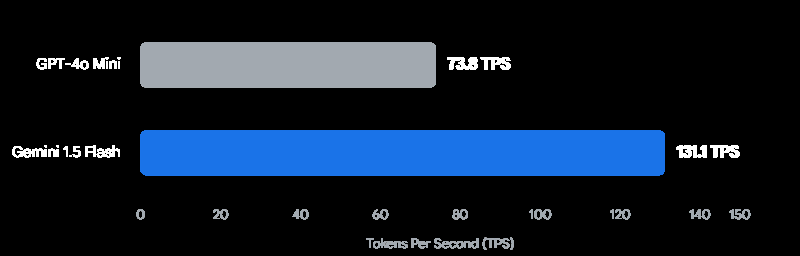
Gemini 1.5 Flash achieves significantly higher token generation speeds, reducing the total processing time for massive batch jobs by nearly half.
This data indicates that Google’s model is roughly 78% faster at generating raw text output. When pushing gigabytes of JSON Lines files through an asynchronous batch pipeline, a 78% increase in overall throughput means that data engineering teams receive their fully processed datasets hours earlier. This accelerated processing speed enables faster downstream analytics, quicker integration into data lakes, and more agile business intelligence workflows. At Tool1.app, we leverage this high throughput to ensure our automated data pipelines never become the limiting factor in our clients’ daily operations.
The Context Window Divide: Strategic Implications
One of the most profound architectural differences between these two language models is the stark disparity in the size of their respective context windows. GPT-4o Mini supports a highly respectable 128,000 tokens. This capacity is more than sufficient for the vast majority of standard bulk processing tasks, such as formatting short text snippets, categorizing single documents, or extracting structured data arrays from a handful of pages.
However, Gemini 1.5 Flash features a colossal 1,000,000-token context window. This structural advantage unlocks entirely new paradigms for bulk text processing that are mathematically impossible to execute with GPT-4o Mini. With a one-million token capacity, engineering teams can execute “Many-Shot” prompting at an unprecedented scale. Instead of providing the model with five or ten examples of how to properly categorize a nuanced product description, developers can embed five thousand perfectly curated examples directly inside the system prompt. This massive application of in-context learning drastically increases the accuracy and consistency of the final output without requiring the complex, expensive, and time-consuming process of formally fine-tuning the model weights.
Furthermore, this immense context window allows for the bulk analysis of unified, highly complex data structures without fragmentation. For example, if an enterprise compliance department needs to perform cross-reference checks across a 1,500-page regulatory manuscript against an internal database of corporate policies, Gemini 1.5 Flash can ingest the entire corpus simultaneously. Attempting the same task with GPT-4o Mini would require the data to be artificially fragmented, chunked, and mapped using an external vector database—a process that introduces significant engineering overhead, latency, and a high probability of context-loss errors during the retrieval phase.
Enterprise Quotas, Rate Limits, and SLA Guarantees
A critical, yet frequently overlooked, consideration for enterprise-grade bulk processing is the artificial rate limits imposed by the API providers. Even if a language model is exceptionally cheap and theoretically fast, it is functionally useless for a massive data pipeline if the provider aggressively throttles the requests after a few minutes of high-volume usage. Understanding the tier systems is essential for stable production deployments.
OpenAI operates on a tiered system based strictly on historical financial spend and the age of the billing account. For organizations looking to process serious bulk data, elevating the account to Tier 4 or Tier 5 is an absolute prerequisite.
| OpenAI Tier | Qualification Criteria | Monthly Usage Limit |
| Tier 1 | €4.75 Paid | €95 / month |
| Tier 2 | €47.50 Paid (7+ days old) | €475 / month |
| Tier 3 | €95 Paid (7+ days old) | €950 / month |
| Tier 4 | €237 Paid (14+ days old) | €4,750 / month |
| Tier 5 | €950 Paid (30+ days old) | €190,000 / month |
Tier 4 grants substantial limits, typically allowing thousands of requests per minute and millions of tokens per minute, which is sufficient for mid-market batch processing. Tier 5 provides maximum elasticity, allowing enterprise organizations to push up to €190,000 worth of compute per month without triggering hard limits.
Google handles rate limits differently depending on whether developers utilize the rapid-prototyping Google AI Studio or the enterprise-grade Google Cloud Vertex AI infrastructure. For serious, mission-critical bulk processing, migration to Vertex AI is mandatory. Google provisions limits on a per-project basis utilizing a token bucket algorithm. Once an active billing account is linked, Google instantly provides generous baseline limits. For instance, standard Tier 1 paid users on Vertex AI often receive between 150 to 300 requests per minute and up to 2,000,000 tokens per minute specifically for the Gemini Flash models.
For ultra-high volume use cases where unpredictable throttling is unacceptable, Google offers “Provisioned Throughput.” This enterprise feature allows organizations to reserve dedicated compute capacity for a fixed weekly or monthly fee. This guarantees a deterministic, zero-throttling experience regardless of global network congestion, ensuring that critical data pipelines complete exactly when scheduled.
Real-World Business Use Cases for Bulk Processing
Understanding the theoretical capabilities and cost structures is important, but applying these language models to solve tangible business problems is where the true enterprise value is realized. At Tool1.app, we have architected highly profitable solutions across multiple industry verticals utilizing these exact models and asynchronous architectures.
E-Commerce Catalog Enrichment and Localization
A global retailer possesses a fragmented inventory database consisting of 500,000 distinct products. The existing metadata is inconsistent, lacking search engine optimized descriptions, and missing standardized feature tags. Using the Batch API, we construct a pipeline that feeds the raw, messy supplier data into a small language model. The model is explicitly instructed to extract key technical features, normalize the formatting, and generate localized product descriptions in multiple languages. By leveraging Gemini 1.5 Flash’s exceptionally low output cost, a retailer can completely rewrite half a million product pages for under €1,000—a monumental task that would require a human copywriting team several years to complete.
Legal Discovery and Compliance Mining
Enterprise law firms and corporate compliance departments sit on mountains of unstructured data: historical contracts, non-disclosure agreements, and complex regulatory filings. Utilizing a one-million token context window, these organizations can upload entire portfolios of historical contracts into Gemini 1.5 Flash. The model can be instructed to read the entire corpus simultaneously, extract specific liability clauses, highlight contract expiration dates, and output the normalized data into a strictly structured CSV format for database ingestion. This augments the capabilities of legal experts, allowing them to focus on high-level strategy rather than manual document review.
Customer Sentiment and Feedback Aggregation
A modern software-as-a-service company receives tens of thousands of support tickets, app store reviews, and survey comments monthly. By batching this massive volume of qualitative data through GPT-4o Mini, the unstructured text can be programmatically categorized by product feature, analyzed for emotional sentiment, and flagged for critical urgency. This structured data is then piped directly into an internal visualization dashboard, providing product managers with a real-time, quantitative view of qualitative user feedback, driving faster product iterations and improving customer retention metrics.
Implementation: Python Automation for Batch Processing
To fully grasp the practical application of bulk text processing, technical leaders must understand how these pipelines are actually engineered in production environments. The industry standard language for interacting with these language models at scale is Python. When our engineering teams at Tool1.app build custom data pipelines, we utilize asynchronous file preparation, robust error handling, and webhooks to manage the flow of data securely and efficiently.
Below is an architectural blueprint demonstrating how to interface with OpenAI’s Batch API using Python. The process requires creating a JSON Lines file where each line is a distinct, independent API request, uploading that file securely to the provider’s servers, and submitting an asynchronous batch execution job.
Python
import json
import time
from openai import OpenAI

# Initialize the OpenAI client with secure credentials
client = OpenAI(api_key="YOUR_SECURE_API_KEY")

# Step 1: Prepare the JSONL data file structure
# Each dictionary represents an independent request to the GPT-4o Mini model
tasks =,
            "max_tokens": 10,
            "temperature": 0.0
        }
    },
    # In a production environment, this array would contain tens of thousands of rows
]

# Write the tasks to a local.jsonl file for upload
with open("support_tickets_batch.jsonl", "w") as file:
    for task in tasks:
        file.write(json.dumps(task) + "n")

# Step 2: Upload the JSONL file to OpenAI's server infrastructure
with open("support_tickets_batch.jsonl", "rb") as file_to_upload:
    batch_input_file = client.files.create(
        file=file_to_upload,
        purpose="batch"
    )

# Step 3: Create and submit the asynchronous Batch Job
batch_job = client.batches.create(
    input_file_id=batch_input_file.id,
    endpoint="/v1/chat/completions",
    completion_window="24h" # Guarantees processing within 24 hours to secure the 50% pricing discount
)

print(f"Batch processing job successfully initiated. Job ID: {batch_job.id}")
# The pipeline will now utilize polling or await a webhook to trigger the download of the completed file.
The underlying architectural logic applies identically to Google Vertex AI’s Batch predictions. However, the Google implementation utilizes Google Cloud Storage buckets to host the JSON Lines files and relies on the google-cloud-aiplatform software development kit. Building the robust infrastructure required to handle massive file chunking, comprehensive error logging, and exponential backoff strategies for rate limits is highly complex. This complexity is precisely why enterprise organizations rely on dedicated software development agencies to harden these pipelines for mission-critical deployments.
Total Cost of Ownership and Ecosystem Integration
While raw token pricing heavily favors Gemini 1.5 Flash, enterprise decision-makers must consider the Total Cost of Ownership before committing to a specific infrastructure path. Total Cost of Ownership encompasses not just the monthly invoice from Google or OpenAI, but the valuable engineering resources required to build, maintain, troubleshoot, and scale the system over time.
OpenAI currently possesses a massive advantage in developer familiarity and tooling ecosystem. The OpenAI software development kit is the defacto standard across the industry, and the vast majority of open-source artificial intelligence frameworks default to OpenAI specifications. Integrating GPT-4o Mini is frequently faster for a standard development team because the documentation, community support, and pre-built integration modules are ubiquitous. Furthermore, in bulk processing, the model must output strictly formatted data so that downstream databases can ingest it automatically. If a model hallucinates a single formatting tag, the entire pipeline can break. Both models support forced output structures, but empirical testing indicates that OpenAI’s strict JSON mode is marginally more resilient against edge-case formatting errors, potentially saving significant engineering hours spent writing complex fallback parsing logic.
Conversely, Google’s Vertex AI requires navigating the intricacies of the Google Cloud Platform, including Identity and Access Management configurations, setting up specific service accounts, and managing secure cloud storage buckets. For an enterprise already deeply embedded in the Google Cloud ecosystem, deploying Gemini is a frictionless, highly secure addition. However, for a startup operating entirely on Amazon Web Services or Microsoft Azure, introducing new Google Cloud infrastructure solely to access Gemini adds considerable DevOps overhead that may negate the token cost savings in the short term.
Strategic Model Routing
The era of choosing a single, monolithic artificial intelligence model to power an entire enterprise is definitively over. The most sophisticated organizations are currently adopting a dynamic, multi-model routing strategy. They utilize expensive flagship models exclusively for complex, highly nuanced, customer-facing reasoning tasks, while aggressively routing background data processing, metadata extraction, and bulk text analysis to hyper-efficient models like Gemini 1.5 Flash and GPT-4o Mini.
The API cost reductions we have witnessed over the past year are unprecedented in the history of cloud computing. Massive data processing tasks that were financially unfeasible just twelve months ago can now be executed flawlessly for pennies. However, capitalizing on these plummeting token costs requires modern, highly resilient software architecture capable of handling asynchronous batching, robust error handling, and dynamic prompt optimization across multiple vendor ecosystems.
Optimize Your Infrastructure with Expert Automation
Navigating the complexities of API rate limits, context caching algorithms, and asynchronous batch architectures requires deep technical expertise. A poorly optimized pipeline can result in bloated cloud invoices, throttled data flows, and corrupted database integrations. Partnering with a specialized agency ensures your artificial intelligence infrastructure is built for maximum efficiency and scalability from day one.
Worried about spiraling API costs or struggling to build reliable, high-throughput AI data pipelines? Let Tool1.app optimize your AI infrastructure for maximum ROI. Our expert engineers will analyze your specific workloads, integrate the most cost-effective language models, and deploy rock-solid Python automations that drive tangible business efficiency. Contact Tool1.app today to schedule a comprehensive technical consultation and transform your raw data into actionable enterprise value.








Leave a Reply
Want to join the discussion?Feel free to contribute!
Join the Discussion
To prevent spam and maintain a high-quality community, please log in or register to post a comment.