

Building Offline-First Mobile Apps with React Native
Table of Contents
- The Financial and Operational Imperative for Offline-First Mobile Strategy
- Decoding the Architectural Shift
- Evaluating Local Storage Engines for React Native
- Advanced Data Modeling with WatermelonDB
- Implementing the Transactional Outbox Pattern
- Mastering State Synchronization Mechanics
- Background Execution in Modern Operating Systems
- Navigating the Complexities of Conflict Resolution
- Quality Assurance and Network State Mocking
- Engineering the Future of Mobile Experience
- Show all

Poor connectivity is an inescapable reality for mobile users. Whether a user is commuting on an underground train, working in a rural agricultural zone, navigating the concrete reinforced walls of a major hospital, or simply experiencing network congestion in a crowded city center, network drop-offs are inevitable. For product managers, founders, and enterprise technical leaders, ensuring a mobile application remains entirely functional during these disconnected moments is no longer a peripheral feature; it is a critical business requirement.
Users expect digital products to function silently and flawlessly, even when the screen is off or the cellular signal drops to absolute zero. If an application freezes with an infinite loading spinner the moment it loses a connection, user trust erodes immediately, leading to immediate abandonment. This exact scenario is why React Native offline first architectures have become a highly requested framework across the mobile development industry.
At Tool1.app, experts specialize in mobile and web applications, custom websites, and AI solutions, frequently consulting with business owners who face this exact operational bottleneck. Enterprises need their digital applications to drive operational efficiency without being tethered to a constant, reliable internet connection. Implementing a React Native offline first architecture requires a fundamental shift in how engineering teams conceptualize data flow, state management, and network requests. This comprehensive report will explore the underlying business value, technical implementation strategies, high-performance local storage solutions, complex synchronization patterns, and conflict resolution mechanisms required to build robust, resilient offline-first mobile applications.
The Financial and Operational Imperative for Offline-First Mobile Strategy
Before diving into the complexities of code, schema migrations, and architectural patterns, it is essential to understand the return on investment and the core business value driving the adoption of offline-first mobile applications. Launching a mobile application requires a significant financial commitment. Developing an application in the European market involves careful budgeting and resource allocation. Building a single application architecture that fails to account for real-world network conditions ultimately jeopardizes that capital investment.
The cost of application development varies drastically based on complexity, platform choice, and the geographical location of the engineering team. Western European development rates typically range between €60 and €120 per hour, while Eastern European teams offer highly competitive rates between €25 and €60 per hour. When factoring in backend development, application programming interface (API) integrations, and rigorous quality assurance testing, the total expenditure for a corporate application can be substantial.
| Application Complexity Tier | Typical Features and Scope | Estimated European Development Cost |
| Simple Applications | Basic features, minimal user interface, no complex backend integration, rudimentary utility functions. | €10,000 – €25,000 |
| Medium Complexity | User accounts, third-party API integrations, payment processing, moderate user interface complexity. | €25,000 – €60,000 |
| Complex Enterprise | Real-time synchronization, artificial intelligence integrations, offline-first architectures, advanced custom design. | €60,000 – €150,000+ |
Protecting this substantial investment means maximizing user retention and ensuring uninterrupted operational efficiency. The mobile app market is notoriously unforgiving, and poor network handling is a primary driver of user churn. Global retention benchmarks reveal a steep and immediate drop-off after the initial installation. On average, application retention falls to roughly 26 percent on the first day, plummets to 13 percent by day seven, and settles at a mere 7 percent by day thirty. Applications that rely entirely on a constant network connection exacerbate this churn. When an application fails to load critical data or loses a user’s form submission due to a sudden network drop, the resulting friction directly damages brand loyalty and diminishes the customer’s lifetime value.
Different industries experience varying levels of baseline retention, but the demand for reliability remains universal.
| Mobile App Industry | Average Retention Rate (Day 30) | Core Driver of Engagement |
| News & Media | 11.3% | Event-driven alerts and daily reading habits. |
| Business & B2B | 5.1% | Workplace adoption and necessary daily operational tools. |
| E-Commerce & Shopping | 5.0% | Purchase cycles and personalized offline catalogs. |
| Finance & Banking | 4.6% | High trust requirements and daily account monitoring. |
| Healthcare & Fitness | 3.7% | Wearable integrations and daily health tracking. |
| Logistics & Utilities | 2.6% | On-the-go utility usage and field service updates. |
An offline-first approach drastically improves the user experience, directly combating these steep churn rates. In industries such as field service management, logistics, and healthcare, the benefits transcend basic user experience and directly impact the corporate bottom line. For instance, rural mobile healthcare clinics implementing offline-first technologies reported up to a 20 percent increase in overall patient capacity. By eliminating the time spent waiting for digital records to load over poor cellular connections, providers were able to see an average of five additional patients per clinic day. This efficiency translated to roughly 120 additional annual visits, generating an estimated €16,500 to €18,000 in additional revenue per provider.
In logistics and utility services, the physical environment dictates the necessity of offline-first design. Technicians operating in remote areas, air-gapped refineries, or subterranean utility tunnels rely heavily on offline-capable applications to update task lists, capture high-resolution inspection photos, and process localized data. Without offline capabilities, workers are forced to rely on paper backups or delay data entry until they return to a connected zone, destroying real-time visibility and introducing massive operational inefficiencies. Building an application with offline capabilities from day one is vastly more cost-effective and structurally sound than attempting to retrofit a cloud-dependent, online-only application after deployment.
Decoding the Architectural Shift
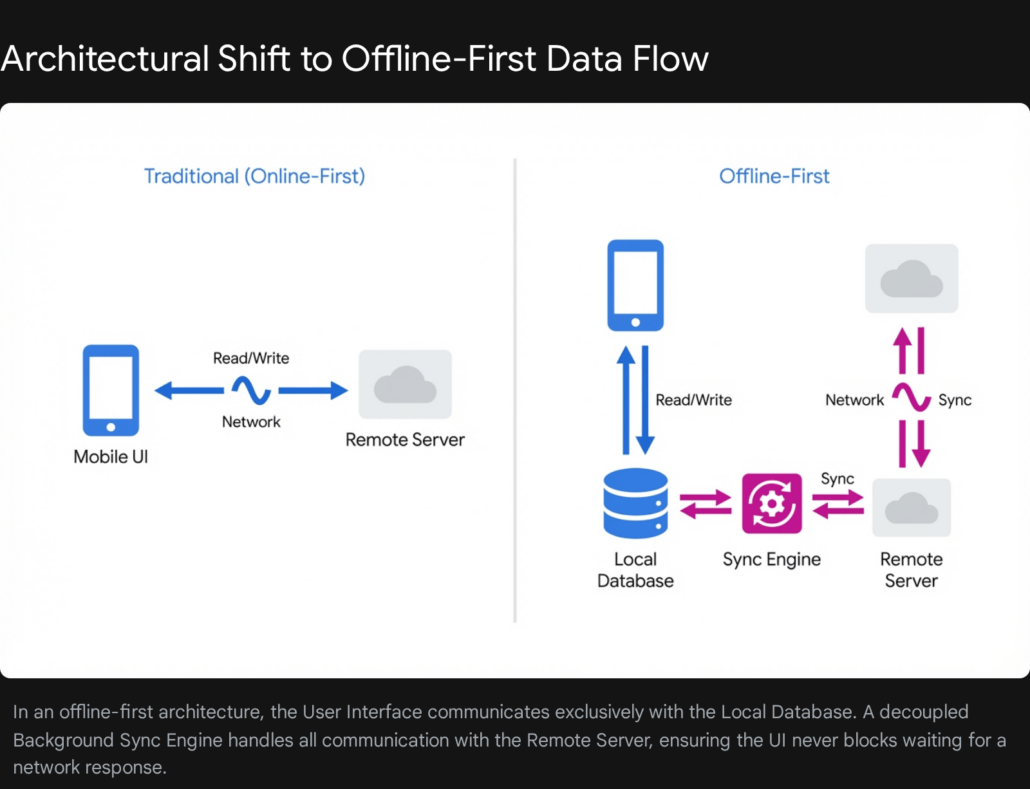
To fully grasp the engineering required for these applications, there must be a clear distinction between an application that is merely “offline-tolerant” and one that is fundamentally “offline-first.” This distinction is not merely semantic; it represents a complete inversion of the traditional client-server relationship.
An offline-tolerant application treats the remote cloud server as the absolute, primary source of truth. Under this model, the application might utilize local storage to cache some data, aiming to speed up subsequent load times or provide limited, read-only access when the network drops. However, any significant user action, mutation, or data creation requires an active connection. If the user attempts to submit a form, process a payment, or update a status while offline, the application typically blocks the action, displaying an error message instructing the user to try again when connectivity is restored. This architecture is inherently fragile, as the application’s core functionality is entirely dependent on the fluctuating state of the cellular network.
An offline-first application flips this traditional architecture entirely. In a React Native offline first paradigm, the local database residing on the user’s mobile device is elevated to act as the primary source of truth for all immediate reads and writes. The user interface is driven exclusively by this local state. When a user creates a new record, the application writes that data directly into the local database. The user interface updates instantaneously, allowing the worker or consumer to proceed to their next task without waiting for a server response.
A sophisticated background synchronization engine then assumes the responsibility of negotiating with the remote server. This engine operates entirely decoupled from the user interface, silently pushing local changes and pulling remote updates whenever the network connection permits. This strict separation of concerns means the user interface layer never needs to be aware of whether the device is online or offline. It simply communicates with the local database, guaranteeing a seamless, zero-latency experience for the end user regardless of external conditions.
Evaluating Local Storage Engines for React Native
The bedrock of any React Native offline first application is the local storage engine. Because all user interactions hit the local storage first before ever touching a network interface, the performance, reliability, and querying capabilities of this engine are paramount. The React Native ecosystem offers several distinct storage options, each tailored for different levels of application complexity and data volume.
For many years, the standard approach involved utilizing AsyncStorage, an unencrypted, asynchronous, persistent key-value storage system. While acceptable for the earliest iterations of React Native, AsyncStorage is fundamentally slow and entirely unsuited for complex, structured queries. It requires data to be serialized and deserialized into JSON strings, introducing massive performance bottlenecks when handling anything beyond basic user preferences or authentication tokens.
Today, the landscape of local storage has matured significantly, dividing into high-performance key-value stores, embedded relational databases, and specialized offline-first data engines.
| Local Database Engine | Core Technology | Primary Use Case | Key Advantages in React Native |
| MMKV | Key-Value Store (C++) | Small data, preferences, tokens. | Exceptionally fast (up to 20x faster than AsyncStorage). Synchronous API. |
| SQLite | Relational SQL | Complex structured data, financial logs. | Industry standard, highly reliable, robust querying capabilities. |
| Realm | NoSQL Object Store | Real-time sync, massive datasets. | High performance, deep integration with MongoDB Atlas, object-oriented. |
| WatermelonDB | Relational (over SQLite) | Large-scale offline-first applications. | Lazy loading, built-in synchronization tracking primitives, highly optimized for UI performance. |
When an application requires simple key-value storage, react-native-mmkv stands out as the definitive industry standard. Powered by a highly optimized C++ core utilized extensively by massive applications like WeChat, MMKV bypasses the slow asynchronous bridge of older storage methods. Benchmarks indicate that MMKV is up to twenty times faster than legacy AsyncStorage and approximately four times faster than querying basic records from heavier relational databases. If a mobile application simply needs to pull a static list of text data from a backend once and store it locally for read-only access, MMKV provides the quickest and most efficient implementation path.
However, modern business applications rarely rely solely on flat key-value data. When an application must manage complex data structures, nested relationships, and relational querying, developers must transition to embedded databases. SQLite remains the most widely deployed embedded relational database globally. Through libraries such as react-native-sqlite-storage or the newer, high-performance bindings provided by react-native-nitro-sqlite, engineering teams can execute complex SQL statements directly on the mobile device.
For developers who prefer NoSQL paradigms, Realm offers a high-performance mobile database designed specifically for real-time synchronization. Realm is incredibly powerful and utilizes a zero-copy architecture that maps memory directly to objects, resulting in blazing fast read speeds. However, Realm is heavily intertwined with the MongoDB Atlas ecosystem. For projects utilizing PostgreSQL backends, custom corporate APIs, or open-source solutions like Supabase, adopting Realm can introduce unwanted vendor lock-in and complicate backend architectures.
This architectural friction is precisely why specialized solutions like WatermelonDB have gained massive traction within the React Native community.
Advanced Data Modeling with WatermelonDB
For complex React Native applications prioritizing offline-first capabilities, WatermelonDB has emerged as the premier database framework. Built specifically to solve the performance bottlenecks of React Native, WatermelonDB sits as a highly optimized layer on top of a standard SQLite database. Its primary design goal is real-world performance; it ensures that applications launch instantly and remain highly responsive, regardless of how much data is stored on the device.
WatermelonDB achieves this remarkable performance through a paradigm known as lazy loading. Unlike traditional databases that might pull thousands of records into the JavaScript thread during a query, WatermelonDB only loads the exact data needed by the currently visible user interface components. As the user scrolls or navigates, the framework dynamically fetches additional records. This prevents the single-threaded React Native JavaScript environment from choking on massive data payloads.
Beyond raw performance, WatermelonDB is uniquely positioned for offline-first development because it provides built-in synchronization primitives. Writing a synchronization engine from scratch requires meticulously tracking every creation, update, and deletion across every table. WatermelonDB automates this entirely. It silently tracks local changes by maintaining hidden fields within every record, specifically tracking the synchronization status (whether a record is newly created, locally updated, or marked for deletion) and logging exactly which columns were altered since the last successful server communication. This built-in change tracking drastically reduces the boilerplate code required to figure out exactly what data needs to be pushed to the server when the device comes back online.
Implementing WatermelonDB requires a structured approach to data modeling. Developers must define rigid schemas and classes to represent the data. Utilizing advanced ES6 decorators, developers map React Native models directly to the underlying SQLite tables.
Schema management and database migrations are handled through a dedicated schemaMigrations application programming interface. As an enterprise application evolves over months and years, the database schema will inevitably change. Adding a new feature might require adding a new column to a user profile or creating an entirely new table for tracking inventory. WatermelonDB manages this by requiring versioned migration steps. When an application launches, the database adapter compares the current local schema version against the code’s target version, systematically applying the necessary addColumns or createTable steps to upgrade the database without destroying the user’s un-synced local data.
At Tool1.app, engineering teams frequently leverage WatermelonDB for demanding enterprise mobile builds. It pairs beautifully with modern backend-as-a-service platforms, allowing developers to rapidly construct resilient, locally-driven mobile applications that can scale to tens of thousands of local records without degrading the frame rate or the user experience.
Implementing the Transactional Outbox Pattern
A primary engineering challenge in building a true React Native offline first application involves solving the distributed systems concept known as the dual-write problem. In a traditional system, when a user taps a “Save” button to create a new record, the application might attempt to save that action to the local database and simultaneously fire an HTTP request to the backend API. If the device powers down, the application crashes, or the network connection drops in the microsecond between these two operations, the system is left in an inconsistent state. The data might exist locally but fail to reach the cloud, leading to phantom records and broken business logic.
To guarantee data integrity across an unreliable network partition, expert developers employ the Transactional Outbox Pattern. This architectural pattern mandates that the application’s core business logic must have absolutely no direct interaction with the network layer.
Under the Outbox Pattern, when a user executes a critical action, such as finalizing a field service inspection report or submitting a high-value purchase order, the application executes a single, atomic database transaction. This transaction performs two actions simultaneously:
First, it writes the actual business entity into the appropriate local table, updating the user’s interface immediately. Second, it writes a serialized event payload into a dedicated outbox table residing within the same local SQLite database.
Because these two operations occur within a single atomic transaction, the database engine guarantees that they will either both succeed or both fail entirely. It is mathematically impossible for the business entity to be saved without its corresponding outbox event being generated.
A typical local outbox table schema requires several critical columns to function effectively. It must track a unique identifier for the event, the aggregate type (for example, identifying the event as belonging to the “Order” or “Customer” domain), the specific event type (such as “OrderCreated” or “OrderShipped”), the serialized JSON payload containing the actual data to be transmitted, and tracking timestamps for creation and eventual publication.
Once the data is securely locked into the local database, the user interface is freed. The user can continue navigating the application, entirely unaware that the data has not yet reached the server. Subsequently, a completely separate, decoupled background process takes over. This background synchronization engine acts as a poller, continuously monitoring the local outbox table for unpublished events.
When network connectivity is detected, this engine retrieves the pending events, reading them in precise chronological order based on their creation timestamp. It attempts to publish these events to the remote server or message broker. Crucially, the local outbox event is only marked as “published” or deleted from the device after the remote server sends a confirmed acknowledgment of receipt. If the network drops while the outbox processor is mid-transmission, the event remains marked as unpublished locally, ensuring it will be retried during the next connection window. This strict separation ensures that no user actions are ever lost into the digital void, providing guaranteed at-least-once delivery to the backend architecture.


Mastering State Synchronization Mechanics
With data safely persisted in the local database and tracked via outbox queues or internal change logs, the application must manage the complex choreography of bidirectional synchronization. The goal is to pull fresh data from the cloud down to the device, while simultaneously pushing local mutations up to the server, ensuring global eventual consistency.
When utilizing frameworks like WatermelonDB, the synchronization logic is formalized into a strict, two-phase procedure: the Pull phase followed immediately by the Push phase.
During the Pull phase, the mobile client reaches out to the remote server and requests all changes that have occurred since the device’s last successful synchronization. The client passes a lastPulledAt timestamp to the server. The server’s database processes this timestamp and returns a structured payload containing lists of newly created records, updated records, and the unique identifiers of any records that were deleted globally since that specific moment in time.
A significant technical hurdle during this phase involves timestamp formatting. Embedded SQLite databases and remote PostgreSQL servers often handle time differently. To ensure absolute precision, developers must frequently implement custom remote procedure calls on the backend that convert JavaScript epoch timestamps into accurate PostgreSQL timestamps with time zone awareness.
Once the payload is received, the mobile application merges these remote changes into the local database. If a record was modified both locally by the offline user and remotely by another system, the system encounters a conflict. By default, WatermelonDB utilizes a granular, per-column client-wins strategy. It will accept the server’s updates for most fields but will preserve the local user’s un-synced edits for any specific columns that were modified locally, ensuring the user’s offline work is not arbitrarily overwritten.
Following a successful Pull, the Push phase commences. The application gathers all local records that its internal mechanisms have flagged as created, updated, or deleted while the device was offline. This data payload is transmitted to the remote server endpoint. The synchronization function must enforce a strict procedural rule: it must only resolve as successful after the backend server explicitly confirms that it has received, validated, and applied all the local changes.
If the backend server rejects the push due to validation errors or deep business logic conflicts, the synchronization process must reject the promise locally. The application must not clear the local change tracking flags prematurely. Only upon verified success are the local tracking flags reset, marking the device as fully synchronized with the global state.
Implementing WatermelonDB Synchronization
sync.ts
import { SyncDatabaseChangeSet, synchronize } from '@nozbe/watermelondb/sync';

// Two-phase sync: pull remote changes, then push local mutations
await synchronize({
  database,
  pullChanges: async ({ lastPulledAt, schemaVersion, migration }) => {
    const { data, error } = await supabase.rpc('pull', {
      last_pulled_at: lastPulledAt,
    });

    const { changes, timestamp } = data as {
      changes: SyncDatabaseChangeSet;
      timestamp: number;
    };

    return { changes, timestamp };
  },
  pushChanges: async ({ changes, lastPulledAt }) => {
    const { error } = await supabase.rpc('push', { changes });
  },
  sendCreatedAsUpdated: true,
});
The synchronize function executes a two-phase process: first pulling the latest changes from the backend based on a timestamp, then pushing any local mutations logged in the internal tracking fields.
Background Execution in Modern Operating Systems
A true offline-first application must synchronize silently. If a logistics driver inputs delivery confirmation data while moving through a subterranean tunnel, they expect that data to synchronize to the central dispatch server the moment their vehicle emerges into cellular coverage, regardless of whether the mobile application is open on the screen or resting in their pocket.
Achieving reliable background synchronization in modern React Native environments is a complex engineering challenge, primarily due to the stringent constraints imposed by mobile operating systems. Operating systems view background processes with extreme suspicion. Both Apple and Google actively hunt down and terminate applications that consume excessive memory or network resources when not actively in focus. In recent iterations, such as iOS 18 and Android 15, aggressive battery optimization logic has made background execution tighter than ever before. If a developer implements background tasks carelessly, the operating system will flag the application as a severe battery drainer, restricting its background privileges permanently and degrading the user experience.
React Native complicates this further because it runs on a single JavaScript thread, while background tasks must interface with deep, platform-specific native subsystems.
On iOS, background execution relies on an intelligent, algorithmic scheduling system. Developers cannot force the iOS operating system to run a background synchronization task at a precise, guaranteed moment. Instead, the application registers an intent, essentially signaling to the operating system that it has data to synchronize. The iOS scheduler then decides the optimal moment to wake the application in the background, factoring in the device’s current battery level, the strength of the network connection, and the user’s historical interaction habits with the device.
Android offers more flexibility but demands significantly more technical boilerplate. Android utilizes mechanisms like WorkManager for asynchronous background work that must be guaranteed to run eventually, even across device reboots. This is ideal for draining an outbox queue. However, if an application requires long-running background tasks, Android forces the application to display a persistent foreground notification to the user, ensuring transparency about resource consumption.
Historically, React Native developers relied on community libraries like react-native-background-fetch to bridge this gap. However, the ecosystem is rapidly shifting toward more integrated, modern platform alignments. Tools like Expo Background Task are replacing older, deprecated APIs by building directly on top of stable native foundations like BGTaskScheduler and WorkManager. By utilizing these modernized system-supported APIs, a React Native offline first application acts as a responsible, first-class citizen on the device, significantly reducing the likelihood of facing OS-level task throttling while keeping local data perfectly synchronized with the cloud.
Navigating the Complexities of Conflict Resolution
When moving from a traditional, centralized application architecture to a distributed, offline-first architecture, engineering teams must confront the inescapable reality of concurrent data modifications. If a logistics application allows a driver to update a delivery status offline at 10:00 AM, and a dispatch manager modifies the details of that exact same delivery via a web dashboard at 10:05 AM, a fundamental conflict arises when the mobile device regains connectivity and attempts to push its local state to the server.
Conflict resolution is arguably the most intellectually demanding aspect of offline-first systems design. It forces developers to balance the mathematical necessity of data consistency against the practical business requirement of system availability. There is no singular, universal solution; different strategies must be employed depending on the specific business context and the value of the underlying data.
The simplest, most widely implemented automated strategy is known as Last-Write-Wins. Under a Last-Write-Wins protocol, the application attaches a strict timestamp to every write operation. When the server receives an update and detects a conflict with an existing record, it simply compares the timestamps. The system blindly discards the older value and keeps the value bearing the higher, more recent timestamp.
While Last-Write-Wins is exceptionally straightforward to implement, its obvious disadvantage is that resolving a conflict in this manner fundamentally means losing data. If one user updates a customer’s phone number offline, and another user simultaneously updates the customer’s shipping address online, a strict Last-Write-Wins approach will overwrite the entire record with the latest payload, permanently erasing one of the user’s distinct, valid edits.
To mitigate this severe data loss, advanced applications implement Custom Semantic Merging strategies. Instead of viewing a database record as a single, monolithic entity that must be entirely accepted or rejected, semantic merging inspects the specific individual fields that were altered. The resolution logic attempts to stitch disparate field updates together into a unified whole.
For example, consider a collaborative document editor. If the server data indicates that the last_reviewed_date field was updated, while the incoming client data shows that a completely different field, such as user_notes, was appended, a custom merge strategy can intelligently accept both changes. The conflict resolver can apply the server’s date update while preserving the local client’s text notes, effectively resolving the collision without sacrificing either piece of valuable business data.
For specialized applications that demand flawless, real-time collaborative editing—such as multi-user document editors or collaborative design tools—engineers look toward Conflict-Free Replicated Data Types, commonly referred to as CRDTs. A CRDT utilizes advanced mathematical structures to guarantee that no matter what chaotic order concurrent updates arrive at the server, all connected clients will eventually converge on the exact same state without ever losing data or requiring manual intervention.
Despite their theoretical elegance, implementing CRDTs manually within a React Native environment is notoriously complex. CRDT algorithms require the system to maintain a vast history of every single operation, including deletions. These preserved deletions, known as tombstones, can lead to massive memory bloat, severely impacting the performance of mobile devices. Furthermore, translating standard user interface text inputs into precise CRDT operations requires building intricate translation layers that often break down under edge-case network conditions.
For the vast majority of standard enterprise applications—those dealing with forms, task lists, and inventory management—adopting field-level semantic merging or utilizing robust outbox queuing with manual administrative reconciliation provides a vastly superior return on investment. At Tool1.app, the engineering philosophy centers on assessing the specific data volatility of each unique project. For real-time collaborative features, established CRDT libraries like Yjs are integrated. For standard field inspection or e-commerce applications, leveraging the built-in column-level conflict resolution of WatermelonDB paired with custom backend logic delivers maximum reliability with minimal overhead.
Quality Assurance and Network State Mocking
The introduction of offline-first capabilities exponentially increases the complexity of an application’s state machine. Because network states are inherently volatile and unpredictable, automated testing is the only defense against fragile programming. Developers must rigorously simulate poor connectivity, sudden drop-offs, and prolonged offline periods during the quality assurance process to uncover hidden edge cases that could cascade into catastrophic data loss in production.
A comprehensive testing strategy begins with static analysis tools like linters and type checkers to catch structural errors, but the true validation occurs within the unit and integration testing frameworks. When utilizing testing suites like Jest to validate React Native applications, developers are required to heavily mock the native network layer to simulate offline behavior reliably.
The core of this testing strategy involves mocking the @react-native-community/netinfo module, which provides the critical application programming interfaces for reading the device’s network state. By overriding the default behavior of NetInfo within the test environment, engineers can construct highly specific scenarios. They can programmatically force the application to believe it has suddenly lost its cellular connection midway through a complex database transaction.
Under these mocked conditions, the test asserts that the application behaves correctly. Instead of attempting a doomed network fetch that would result in a crash, the test verifies that the business logic gracefully intercepts the action, successfully writes the payload to the local outbox queue, and visually alerts the user that the data has been safely saved locally. Without this level of rigorous, mocked network state testing, launching an offline-first application is a profound operational risk. Furthermore, beyond automated scripts, robust quality assurance demands manual validation on physical hardware, utilizing tools to artificially throttle network bandwidth to simulate 3G speeds, ensuring the background synchronization logic does not excessively drain the device battery or lock the user interface during heavy data payloads.
Engineering the Future of Mobile Experience
Building a React Native offline first application is not merely a technical checkbox; it is a sophisticated, strategic architectural undertaking. It requires engineering teams to completely discard the fragile, traditional online-only mindset. Instead, they must embrace high-performance local databases, orchestrate complex background synchronization engines, implement rigorous transactional outbox patterns, and design nuanced conflict resolution strategies that protect data integrity at all costs.
When executed with precision, an offline-first architecture transcends standard mobile development. It provides an incredibly fast, frictionless user experience that directly drives higher user retention rates. It protects revenue streams in mission-critical field operations where connectivity is scarce, and it firmly sets a brand apart from competitors who continue to rely on brittle, cloud-dependent infrastructures.
From custom React Native applications to advanced AI automation, Tool1.app engineers solutions that drive business efficiency. The transition to an offline-first architecture is a vital step for any enterprise looking to future-proof its digital presence and ensure unyielding operational reliability.
Want an app that works flawlessly anywhere? Tool1.app builds resilient React Native applications tailored to specific enterprise needs. Whether the project requires custom mobile development, complex offline data synchronization, or advanced backend integrations to streamline global operations, expert engineering teams are ready to architect the solution. Reach out to Tool1.app today to secure a consultation and discuss the next evolution of your mobile strategy.
SEO Data Appendices
- SEO Title: React Native Offline First: The Ultimate Architecture Guide
- Meta Description: Master React Native offline first architectures. Learn how to implement WatermelonDB, background synchronization, the outbox pattern, and conflict resolution.
- Focus Keyword: React Native offline first
- Blog Post Tags: react native, offline first, mobile development, watermelondb, software architecture, automation, synchronization
- Page Slug: react-native-offline-first-architecture-guide
- English image generation prompt: A technical, highly detailed isometric 3D illustration showing a modern smartphone connected to a secure local database cylinder. A dotted line connects the local database to a distant, glowing remote cloud server. The visual style should be corporate, clean, and tech-forward, utilizing a color palette of pure white, deep blue, and vibrant cyan. Soft studio lighting with no text elements.








Leave a Reply
Want to join the discussion?Feel free to contribute!
Join the Discussion
To prevent spam and maintain a high-quality community, please log in or register to post a comment.