

Upgrading from AngularJS to Modern Angular in 2026: A Business Guide
Table of Contents
- The Existential Threats of Remaining on Legacy Code
- Quantifying the Financial Impact of Technical Debt
- Why 79% of Frontend Modernization Projects Fail
- The Hybrid Upgrade Approach Using ngUpgrade
- Step-by-Step Technical Execution for Hybrid Migration
- Refactoring to Modern Angular 21 Architecture
- Accelerating the Transition with AI and Agentic Engineering
- Budgeting, Timeline Estimations, and the European Market Advantage
- Secure Your Digital Future
- Show all

The digital landscape of 2026 is unforgiving to technical complacency. For years, enterprise technology leaders have treated legacy frontend frameworks as a deferred maintenance issue—a problem to be solved when budgets expand or feature roadmaps clear. However, the reality of maintaining legacy applications has escalated from a passive technical debt concern to an active, existential threat to business continuity. As web browsers fundamentally alter their underlying architectures, regulatory bodies enforce draconian accessibility standards, and the artificial intelligence revolution demands dynamic, composable interfaces, organizations can no longer afford to delay modernization.
If your enterprise relies on web applications built prior to the great framework shifts of the last decade, you are likely feeling the friction. Feature development has slowed to a crawl. Onboarding new engineers takes weeks instead of days. Security audits raise red flags that cannot be easily patched. The question is no longer whether you should migrate AngularJS to Angular, but rather how you can execute this transition strategically without halting your ongoing business operations.
We at Tool1.app have guided numerous enterprises through complex architectural transitions, leveraging modern web development practices and AI-driven automation to ensure seamless upgrades. This exhaustive guide provides a comprehensive business and technical roadmap for upgrading to modern Angular in 2026. It dissects the hidden costs of legacy systems, outlines the safest hybrid migration strategies, explores the role of agentic AI in code refactoring, and provides clear financial frameworks to help you budget for a successful frontend transformation.
The Existential Threats of Remaining on Legacy Code
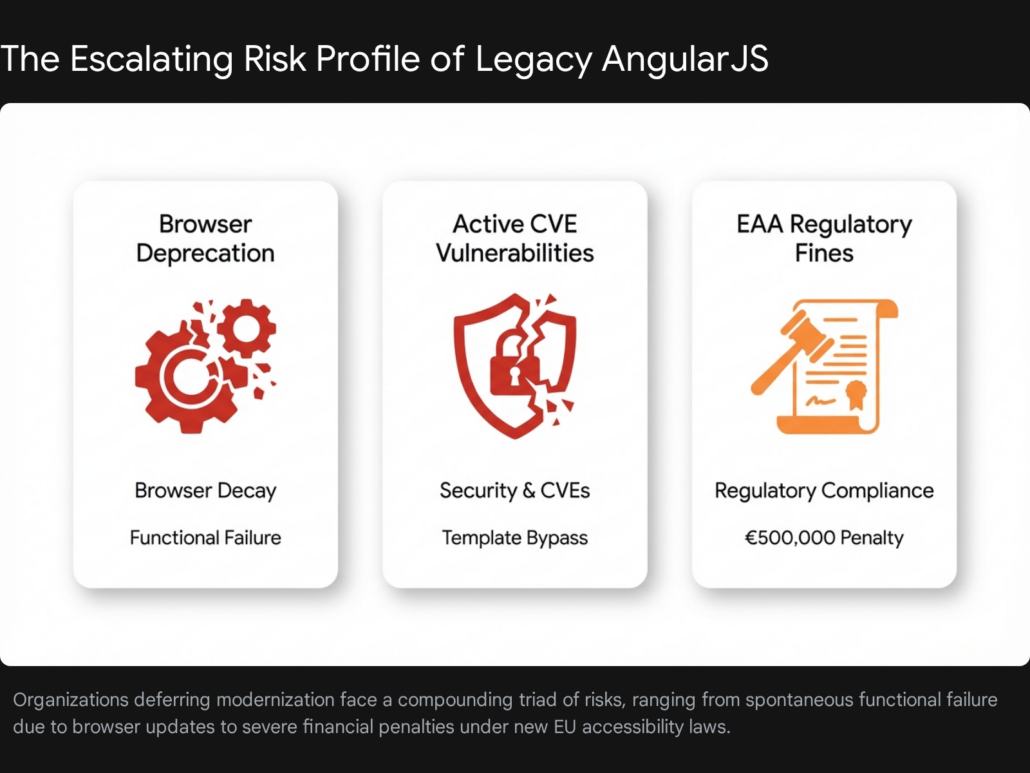
The decision to maintain a deprecated software framework is often rooted in a desire to minimize short-term risk. Executives reasonably fear that a massive rewrite will disrupt user experiences, consume vast engineering resources, and introduce new bugs. However, in 2026, the risk equation has completely inverted. Remaining on a deprecated architecture is now demonstrably more dangerous and expensive than undertaking a strategic migration. This heightened risk profile is driven by three converging forces: infrastructure decay, active security vulnerabilities, and aggressive regulatory enforcement.
The Browser Apocalypse and Infrastructure Decay
Though headline-grabbing security breaches often capture executive attention, the most immediate risk to legacy applications lies in functional obsolescence. Web browsers are living platforms that continually evolve. To optimize performance and security for modern internet users, consortiums representing major browser vendors—including Google, Apple, and Mozilla—have aggressively pursued interoperability and modernization initiatives throughout 2025 and 2026.
These initiatives have progressed beyond simply deprecating minor application programming interface (API) features; browser vendors are actively stripping out foundational primitives that older frameworks rely upon. Legacy frameworks heavily utilize outdated browser behaviors, such as synchronous XHR connections and Mutation Events, to handle their signature two-way data binding and Document Object Model (DOM) manipulation. As browsers phase out support for these obsolete patterns, legacy applications will not merely run slower—they will experience catastrophic, unrecoverable rendering failures.
Maintaining backward compatibility for JavaScript patterns established over fifteen years ago has become too burdensome for browser vendors to support. When the underlying browser engine no longer understands the instructions generated by an archaic framework, the application simply breaks, resulting in a blank screen for the end user and an immediate cessation of business operations. Furthermore, modern JavaScript engines like V8 are optimized for contemporary code execution paths. Legacy frameworks that rely on heavy, synchronous digest cycles are inherently penalized by modern browser parsers, leading to severe performance degradation even before the core APIs are fully removed.
Active Security Vulnerabilities in Deprecated Frameworks
The original generation of Angular reached its official End of Life (EOL) years ago, meaning it no longer receives official security patches from Google. In the cybersecurity landscape of 2026, where threat actors utilize AI-powered discovery tools to identify exploit chains in seconds, running unsupported software is akin to leaving the corporate vault door open.
What makes the current security climate particularly alarming is that high-severity Common Vulnerabilities and Exposures (CVEs) are still being discovered within the core legacy framework long after its deprecation. Because the codebase is no longer actively maintained by its creators, these vulnerabilities persist in the wild indefinitely unless organizations purchase expensive commercial long-term support licenses or engineer complex, fragile workarounds.
Recent disclosures have highlighted critical flaws in how the legacy framework handles template compilation and input sanitization. In early 2026, a high-severity cross-site scripting (XSS) vulnerability was disclosed affecting the legacy Template Compiler (CVE-2026-22610). The internal sanitization schema failed to properly categorize hyper-reference attributes within scalable vector graphics (SVG) script elements. An attacker could inject a malicious payload that bypasses standard XSS filters, allowing arbitrary JavaScript execution directly within the user’s browser.
Furthermore, multiple vulnerabilities related to Regular Expression Denial of Service (ReDoS) have been identified in fundamental utility functions, such as the location utilities (CVE-2022-25844) and the ng-srcset directive (CVE-2024-21490). An attacker can submit specially crafted input strings that force the application’s regex engine into a catastrophic computational loop. This instantly consumes all available client-side processing power, effectively crashing the browser tab and denying service to legitimate users.
Another highly critical area is the “angular-sanitize” module. Researchers recently identified vulnerabilities (CVE-2025-4690 and CVE-2025-2336) that enable attackers to bypass sanitization processes entirely. For applications binding untrusted user input directly to the DOM, this renders the application completely defenseless against data exfiltration and session hijacking. Because the framework is deprecated, these fundamental architectural flaws cannot be remedied through a simple package update; they require extensive, custom-engineered code modifications that degrade application performance and further bloat the codebase.
The Regulatory Hammer: The European Accessibility Act
Beyond technical and security concerns, severe compliance mandates are forcing the hand of enterprise leadership. The European Accessibility Act (EAA), which began strict enforcement in the summer of 2025, has transformed digital accessibility from a moral best practice into a rigorous legal requirement. The EAA mandates that digital products and services operating within or selling to the European Union meet comprehensive accessibility standards, explicitly incorporating the EN 301 549 standards which utilize the Web Content Accessibility Guidelines (WCAG) 2.1 Level AA as the baseline.
The financial exposure for non-compliance is severe and unprecedented. Organizations face maximum fines of €500,000 per violation, per EU member state. Additionally, daily fines of up to €1,000 can be levied until the specific accessibility violation is fully resolved. Beyond the direct financial penalties, non-compliant organizations face immediate disqualification from enterprise procurement pipelines and government contracts. EAA compliance is now a critical procurement qualifier; any enterprise customer involved in an EU procurement process requires verified accessibility documentation, such as a Voluntary Product Accessibility Template (VPAT).
Retrofitting an outdated single-page application to meet these modern accessibility standards is an agonizing, and often mathematically impossible, task. Legacy architectures fundamentally clash with modern screen readers because traditional routing mechanisms do not explicitly announce page changes or manage focus states for assistive technologies. When a user navigates to a new view in a legacy application, the screen reader often remains silent, leaving visually impaired users completely disoriented.
Furthermore, dynamically loaded components—such as custom dropdowns, modal windows, and date pickers—frequently lack the required ARIA (Accessible Rich Internet Applications) labels, focus trapping mechanisms, and keyboard navigation support required by law. These flaws are often missed by static linters because the DOM is empty during initial parsing. Research shows that retrofitting WCAG compliance into a legacy frontend costs between three and ten times more than building it natively into a modern architecture. Attempting to bolt these accessibility features onto an archaic framework requires fundamentally re-engineering the interactive components from scratch, which costs exponentially more than migrating to a modern, accessible-by-default Angular foundation.
Quantifying the Financial Impact of Technical Debt
To build a compelling business case for modernization, leadership must quantify the silent financial bleed of technical debt. Technical debt occurs when development teams take shortcuts to ship faster, trading long-term maintainability for short-term speed. Over a decade, these shortcuts compound, resulting in a fragile system where a simple feature addition that should take three days instead requires three weeks of architectural wrestling.
The financial impact of this debt can be calculated using a standardized Technical Debt Ratio formula: Technical Debt Ratio = Cost of Remediation ÷ Total Project Cost.
If an enterprise application originally cost €500,000 to build, and resolving the accumulated legacy debt requires €40,000 of dedicated refactoring, the technical debt ratio sits at an acceptable 8%. However, in legacy frontend systems built over a decade ago, this ratio often balloons past 50% because the framework itself constitutes the debt. Industry analysts report that, on average, organizations are spending up to 61% of their entire IT budget merely maintaining legacy systems, leaving fewer resources for innovation or AI adoption.
The Return on Investment for Performance Optimization
The cost of technical debt is not only measured in wasted engineering hours; it is directly measurable in lost revenue. In 2026, performance metrics and Core Web Vitals (CWV) are treated as definitive boardroom arguments. Legacy application bundles are exceedingly heavy, relying on synchronous loading patterns and massive, monolithic JavaScript files that destroy modern performance metrics.
Specifically, legacy stacks routinely fail the Interaction to Next Paint (INP) metric, which replaced First Input Delay (FID) as a primary performance indicator. INP failures are driven by long JavaScript execution tasks originating from legacy synchronous event handlers and unoptimized state updates. When a user clicks a button, the outdated framework must traverse massive component trees to calculate changes, causing the interface to freeze momentarily.
The revenue correlation is undeniable. Data established by global e-commerce and SaaS benchmarks dictates that every single second shaved from a web application’s load time lifts conversion rates by 20% to 40%. Achieving “good” CWV thresholds leads to a documented 15% to 30% conversion improvement. Furthermore, search engine algorithms heavily penalize sluggish applications. Migrating from an outdated single-page application to a modern, server-side rendered (SSR) architecture results in a 40% improvement in search visibility and organic traffic, alongside a 20% to 50% reduction in user bounce rates.
When factoring in the engineering hours saved by modern tooling, the mitigation of regulatory fines, and the revenue lift from superior performance, the return on investment (ROI) for modernizing an enterprise application is immense. A well-executed legacy modernization business case typically reveals a 200% to 344% ROI over three years, with an operational payback period of just 14 to 18 months.
Why 79% of Frontend Modernization Projects Fail
Recognizing the urgent need to migrate is only the first step; choosing the right execution strategy dictates whether the initiative succeeds or becomes a catastrophic financial sinkhole. Thorough industry analysis published in early 2026 reveals a chilling statistic: 79% of enterprise frontend modernization projects fail, often costing organizations millions of Euros with nothing to show for it.
To truly understand the divergence in outcomes between migration philosophies, one must analyze the risk and value trajectories over a standard twelve-month project lifecycle. The historical data demonstrates a consistent, stark contrast: the “Big Bang” approach carries a staggering 79% failure risk, delaying all business value until a hypothetical launch day that often never arrives. In contrast, the Hybrid “Strangler Fig” approach mitigates this risk to below 15% by migrating individual components, delivering continuous, incremental value month over month.
The failures of these modernization projects are almost universally driven by three specific strategic errors:
- The Big-Bang Rewrite Trap: This is the undisputed primary cause of failure. A Big Bang rewrite involves freezing the current legacy system and attempting to rebuild the entire application from scratch in a new framework, with the intention of flipping a switch on launch day. This approach is fundamentally flawed. Business requirements do not pause during a year-long migration. As stakeholders demand new features to remain competitive, the scope of the new build expands uncontrollably. Concurrently, the engineering team is crushed under the burden of maintaining two completely distinct, parallel codebases. Eventually, budgets evaporate, timelines extend indefinitely, and the project collapses under its own weight.
- The Governance Vacuum: Failure rapidly occurs when there is no enforcement of design systems, a lack of migration champions, and zero executive sponsorship. Without strict organizational authority, development teams fragment. Design systems turn into “component graveyards” where engineers fork code instead of contributing back to a unified repository, destroying the efficiency gains that modern component architectures are supposed to provide.
- Integration Underestimation: Organizations frequently underestimate the massive parallel modernization required for legacy backends, authentication layers, and analytics instrumentation. A modern frontend cannot operate efficiently if it is throttled by a decade-old, tightly coupled monolithic backend.
Comparison of Migration Strategies
| Strategic Dimension | Big Bang Rewrite | Hybrid Strangler Fig Pattern |
| Time-to-Value | 12 to 18 months (Zero value until launch) | Continuous (Value delivered immediately per sprint) |
| Business Disruption | High (Feature freezes required on legacy app) | Minimal (Live application remains fully functional) |
| Risk of Failure | 79% (Due to scope creep and parallel maintenance) | < 15% (Issues are isolated to single components) |
| Cost Structure | Massive upfront capital expenditure | Distributed operational expenditure over time |
| Developer Morale | Low (Maintaining two disjointed codebases) | High (Working with modern tools continuously) |
The Hybrid Upgrade Approach Using ngUpgrade
The definitive antidote to the Big Bang trap is an incremental, evolutionary approach commonly referred to as the Strangler Fig pattern. Named after a botanical vine that slowly envelops and eventually replaces its host tree, this strategy allows the new modern Angular application to organically grow around the edges of the legacy system until the old code is entirely replaced and decommissioned.
This methodology is made technically viable through a highly orchestrated hybrid architecture. By utilizing the official ngUpgrade library provided by the framework authors, development teams can bootstrap a single application environment where both legacy code and modern Angular code coexist and run side-by-side.
This shared state means that users seamlessly interact with both legacy and modern components without ever realizing they are crossing framework boundaries. The application downloads both framework engines, synchronizes their respective change detection cycles, and allows data to flow predictably between old controllers and new standalone components.
The Benefits of Hybrid Coexistence
The business benefits of the hybrid approach are transformative for enterprise risk management. First, it ensures minimal business disruption. Users continue to navigate the live application, and critical revenue pathways remain perfectly intact during the migration process. Second, it allows for continuous value delivery. If the marketing team requires a new product dashboard, that new feature is built exclusively in modern Angular and deployed immediately. The business realizes instant ROI on the new framework rather than waiting for a distant launch day.
Finally, it radically lowers up-front risk. By dividing the project into small, manageable pieces, the chance of a catastrophic system-wide failure is eliminated. If a newly migrated component exhibits unexpected behavior in the production environment, it can be instantly isolated, downgraded, or rolled back without bringing down the entire enterprise platform.
Step-by-Step Technical Execution for Hybrid Migration
Successfully migrating an enterprise application requires rigorous engineering discipline and a phased execution model. Drawing from extensive project management methodologies and real-world implementation data, the transition generally follows a strict sequence of operations.
Phase 1: Preparation and Build Modernization
Before a single line of component code is converted, the engineering team must modernize the underlying build infrastructure. Legacy applications typically rely on outdated task runners like Gulp or bloated Webpack configurations. The first step is migrating the build system to a modern compiler capable of handling both legacy JavaScript and modern strict TypeScript simultaneously. Moving from an archaic Webpack setup to a modern build tool like Vite offers an immediate improvement in the developer experience, reducing Hot Module Replacement (HMR) times from several seconds to mere milliseconds.
During this phase, the team must also meticulously clean the legacy codebase. This involves moving all existing logic to the “controller-as” syntax, updating to the absolute latest version of the legacy framework (1.7.x), and restructuring files to map conceptually to a component-based architecture.
Phase 2: Bootstrapping the Dual Environment
The technical foundation is laid by initializing a modern project footprint directly over the legacy codebase using the command-line interface. Once the build pipeline is secure, the official UpgradeModule is integrated. This module is the magical bridge that binds the legacy dependency injection system with the modern framework.


To bootstrap the hybrid application, the initialization sequence must be carefully controlled. The modern framework is loaded first, and once its root module is compiled, it programmatically triggers the bootstrapping of the legacy application.
TypeScript
// main.ts - Bootstrapping a Hybrid Application
import { platformBrowserDynamic } from '@angular/platform-browser-dynamic';
import { UpgradeModule } from '@angular/upgrade/static';
import { AppModule } from './app.module';

// First, bootstrap the modern Angular application
platformBrowserDynamic().bootstrapModule(AppModule)
 .then(platformRef => {
    // Extract the UpgradeModule from the modern injector
    const upgrade = platformRef.injector.get(UpgradeModule) as UpgradeModule;

    // Programmatically bootstrap the legacy application onto the document
    upgrade.bootstrap(document.documentElement, ['legacyEnterpriseApp']);
    console.log('Hybrid framework successfully initialized.');
  })
 .catch(err => console.error('Bootstrapping error:', err));
Phase 3: Upgrading and Downgrading Components
With the hybrid setup in place, the heavy lifting begins. Developers systematically identify “leaf components”—the small, isolated user interface elements at the edges of the application that have no external dependencies. These are the optimal candidates for initial migration.
As these foundational elements are rewritten into modern code, they must be made available to the parts of the application that are still running on the legacy framework. This is achieved through a process called “downgrading.” A modern component is wrapped in a specialized directive that exposes it as a legacy directive, allowing it to be seamlessly rendered inside an old template. Conversely, legacy services (like a massive authentication service that cannot be rewritten yet) can be “upgraded” and injected into modern components.
Phase 4: Routing Cutover and Decommissioning
Routing presents a unique challenge, as legacy routers (like ui-router) cannot natively interpret modern component trees. For the majority of the migration, a hybrid routing schema (such as ui-router-react or its Angular equivalent) is utilized to direct traffic between old and new views.
Once approximately eighty percent of the application architecture has been migrated, a critical milestone known as the “flag day” event occurs. The legacy routing engine is completely decommissioned and replaced by the modern routing infrastructure. Following this cutover, the final legacy dependencies are systematically eradicated from the codebase. The UpgradeModule is uninstalled, and the application transitions into a pure, secure, and blazing-fast modern software product.
Refactoring to Modern Angular 21 Architecture
To truly appreciate the necessity and value of this upgrade, one must examine the vast architectural chasm between legacy code and the bleeding-edge standards of modern Angular—specifically Angular 21, which serves as the industry standard for 2026. The transition requires a fundamental psychological shift for development teams, moving from controller-based, heavily abstracted logic to a composable, highly reactive, component-based architecture.
The Demise of NgModules and the Rise of Standalone Components
For years, the Angular ecosystem relied heavily on NgModules to bundle and declare dependencies. While effective for massive applications, this created enormous amounts of boilerplate code, complicated the learning curve for new developers, and bloated application payloads.
Modern Angular has fully embraced the Standalone Component paradigm. By eliminating module boilerplate entirely, components become truly self-contained and autonomous. A standalone component explicitly declares only the exact dependencies it requires directly within its decorator.
This architectural shift profoundly impacts web performance. Because dependencies are explicitly linked at the individual component level, the advanced compiler can perform highly aggressive “tree-shaking”—identifying and discarding any unused library code before it ever reaches the user’s browser. Enterprises executing this migration routinely observe their initial JavaScript bundle sizes shrinking by up to 50%. This optimization directly accelerates Largest Contentful Paint (LCP) and dramatically improves the overall user experience.
The Revolution of Signals and Zoneless Reactivity
Perhaps the most groundbreaking advancement in the modern framework is the introduction of Signals and the aggressive transition toward a “zoneless” application architecture. Legacy applications rely heavily on a deeply flawed change detection mechanism that constantly checks every single variable in the application to see if anything has changed—a process that causes massive CPU spikes and performance bottlenecks as applications scale.
Signals provide a granular, explicitly reactive primitive. Instead of the framework guessing what changed through a heavy background synchronization library (Zone.js), a Signal inherently knows exactly when its value updates. When a Signal changes, it surgically targets and updates only the specific piece of the user interface that depends on it, leaving the rest of the application completely untouched.
With the release of Angular 21, experimental Signal Forms have fundamentally revolutionized how complex data entry is handled. They completely remove bloated observable chains and heavy subscriptions, replacing them with a pristine, synchronous data flow. Furthermore, new applications built in 2026 no longer include Zone.js by default, resulting in unprecedented rendering speeds.
Consider a legacy implementation where logic was tangled within a controller and required heavy scope manipulation:
JavaScript
// Legacy AngularJS Directive & Controller Example
angular.module('enterpriseBilling').component('invoiceSummary', {
    templateUrl: '/partials/invoice-summary.html',
    controller: function(InvoiceService, $scope) {
        var $ctrl = this;
        $ctrl.isLoading = true;

        // Relies on heavy digest cycles to update the view
        InvoiceService.getPending().then(function(data) {
            $ctrl.invoices = data;
            $ctrl.isLoading = false;
            $scope.$apply(); // Forced synchronization
        }).catch(function(error) {
            $ctrl.hasError = true;
            $scope.$apply();
        });
    }
});
In the modern Angular 21 paradigm, this exact functionality is reimagined through a sleek, reactive, and strictly typed Standalone Component using Signals. Note the complete absence of external HTML template URLs, the streamlined dependency injection, and the surgical reactivity:
TypeScript
// Modern Angular 21 Standalone Component using Signals
import { Component, inject, Signal } from '@angular/core';
import { NgIf, NgFor, CurrencyPipe } from '@angular/common';
import { InvoiceService } from './invoice.service';

@Component({
    selector: 'app-invoice-summary',
    standalone: true, // No NgModule required
    imports: [NgIf, NgFor, CurrencyPipe],
    template: `
        <div *ngIf="invoiceState().isLoading">Processing financial data...</div>
        <div *ngIf="invoiceState().hasError">Unable to retrieve invoices.</div>

        <ul *ngIf="!invoiceState().isLoading">
            <li *ngFor="let inv of invoiceState().data">
                Invoice: {{ inv.amount | currency:'EUR' }}
            </li>
        </ul>
    `
})
export class InvoiceSummaryComponent {
    // Modern dependency injection
    private invoiceService = inject(InvoiceService);

    // Utilizing modern Signals for inherently reactive state management
    // No manual subscriptions or digest cycles required
    invoiceState = this.invoiceService.getPendingSignal();
}
Accelerating the Transition with AI and Agentic Engineering
The prospect of manually refactoring hundreds of complex components is daunting, which is why migrations historically took years to complete. However, 2026 marks a paradigm shift in software migration economics, driven entirely by the deep integration of Large Language Models (LLMs) and agentic engineering pipelines. The narrative that AI replaces human strategy is demonstrably false; rather, AI acts as an exhaustless reasoning engine plugged into the migration pipeline, dramatically accelerating the execution of well-defined architectural patterns.
At Tool1.app, our AI/LLM solutions for business efficiency accelerate these highly complex code transformations. By treating artificial intelligence as a highly capable assistant rather than an autonomous decision-maker, multi-year legacy migration slogs are compressed into highly predictable, accelerated technical sprints.
The Angular MCP Server and the Web Codegen Scorer
The creators of Angular have actively embraced this AI-augmented reality. The modern framework now includes built-in capabilities designed specifically to interface with AI coding assistants. Through the experimental Model Context Protocol (MCP) server, developers can grant AI agents direct, structured access to the latest framework documentation, schematic tools, and best-practice guidelines.
This effectively solves the “knowledge cutoff” problem inherent in many public LLMs. Historically, an AI asked to write Angular code might hallucinate deprecated syntax from three years ago because that was the bulk of its training data. By utilizing the MCP server, the AI agent can dynamically pull the absolute latest Angular 21 features—such as Signal Forms, Zoneless architecture instructions, and Angular Aria compliance rules—ensuring the generated code adheres to modern standards from day one.
To guarantee the quality and safety of this machine-generated code, sophisticated tools like the Web Codegen Scorer have been introduced to the ecosystem. The Web Codegen Scorer systematically evaluates AI outputs against rigorous, quantifiable benchmarks for security, performance, and accessibility. If an LLM attempts to generate a component that violates European Accessibility Act standards, uses outdated NgModules, or utilizes inefficient state management, the scoring system flags the error. It can even force the AI agent to self-correct and rewrite the code before it is ever presented to a human reviewer.
By leveraging fine-tuned LLMs specifically trained on legacy-to-modern translation patterns, engineering teams can automate up to 60% of the repetitive mechanical transformations—such as mapping legacy lifecycle hooks to modern equivalents or converting legacy two-way bindings into strictly typed Signals. This allows senior software architects to focus their valuable expertise on the most complex, high-value business logic, systemic architecture, and data security, rather than manually re-typing thousands of lines of boilerplate code.
Budgeting, Timeline Estimations, and the European Market Advantage
A comprehensive business guide must provide transparent, actionable analysis regarding project costs and timelines. Estimating a legacy migration project cannot be done through generalized guesswork; it depends heavily on the sheer volume of code, the density of custom legacy directives, and the complexity of global state mutations.
Component-Based Effort Estimation
Rather than guessing at an overarching project cost, the most accurate budgeting methodology isolates the engineering effort at the component level. A streamlined frontend with isolated features and clear ownership can be migrated rapidly, whereas systems with nested views, shared globals, and untyped state logic require deeper architectural segmentation.
Based on extensive 2026 market data, modernizing a single legacy component costs between €50 and €150, depending heavily on its complexity and integration density.
- Simple UI Elements (Buttons, Toggles, Cards): Highly automatable via agentic AI pipelines, requiring minimal human review and testing. Cost approaches the €50 baseline.
- Mid-Level Components (Standard Forms, Dashboards): Requires moderate effort to translate legacy validation logic into modern Signal Forms and ensure full WCAG accessibility compliance.
- Complex Architectural Containers (Data Grids, Routing Hubs): Demands intense architectural planning, custom state management refactoring, and meticulous routing synchronization. Cost approaches the €150 ceiling.
For a mid-sized enterprise application encompassing roughly 200 to 300 components, the migration represents a total investment ranging from €150,000 to €300,000, typically requiring 4 to 8 months of development time when executed efficiently via the Strangler Fig pattern. Massive, enterprise-scale platforms with deep legacy integrations and thousands of components may require a total budget stretching from €600,000 to €1,200,000, with a phased timeline extending across 12 to 18 months.
Strategic Sourcing and the Nearshoring Advantage
The primary cost driver in any software modernization initiative is engineering talent. While North American and Western European markets command massive premiums—often exceeding €100 to €130 per hour for senior frontend architects—astute organizations are leveraging highly mature nearshore tech hubs to optimize their budgets without compromising on regulatory compliance, security, or time-zone alignment.
Bulgaria, and specifically its capital Sofia, has firmly established itself as a premier European destination for high-complexity software engineering in 2026. The technical education infrastructure is incredibly robust, supported by institutions like the Technical University of Sofia and comprehensive software academies, producing thousands of engineers highly fluent in modern paradigms like strict TypeScript, AI integrations, and scalable cloud architecture.
The financial arbitrage available in this region is significant and highly attractive to Western enterprises. While a senior developer in standard Western markets commands exceptionally high rates, a senior Angular developer in Bulgaria commands an average annual compensation between €45,000 and €65,000. Translated to hourly project engagements, this equates to roughly €25 to €35 per hour for top-tier senior engineering talent, compared to the €100+ required elsewhere.
By structuring a migration team around this high-value talent pool, utilizing a “blended-shore” model that pairs strategic oversight with nearshore execution, enterprises can effectively slice their overall modernization budget by up to 40%. Crucially, this cost reduction is achieved while maintaining the rigorous quality standards, data privacy laws (GDPR), and operational security demanded by the EU digital ecosystem. This massive cost-efficiency allows organizations to reallocate freed capital toward forward-looking innovation, AI adoption, and product expansion, rather than merely paying a massive premium for technical debt remediation.
Partnering with an expert agency like Tool1.app ensures that you can leverage these global talent economics perfectly, backed by battle-tested migration playbooks and advanced AI tooling.
Secure Your Digital Future
The grace period for legacy web architecture has undeniably expired. Browsers are actively dismantling the foundational scaffolding that keeps outdated applications operational, while aggressive regulatory bodies are armed with massive financial penalties for accessibility non-compliance. Every single day an organization delays modernization, it accrues further technical debt, sacrifices vital conversion rates to sluggish performance, and exposes its user base to unpatchable security vulnerabilities that threaten the very existence of the business.
However, as this comprehensive guide demonstrates, escaping the legacy trap does not require halting business operations, angering your user base, or gambling your entire IT budget on a doomed Big Bang rewrite. By adopting a disciplined, hybrid Strangler Fig strategy, embracing the immense power of agentic AI code refactoring, and leveraging optimal European engineering talent, you can transform your aging software into a secure, lightning-fast, and infinitely scalable digital asset.
Don’t let legacy code slow your business down. Tool1.app can safely migrate your AngularJS applications without disrupting your ongoing operations. We combine deep architectural expertise with cutting-edge AI automation to deliver flawless frontend modernizations tailored to the rigorous demands of the 2026 digital economy. Contact us today to secure a comprehensive technical assessment and chart your definitive roadmap to the future of web development.







Leave a Reply
Want to join the discussion?Feel free to contribute!
Join the Discussion
To prevent spam and maintain a high-quality community, please log in or register to post a comment.