

Automating E-commerce Inventory Management via Python and API
Table of Contents
- The Hidden Financial Hemorrhage of Inventory Mismanagement
- Architecting Cloud-Native Python Middleware
- Defeating API Rate Limits: The Leaky Bucket Algorithm
- Mastering the Shopify Admin API for Inventory Sync
- Mastering the WooCommerce REST API Data Pipeline
- Integrating Complex Warehouse Management Systems (WMS)
- Defeating Race Conditions and the Threat of Overselling
- Algorithmic Buffer Stock Automation: Proactive Intelligence
- Multi-Warehouse Logic and Complex SKU Mapping Strategies
- Strategic Resilience Through Custom Software
- Transform Your Supply Chain Operations Today
- Show all

Strategic E-commerce Scaling: Automating Inventory Management via Python and API
The modern digital commerce landscape is an incredibly high-stakes environment where operational efficiency directly dictates profitability and market survival. In 2024, the total European business-to-consumer (B2C) e-commerce turnover experienced a robust and definitive resurgence, climbing 7% to reach a staggering €842 billion. This growth upended the relative stagnation observed since 2022, representing an inflation-adjusted real growth rate of 4.6%. As consumer confidence rebounds and online spending accelerates across the continent, retailers are aggressively rushing to expand their multi-channel presence. From the massive €175.3 billion French market to rapidly accelerating regions like Eastern Europe, which reported an 18% growth rate , the sheer volume of cross-border digital trade is monumental.
However, scaling revenue across a proprietary website, third-party marketplaces, and diverse international storefronts introduces a profound technical challenge: synchronizing inventory in real time across fragmented geographical borders. When a single product catalog is distributed across multiple platforms, the latency between a physical warehouse receiving new stock and a digital storefront updating its availability becomes a critical vulnerability. During peak trading events like Black Friday and Cyber Monday in 2024, package volume in Europe surged by 93.7%, exposing critical weaknesses in fulfillment infrastructure as the issue ratio rose from 6.0% to 6.7%. Manual data entry, legacy flat-file transfers, and fragmented third-party plugins are no longer viable for high-volume merchants dealing with these massive transactional loads.
The definitive solution to this operational bottleneck is Python inventory automation. By leveraging Python as a highly scalable, event-driven middleware, businesses can directly connect their Warehouse Management Systems (WMS) to major e-commerce platforms like Shopify and WooCommerce, ensuring absolute data integrity. Python’s unparalleled ecosystem for data manipulation and network requests makes it the ideal candidate for processing complex APIs, handling rate limits, and executing algorithmic buffer stock strategies.
For business owners, chief technology officers, and operations directors seeking to eliminate the margin-crushing errors of stockouts and overselling, understanding the technical architecture of these automated solutions is paramount. As an agency specializing in custom software, mobile applications, and business efficiency, Tool1.app frequently designs and deploys these robust architectures to bridge the gap between complex logistical networks and high-performing digital storefronts. This comprehensive report will dissect the financial imperatives, the architectural frameworks, and the precise API methodologies required to implement an enterprise-grade Python inventory automation system.
The Hidden Financial Hemorrhage of Inventory Mismanagement
Before examining the intricate technical implementation of API synchronization, it is crucial to quantify the severe financial toll of disjointed inventory management. Inventory discrepancies do not merely cause administrative headaches; they actively erode profit margins, inflate operational expenditures, and permanently damage customer lifetime value.
Industry analytics reveal that approximately 23% of e-commerce businesses suffer a direct, measurable negative impact on their profitability due to inventory mismanagement. Furthermore, 43% of these retailers acknowledge that stockouts and overstocking significantly reduce their revenue ceilings. With the European e-commerce market processing billions of transactions annually, the exact financial damage manifests in three distinct operational areas that algorithms are specifically designed to mitigate.
Lost Sales and the Psychology of Cart Abandonment
When a highly anticipated product runs out of stock, the immediate consequence is a lost transaction. However, the secondary, long-term damage to the brand’s reputation is far more severe. Consumer behavior studies indicate that 70% of online shoppers abandon their shopping carts entirely when encountering a stockout, often pivoting immediately to a competitor to fulfill their immediate needs. In the highly competitive digital space, where customer acquisition costs (CAC) are continually rising, losing an acquired customer at the final stage of the checkout funnel is a catastrophic failure of the supply chain.
Research across the consumer packaged goods sector indicates that stockouts result in an average revenue loss of up to 7.4%. When applied to the €842 billion European market , these percentages represent tens of billions of euros in evaporated capital annually. In Germany alone, which stands as the continent’s largest logistics hub and a critical epicenter for European inventory challenges, the sheer volume of goods moving through fulfillment centers requires absolute precision. When a system fails to update a Shopify or WooCommerce storefront immediately after a warehouse decrement, the merchant continues to advertise products they cannot physically provide.
The Exorbitant Weight of Holding Costs
Conversely, the pervasive fear of stockouts frequently drives risk-averse merchants to overstock their inventory, moving away from lean “just-in-time” models to heavy “just-in-case” inventory hoarding. Holding excess inventory incurs compounding, silent expenses, including premium warehousing space, higher insurance premiums, and inevitable product depreciation or obsolescence.
Ineffective inventory systems that fail to provide accurate, real-time velocity data can cause these holding costs to balloon. Studies indicate that companies can spend up to 25% more on holding costs due to poor inventory visibility. This traps vital cash flow on warehouse shelves, paralyzing a company’s operational flexibility and preventing them from investing in marketing, research and development, or software infrastructure. Python inventory automation allows businesses to operate leaner, maintaining tighter inventory thresholds because the software guarantees the digital storefront perfectly mirrors the physical shelves.
The Catastrophe of Overselling and Reverse Logistics
Perhaps the most damaging scenario in digital retail is overselling—allowing a customer to successfully purchase an item that is no longer physically available in the fulfillment center. This forces the merchant to manually cancel the order, issue a refund, and absorb payment gateway processing fees, while simultaneously delivering a disastrous customer experience. Even when alternative fulfillment is arranged, the operational friction spikes dramatically.
Furthermore, inefficient inventory management leads to a massive increase in operational costs associated with returns and order processing. Companies experiencing inventory inaccuracies can lose as much as €1 million annually due to operational inefficiencies stemming from returns and processing errors. The scale of reverse logistics in Europe is staggering. In the DACH region (Germany, Austria, Switzerland), return rates are a massive burden, particularly in specific sectors.
| E-commerce Sector | Estimated Return Rate Profile | Operational Impact |
| Fashion & Textiles | 87.7% of sellers report return rates up to 50% | Severe. Requires rapid restock syncing to resell items before seasonal obsolescence. |
| Consumer Electronics | 85.7% of sellers report return rates under 10% | Moderate. Serial number tracking and high-value validation required upon return. |
| Furniture & Home | 93% of sellers report return rates under 10% | High cost per item. Restocking requires significant warehouse labor and immediate API updates. |
When a returned item arrives at the warehouse, it must be inspected and restocked. If the digital systems are not automated, that physical item sits in a warehouse bin, unsold, while the website continues to list it as “Out of Stock.” A Python script listening to the warehouse’s receipt API can instantly push that single unit back to the active Shopify or WooCommerce inventory, immediately capturing a potential sale.
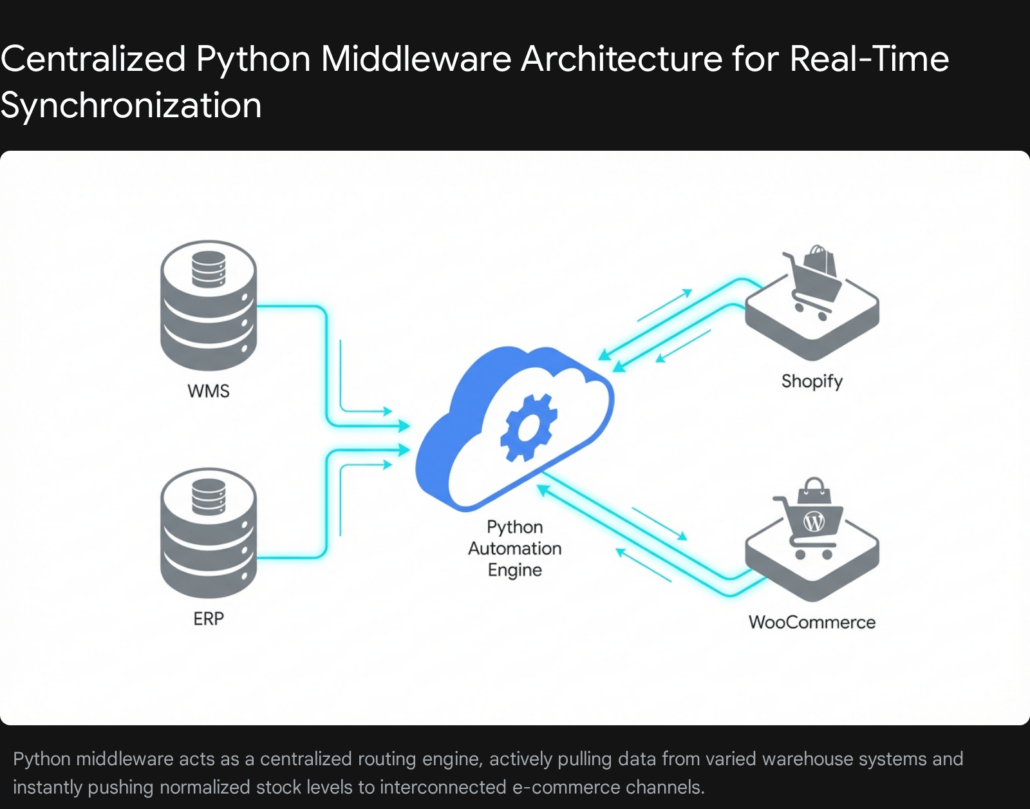
Architecting Cloud-Native Python Middleware
To solve these systemic issues, businesses must transition away from point-to-point plugin integrations and adopt a highly decoupled middleware architecture. Python inventory automation serves as this central nervous system. Hosted on scalable cloud environments like Google Cloud Platform (GCP) or Amazon Web Services (AWS), Python scripts can be deployed utilizing modern serverless paradigms that guarantee high availability and infinite scalability.
Python has become the undisputed language of choice for cloud-native API integrations due to its unparalleled ecosystem of data processing libraries (such as Pandas and NumPy) and its robust, highly concurrent HTTP request handling capabilities. When architecting a workflow on Google Cloud, for example, developers have several execution models to choose from, each suited to a different facet of inventory management.
Event-Driven Execution vs. Scheduled Batch Processing
A properly architected Python automation system relies on two primary data ingestion methods to keep systems synchronized: Event-Driven Webhooks and Scheduled Batch Polling.
Webhook-Driven Event Processing (The Push Model) One of the simplest and most instantaneous ways online applications share data is through webhooks, a one-way communication format for moving data from a source to a destination. When a customer completes a checkout on an e-commerce platform, the platform immediately fires an HTTP POST request containing a JSON payload of the order details to an exposed webhook URL.
In a cloud-native architecture, this webhook is caught by a serverless function, such as Google Cloud Functions. Cloud Functions are fully managed, event-driven compute services that execute Python logic the millisecond a request arrives. The Python script parses the payload, identifies the purchased SKUs, authenticates with the Warehouse Management System (WMS) API, and sends an immediate command to allocate or decrement the physical stock. Because Cloud Functions scale automatically from zero to thousands of simultaneous instances, the Python architecture can seamlessly handle massive, unpredictable traffic spikes during flash sales without server crashes.
Scheduled Batch Polling (The Pull Model)
While webhooks handle top-down sales data perfectly, bottom-up physical warehouse movements require a different approach. When a warehouse receives a massive new shipment from a supplier on a loading dock, or when workers perform manual cycle counts, the WMS must inform the storefront. Since many legacy ERPs and WMS platforms cannot send outbound webhooks, the Python automation must proactively poll them.
Utilizing a service like Google Cloud Scheduler combined with Cloud Run (which allows for the deployment of containerized Python microservices), the system can trigger a script every five minutes. This script requests all inventory changes that have occurred since the last successful execution timestamp. It compiles a batch of hundreds of updated SKUs, formats them into a normalized payload, and pushes a bulk update to the digital storefronts. By maintaining this continuous, bidirectional flow—pushing sales down and pulling receipts up—the digital catalog remains a perfect reflection of physical reality. At Tool1.app, we engineer these dual-pathway systems to ensure that our clients never experience a sync latency of more than a few minutes.
Defeating API Rate Limits: The Leaky Bucket Algorithm
When developers begin writing scripts to synchronize inventory at scale, they immediately encounter a fundamental infrastructure constraint imposed by every major software-as-a-service (SaaS) platform: API rate limits. Platforms like Shopify utilize a sophisticated traffic-shaping mechanism known in computer science as the “Leaky Bucket Algorithm”.
The Leaky Bucket Algorithm is designed to control the flow of data, ensuring that no single application can overwhelm the platform’s servers with excessive traffic. Imagine a literal bucket that has a fixed capacity. Each API request your Python script makes represents a volume of water (or a marble) tossed into the bucket. Simultaneously, the bucket has a hole in the bottom that leaks out the contents at a constant, steady rate.
If your script attempts to update 5,000 SKUs as fast as the Python runtime can execute, the bucket will fill up in a matter of milliseconds. Once the bucket overflows due to the excessive inflow, the Shopify API violently rejects all further requests, returning a hard HTTP 429 Too Many Requests status code.
Implementing Python Traffic Control
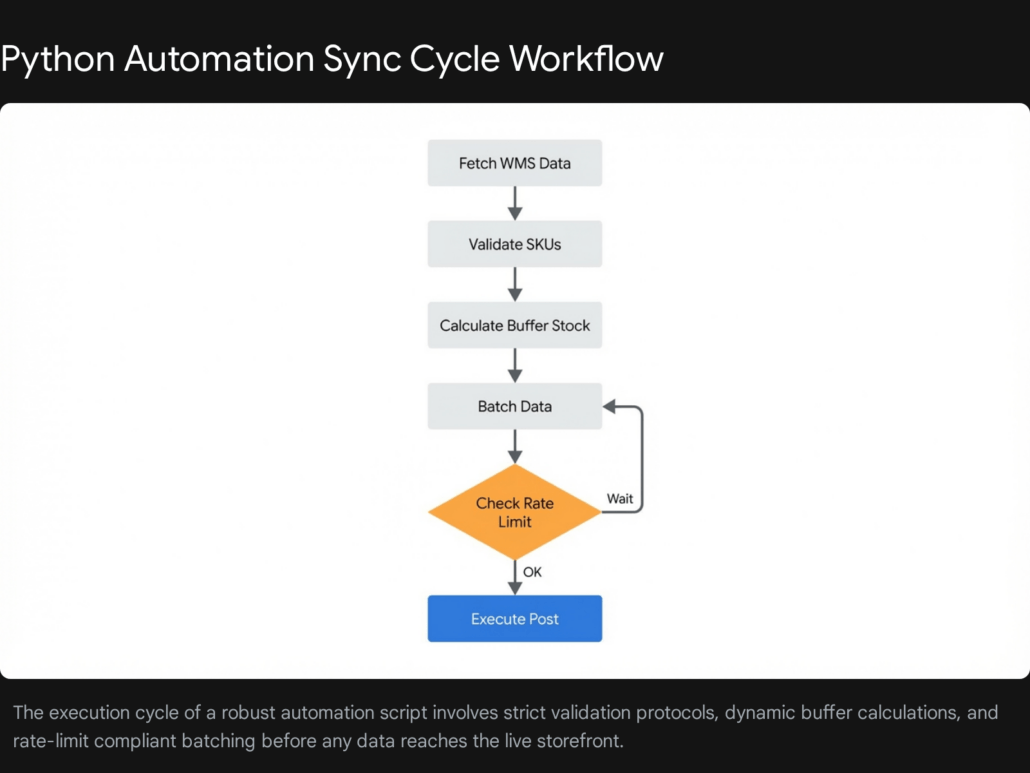
To build a resilient Python inventory automation tool, developers must implement advanced concurrency controls and exponential backoff strategies. A script cannot merely iterate through a list of products in a basic for loop; it must dynamically monitor the API response headers provided by Shopify, calculate the remaining bucket capacity, and deliberately pause execution to allow the bucket to drain.
| Shopify Plan Level | Maximum Bucket Capacity | Leak Rate (Restoration) | Operational Implication |
| Standard Shopify | 40 requests per app per store | 2 requests per second | Scripts must average no more than 2 requests per second to avoid throttling. Ideal for small catalogs. |
| Shopify Plus | 400 requests per app per store | 20 requests per second | Enterprise capacity. Supports massive, high-speed concurrency. Requires sophisticated multi-threading in Python. |
A robust Python implementation will utilize asynchronous programming (asyncio) or robust retry libraries (like Tenacity) to manage this flow. When an HTTP 429 error is inevitably encountered during a massive sync, the script catches the exception, pauses for a dynamically calculated duration (e.g., waiting 2 seconds, then 4 seconds, then 8 seconds if the error persists), and automatically retries the failed batch. This ensures that no inventory data is ever dropped in transit, guaranteeing absolute eventual consistency across the network.
Mastering the Shopify Admin API for Inventory Sync
Shopify is a dominant force in modern digital commerce, but its underlying inventory data model is notoriously complex and highly relational. In the Shopify ecosystem, inventory is not tied directly to the parent Product object. Instead, a Product contains Variants (e.g., Size Medium, Color Blue). Each Variant is then linked to a unique inventory_item_id. Furthermore, that inventory_item_id is distributed across various location_ids, which represent the merchant’s different physical warehouses, retail stores, or third-party logistics (3PL) centers.
Therefore, to update the stock of a blue t-shirt stored specifically in a Berlin warehouse, your Python script cannot simply target a product SKU. It must navigate the relational architecture to identify the specific combination of the Inventory Item ID and the Berlin Location ID.
The Critical Migration from REST to GraphQL
Historically, developers relied heavily on the Shopify REST Admin API to manage inventory. They would iterate through items and update them via the /admin/api/latest/inventory_levels/set.json endpoint. However, the REST endpoint is severely limited: it only accepts single items per call, completely lacking the ability to accept bulk arrays of data. As a merchant scales their catalog, updating 10,000 items one by one via REST is highly inefficient, taking hours to complete and consistently crashing against the aforementioned leaky bucket rate limits.
Shopify has actively acknowledged this bottleneck and is forcing a massive paradigm shift toward the GraphQL Admin API. GraphQL is vastly superior for inventory automation. Unlike REST, which requires multiple round trips to different endpoints to gather relational data, GraphQL allows a Python script to request precisely the data it needs, and nothing more, in a single call. More importantly, it allows developers to package hundreds of inventory adjustments into a single, massive HTTP request.
In Shopify’s GraphQL implementation, operations are calculated by “query cost” rather than strictly by request volume. A complex bulk mutation might cost 10 points out of your available bucket, but it simultaneously updates up to 100 items at a specific location. This yields a massive, exponential increase in throughput. With a GraphQL bucket refill rate of 50 points per second, a well-optimized Python script can adjust the inventory of up to 500 items per second, completely obliterating the performance bottlenecks of the legacy REST framework.
Executing Advanced GraphQL Mutations in Python
To perform these bulk updates securely, modern Python automations utilize mutations like inventorySetOnHandQuantities. This mutation sets an inventory item’s on-hand quantities to specific absolute values at designated locations.
A critical architectural requirement for utilizing this mutation is the mandatory inclusion of an “idempotency key” using the @idempotent directive. An idempotency key is a unique, randomly generated string created by the Python script for each request. It ensures that if the network drops mid-transmission and the script automatically retries sending the payload, Shopify recognizes the key and only processes the inventory adjustment once. This completely eliminates the risk of doubled stock counts resulting from network instability.
A standardized implementation requires the Python requests library to format the complex GraphQL query as a JSON string. The script iterates over the massive dataset pulled from the WMS, constructs a highly nested array of changes containing the inventoryItemId, locationId, and the absolute quantity, and fires the request.
This architectural approach is transformative for mid-market and enterprise retailers. What previously took a monolithic script 12 hours to sync overnight can now be processed in a matter of seconds. Bridging the gap between legacy ERP systems and modern Shopify storefronts with this level of performance is exactly why companies turn to agencies for custom implementations. At Tool1.app, migrating clunky, error-prone REST integrations to highly optimized, rate-limit-aware GraphQL Python architectures is a foundational step we take when revitalizing a client’s digital supply chain.


Mastering the WooCommerce REST API Data Pipeline
While Shopify dominates the hosted platform sector, merchants who prefer absolute data ownership, flexibility, and the open-source ecosystem consistently rely on WooCommerce. Connecting a massive warehouse API to a WooCommerce store requires a fundamentally different, yet equally rigorous, Python methodology.
WooCommerce (version 3.5 and above) is fully and natively integrated with the modern WordPress REST API. This integration allows WooCommerce data to be created, read, updated, and deleted using standard HTTP requests formatted in plain JSON. To communicate securely over HTTPS, developers generate a Consumer Key and Consumer Secret directly from the WooCommerce advanced settings dashboard. These credentials are then base64 encoded by the Python script and passed into the authentication headers of the request.
Unlike Shopify’s highly nested variant-to-item-to-location mapping, WooCommerce drastically simplifies the inventory data model. Stock availability is directly attributed to a product_id (for standalone, simple products) or a variation_id (for variable products, like clothing with multiple sizes).
Leveraging the High-Performance Batch Update Endpoint
If a central warehouse receives a massive maritime shipment consisting of 500 different SKUs, sending 500 individual PUT requests to a WooCommerce server would severely degrade the performance of the underlying hosting infrastructure, potentially taking the website offline during a critical sales window. Instead, a highly optimized Python inventory automation utilizes the native WooCommerce batch processing endpoint: /wp-json/wc/v3/products/batch.
A critical prerequisite for inventory manipulation in WooCommerce is that the specific product must be explicitly configured to track inventory. If the manage_stock parameter is set to false, attempting to update the stock_quantity will fail silently, having no effect on the storefront’s logic.
To execute a comprehensive bulk synchronization, the Python script compiles a massive JSON payload containing an array of objects nested under an "update" key. Each object within this array specifies the product’s unique id, enforces the rule "manage_stock": true, and sets the updated numerical "stock_quantity".
| Field Name | Data Type | Required | Description |
id | Integer | Yes | The unique identifier of the product or variation. |
manage_stock | Boolean | Yes | Must be explicitly set to true to enable quantity tracking. |
stock_quantity | Integer | Yes | The absolute number of physical units available. |
Using the official woocommerce Python wrapper library, the execution logic becomes incredibly streamlined. The script authenticates against the server, assembles the payload array representing the physical warehouse data, and pushes it to the batch endpoint. The WooCommerce server processes the array internally and returns a comprehensive JSON response detailing the success or failure of each individual item update within the batch. This granular response allows the Python script to intelligently log discrepancies and automatically trigger alerts via Slack or email to the operations team if an SKU fails to map correctly between the warehouse and the store.
Integrating Complex Warehouse Management Systems (WMS)
The effectiveness of any Python inventory automation is entirely dependent on its ability to accurately extract data from the merchant’s physical storage facilities. The ecosystem of Warehouse Management Systems and ERPs is vast, and Python excels at interfacing with their diverse, often archaic API structures.
For merchants utilizing specialized fulfillment software like ShipStation, Python can easily query the /v2/inventory_locations/ or /products/ endpoints to retrieve exact stock counts and warehouse mappings. A standard GET request to the ShipStation API returns a detailed JSON object containing the productId, sku, and specific warehouseLocation bin metrics. The Python script parses this data, extracts the relevant integers, and prepares them for the Shopify or WooCommerce transformation pipeline.
Enterprise-level systems introduce further complexity. Oracle WMS Cloud, for example, utilizes a highly structured REST API that requires strict Basic Authentication and specific user permissions (can_run_ws_stage_interface) to access entity statuses. When querying Oracle, the initial response may arrive in XML format, which Python effortlessly parses using libraries like xml.etree.ElementTree or BeautifulSoup, converting it into a standard JSON dictionary. Similarly, platforms like Erply or Ongoing WMS provide extensive REST architectures designed specifically for integration with web shops. Ongoing WMS, for instance, allows for both SOAP and REST API access, providing developers with the choice between fine-grained XML control or lightweight JSON interactions.
In all these cases, the Python middleware acts as the universal translator. It authenticates with the WMS, pulls the raw logistical data (often handling paginated responses to gather tens of thousands of records), normalizes the data structure into a unified format, and initiates the downstream push to the e-commerce platforms.
Defeating Race Conditions and the Threat of Overselling
One of the most insidious and mathematically complex threats to an e-commerce business is the “race condition.” A race condition is a fundamental computer science anomaly that occurs when the behavior of a software system depends on the precise, unpredictable timing of multiple parallel events or threads. They do not crash the application or throw error logs; they silently corrupt the underlying database, creating logistical nightmares that are nearly impossible to reproduce in testing environments.
Consider a scenario involving a highly anticipated, limited-edition product drop with exactly 10 units left in stock. Two customers, simultaneously executing a transaction, click the “Buy Now” button for 8 units each at the exact same millisecond. Without proper architectural synchronization, the sequence unfolds catastrophically:
- The server receives Customer A’s request and reads the database: Current Stock = 10. It calculates that 10 minus 8 leaves 2 units remaining.
- A microsecond later, before Customer A’s transaction finalizes and writes the new value, the server processes Customer B’s request. It also reads the database, which still shows: Current Stock = 10. It also calculates 2 units remaining.
- Customer A’s order completes, and the stock updates to 2.
- Customer B’s order completes. The script overwrites the stock to 2 again.
Both customers receive a successful order confirmation, accounting for 16 units sold. However, only 10 physical items exist. The merchant has just oversold the product by 6 units, guaranteeing a disastrous customer service interaction. In a distributed REST API environment, where multiple requests continuously hit the server, this lack of proper synchronization leads to absolute chaos.
Implementing Distributed Locks and Concurrency Controls
To eradicate the threat of overselling, a Python inventory automation system must implement strict concurrency controls at the code level. This is typically achieved through atomic operations and distributed database locking.
When building custom middle-tier infrastructure at Tool1.app, we implement advanced “compare-and-set” functionality. When the Python script attempts to update the inventory level, it does not blindly overwrite the existing value. Instead, it sends a conditional command stating: “Set the new stock to 2, but ONLY IF the current stock is still exactly 10.”
If Customer B’s request arrives and the stock has already been altered by Customer A, the condition evaluates to false. The database rejects the second operation entirely. The system then safely denies Customer B’s order, alerting them that the item sold out while in their cart.
In highly distributed, multi-node architectures, developers utilize in-memory data stores like Redis to implement distributed locking mechanisms. Alternatively, when interacting directly with platforms, they leverage native API features designed for concurrency. Shopify’s GraphQL inventoryAdjustQuantities mutation, for example, safely adds or subtracts relative quantities (e.g., “-8”) rather than forcing absolute values. By sending relative adjustments, the platform’s internal database safely queues and processes the math sequentially, ensuring that simultaneous API calls resolve gracefully without causing inventory corruption or negative stock balances.
Algorithmic Buffer Stock Automation: Proactive Intelligence
While establishing real-time synchronization is the baseline requirement for any modern brand, truly advanced e-commerce operations transition from reactive data mapping to proactive inventory intelligence. The global supply chain is fraught with inescapable volatility—supplier manufacturing delays, unexpected viral social media demand spikes, and cross-border transit disruptions. Relying solely on raw, absolute stock numbers from a warehouse is a dangerous strategy.
The most sophisticated application of Python inventory automation is the dynamic, continuous calculation of buffer stock (often referred to as safety stock). Buffer stock is a mathematically derived cushion of inventory that is deliberately withheld from the public storefront. Its entire purpose is to absorb sudden demand shocks or lead-time delays without disrupting operations or risking overselling.
The Mathematics of Safety Stock
Instead of relying on human operators to manually guess how much stock to hold back, a Python script can execute rigorous statistical formulas against the entire catalog every night. The standard, foundational calculation for determining optimal buffer stock focuses on demand-side fluctuations and is expressed as:
Buffer Stock = (Maximum Daily Sales × Maximum Lead Time) − (Average Daily Sales × Average Lead Time)
To execute this complex logic seamlessly, the Python automation performs the following systemic sequence:
- Historical Data Ingestion: The script queries the e-commerce platform’s order history API, pulling the last 365 days of highly granular transactional data into a Python Pandas DataFrame.
- Statistical Analysis: The script aggregates the data to calculate the exact average and maximum daily sales velocity for every individual SKU. Simultaneously, it cross-references the ERP system or supplier databases to determine the historical average and maximum lead times for receiving new stock.
- Dynamic Buffer Application: The algorithm calculates the unique buffer stock required for each SKU. For example, consider a warehouse that processes a core t-shirt. The brand sees peak daily sales of 80 units, with a maximum lead time of 15 days. On average, they sell 50 units daily with a 10-day lead time. The Python script calculates: (80 × 15) − (50 × 10) = 1,200 − 500 = 700 units of buffer stock.
- Intelligent Publishing: If the physical warehouse reports 2,000 actual units in stock, the Python script deliberately subtracts the 700-unit buffer and pushes an “Available” quantity of only 1,300 to the Shopify storefront.
This dynamic logic ensures that fast-moving items are heavily protected during intense promotional windows, while slow-moving items are not subjected to unnecessarily high buffer limits that restrict potential sales. Hardcoding global buffer rules (e.g., “always keep 5 units offline”) across an entire catalog is highly inefficient and leaves money on the table. Automating SKU-level, statistically sound logic via Python provides a massive competitive advantage. Furthermore, as inventory turnover ratios change and market conditions shift, these dynamic calculations adapt automatically without manual intervention.
Dynamic Buffer Stock Allocation by SKU
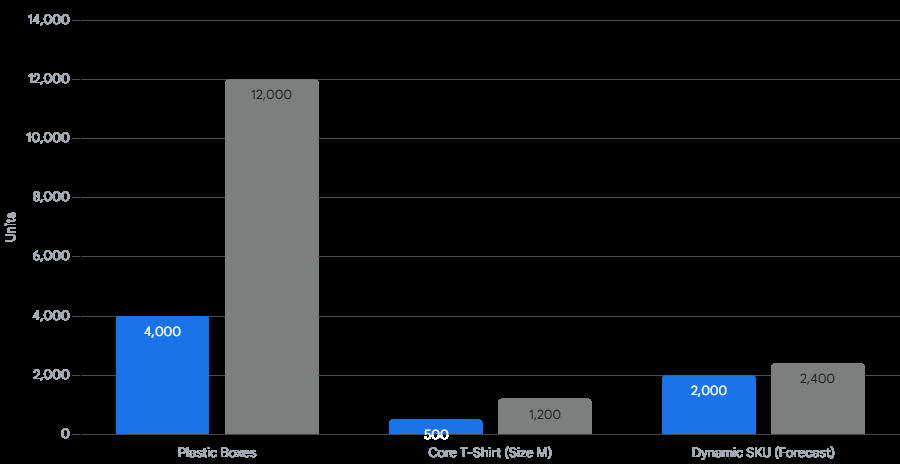
By calculating historical sales velocity and supplier lead times, the Python automation continuously adjusts the visible stock on the e-commerce storefront, withholding a strategic buffer to prevent overselling during demand spikes.
Multi-Warehouse Logic and Complex SKU Mapping Strategies
As digital businesses mature and revenue climbs, they inevitably expand from a single, centralized fulfillment center to a distributed, multi-warehouse network. Operating warehouses in different geographical zones is essential for minimizing transit times and reducing cross-border customs fees. A customer ordering from Paris should logically have their order routed to a facility in Germany or France, rather than a warehouse in North America.
However, synchronizing inventory across multiple geographic nodes introduces severe data complexity. In many legacy setups, particularly those built through acquisitions or varying supplier contracts, a specific product might be cataloged under completely different SKUs depending on the warehouse facility. Effective implementation of a global inventory system requires a standardized coding structure. But when legacy systems cannot be easily rewritten, middleware must bridge the gap.
A custom Python inventory automation acts as the ultimate translation and mapping layer. The middleware maintains a master SKU mapping database, often housed in a fast SQL or NoSQL environment. When the German warehouse API reports stock for the internal SKU EU-TSHIRT-BLU-M, and the US warehouse API concurrently reports stock for NA-TSHT-BL-MED, the Python script relies on its internal mapping dictionary to recognize both of these disparate codes as the exact same identical global Shopify inventory_item_id.
The script aggregates the disparate data, normalizes it, and maps it to the correct location_id within the e-commerce platform. For instance, a simple Python loop iterating through a list of predefined location_ids can filter and retrieve the specific inventory subsets required for processing.
Furthermore, the automation handles intelligent, algorithmic order routing. By continually querying the e-commerce platform for new, unfulfilled orders via webhooks, the script instantly extracts the customer’s shipping postal code. It then calculates the optimal fulfillment facility based on complex routing rules: geographic proximity, current localized stock levels, and daily carrier cutoff times. The script tags the order appropriately, decrements the localized stock in the specific corresponding warehouse, and seamlessly triggers the fulfillment cycle—all without a human operator ever touching a keyboard.
Strategic Resilience Through Custom Software
The era of managing high-volume e-commerce inventory through disjointed spreadsheets, manual CSV file uploads, and generic, severely rate-limited plugins is decisively over. As cross-border digital trade continues to accelerate across Europe and the globe, and as consumer expectations for instant, flawless fulfillment solidify into non-negotiable demands, the integrity and speed of your data pipeline become the ultimate arbiters of commercial success.
Every single instance of a stockout is a direct transfer of wealth from your business to a competitor. Every oversold item is a permanent degradation of brand trust and an inflation of operational waste. Python inventory automation strips away these systemic vulnerabilities. By implementing robust middleware that leverages the high-speed GraphQL capabilities of Shopify, the batch processing power of WooCommerce, and the infinite scalability of cloud-native computing, businesses achieve absolute operational parity between their physical warehouse shelves and their digital storefronts.
Transitioning to this elite level of automation requires deep, specialized technical expertise in API architecture, serverless cloud infrastructure, and highly concurrent traffic management. It is not solved by off-the-shelf software; it requires custom software engineered specifically to the unique logistical footprints, supplier integrations, and geographic nodes of your specific supply chain. The investment in this technological infrastructure pays massive, compounding dividends by eliminating the hidden costs of holding excess stock, eradicating the severe friction of reverse logistics, and maximizing revenue capture on every single SKU.
Transform Your Supply Chain Operations Today
Stop losing critical sales to preventable inventory errors and stop suffocating your operations team with endless manual data entry and reconciliation. Let Tool1.app build a custom inventory sync automation specifically tailored for your business. Our expert developers specialize in designing high-performance, resilient Python architectures that seamlessly and securely integrate your WMS, ERP, and e-commerce platforms. We transform fragmented data silos into unified, intelligent operational engines. Contact Tool1.app today for a comprehensive consultation, and turn your inventory management from a critical liability into your greatest, most reliable competitive advantage.








Leave a Reply
Want to join the discussion?Feel free to contribute!
Join the Discussion
To prevent spam and maintain a high-quality community, please log in or register to post a comment.