Python Everywhere: The Secret Language Behind Your Favorite Apps (And Why It Matters for Business)
Table of Contents
- The Ubiquity of Python: More Than Just Code
- Why Python Matters for Business Agility and Innovation
- Driving Productivity: Python's Impact on Business Operations
- Scalability and Integration: A Language for Growth
- Securing the Future: Python as a Strategic Business Asset
- The Secret to Modern Business Efficiency
- Show all

When you open your smartphone in the morning, check your social media feeds, listen to a personalized music playlist on your commute, or order a ride to your next meeting, you are interacting with invisible architecture. Behind the sleek interfaces and instant results lies a powerful engine driving the modern digital economy. More often than not, that engine is built on Python.
While consumers see the flawless execution of their favorite applications, business leaders and entrepreneurs need to look at the underlying technology that makes such scale and personalization possible. Understanding the mechanics of these digital giants is not just an exercise in technical curiosity; it is a vital step in modernizing your own company. Utilizing Python for Business is no longer a niche strategy reserved for Silicon Valley tech startups. It has become a fundamental pillar for enterprise growth, automation, and long-term sustainability.
In this comprehensive guide, we will pull back the curtain on how the world’s most successful applications utilize this versatile programming language. More importantly, we will explore exactly how you can leverage these same enterprise-grade capabilities to automate your workflows, reduce operational costs, and transform your business into a data-driven powerhouse.
The Ubiquity of Python: More Than Just Code
To truly grasp the power of Python, we must first look at its footprint in the applications we use every single day. Python is not merely a language for writing simple scripts; it is the structural steel holding up some of the most traffic-heavy platforms on the internet.
Consider Instagram. When the platform was first scaling to accommodate millions, and eventually billions, of users, its engineering team relied heavily on Django—a high-level Python web framework. Python allowed Instagram’s developers to iterate rapidly, roll out new features securely, and manage an astronomical amount of visual data seamlessly. The simplicity of Python’s syntax meant that the engineering team could focus on solving complex architectural problems rather than wrestling with convoluted code.
Spotify provides another brilliant example of Python in action. While you enjoy a seamlessly curated “Discover Weekly” playlist, Spotify’s backend is heavily reliant on Python to manage its backend services and perform advanced data analysis. The platform processes billions of data points daily—listening habits, skip rates, genre preferences, and user locations. Python is the tool of choice for constructing the data pipelines and machine learning algorithms that parse this colossal amount of information to predict exactly what song you want to hear next.
Netflix uses Python across its entire lifecycle, from maintaining its content delivery networks to powering the recommendation algorithms that keep viewers engaged. Uber utilizes Python, alongside other languages, to handle the complex mathematics required for surge pricing, route optimization, and driver-rider matching in real-time.
What is the common thread here? All of these platforms required a technology that could handle immense scale, integrate easily with other systems, and process complex data structures natively. But the true secret is that these capabilities are not locked away in a billionaire’s tech vault. The exact same language powering Netflix’s global streaming infrastructure is open-source and freely available to be deployed for your own business needs.
Why Python Matters for Business Agility and Innovation
The transition from recognizing Python’s role in global applications to understanding its value for your own operations begins with one word: agility. In today’s hyper-competitive market, the speed at which a business can deploy internal tools, customer-facing applications, or automated workflows often dictates its market position.
Cost-Efficiency and Rapid Development
Traditional software development using verbose languages can be slow, resource-heavy, and exceptionally expensive. Python fundamentally shifts this paradigm through its design philosophy, which emphasizes code readability and simplicity. Developers write fewer lines of code to accomplish the same tasks compared to other enterprise languages.
For a business owner, fewer lines of code translate directly into faster development cycles. When development time is cut by 30% or 40%, the financial savings are substantial. For example, if a custom enterprise resource planning (ERP) integration is estimated to take six months using traditional legacy languages at a cost of €120,000, achieving that same integration in just three or four months using Python could reduce your capital expenditure to €70,000 or €80,000. That freed-up capital can then be redirected toward marketing, customer acquisition, or further technological innovation.
The Power of “Batteries Included”
Python is often described as having “batteries included,” a reference to its massive standard library and the Python Package Index (PyPI), which contains hundreds of thousands of pre-built modules. If your business needs to integrate with a third-party payment gateway, scrape data from a competitor’s website, build a graphical dashboard, or connect to an AI model, there is a very high probability that a robust, secure, open-source Python library already exists to handle the heavy lifting.
Instead of paying developers to reinvent the wheel, partnering with a specialized software development agency like Tool1.app allows you to leverage these existing libraries to snap together complex functionalities like building blocks. This modular approach not only accelerates the initial build but also makes future updates and feature additions significantly cheaper and less prone to systemic errors.
Community and Open-Source Momentum
Python’s status as an open-source language means it is not controlled by a single corporate entity that can unexpectedly hike licensing fees or alter the technology’s trajectory to suit its own agenda. It is supported by one of the largest, most active, and most passionate developer communities in the world.
For a business, this community provides an invisible safety net. Security vulnerabilities are spotted and patched rapidly. Extensive documentation, tutorials, and third-party tools are continuously updated. When your business infrastructure relies on Python, you are backed by a global workforce of engineers constantly improving the core technology at no cost to you.
Driving Productivity: Python’s Impact on Business Operations
While building dynamic mobile and web applications is a core strength of Python, its most immediate and transformative impact for non-tech businesses often lies behind the scenes. Python for Business is synonymous with driving internal productivity, streamlining workflows, and turning raw operational data into actionable intelligence.
Eradicating Inefficiency Through Automation
Every business, regardless of size or industry, suffers from repetitive administrative overhead. Data entry, cross-referencing spreadsheets, migrating information between incompatible software platforms, generating weekly financial reports, and sorting customer service emails—these tasks drain thousands of hours from your workforce annually.
Python excels at Robotic Process Automation (RPA) and script-based automation. A custom Python script can be scheduled to run at midnight every day, securely log into your sales database, extract the latest figures, compare them against inventory levels, format the data into a beautifully styled PDF, and email it to your executive team before they wake up.
To illustrate how efficiently Python handles business data, consider a scenario where your HR or Sales team spends hours manually combining multiple weekly sales spreadsheets into one master document. A custom Python script using the powerful pandas library can do this instantly:
Python


import pandas as pd
import glob
import os

# Define the folder containing weekly sales data in CSV format
path = './weekly_sales_data'
all_files = glob.glob(os.path.join(path, "*.csv"))

# Read and combine all files instantly
df_from_each_file = (pd.read_csv(f) for f in all_files)
concatenated_df = pd.concat(df_from_each_file, ignore_index=True)

# Calculate total revenue per product line automatically
revenue_summary = concatenated_df.groupby('Product_Line')['Revenue'].sum().reset_index()

# Export the clean, summarized data to a new Excel file for the executive team
revenue_summary.to_excel('Master_Sales_Summary.xlsx', index=False)
print("Automated Sales Report successfully generated.")
This simple, elegant script replaces hours of manual, error-prone data entry with a process that takes milliseconds. When extrapolated across dozens of daily administrative tasks, the productivity gains are staggering. At Tool1.app, we frequently deploy custom Python automation scripts that save companies hundreds of hours of manual labor per month, allowing employees to redirect their focus toward high-value, creative, and strategic tasks that directly generate revenue.
Data-Driven Insights and Predictive Modeling
We operate in a data-centric economy. Every interaction a customer has with your business—every click, purchase, support ticket, and website visit—generates data. However, data is completely useless if it sits idle in a database. Business agility requires turning that raw data into actionable insights.
Python is the undisputed king of data science. Libraries like NumPy, Pandas, and Matplotlib allow businesses to clean, analyze, and visualize colossal datasets. You no longer have to rely on gut feelings to make critical business decisions. Python can help you identify hidden purchasing trends, forecast seasonal inventory demands, analyze customer churn rates, and optimize your pricing models based on real-time competitor analysis.
For instance, an e-commerce retailer might use Python to build a dynamic pricing engine. By continuously scraping competitor prices, evaluating internal stock levels, and analyzing historical sales velocity, a Python backend can automatically adjust the prices of thousands of SKUs to maximize profit margins—a task impossible for a human team to manage continuously.
The Foundation of Modern Artificial Intelligence
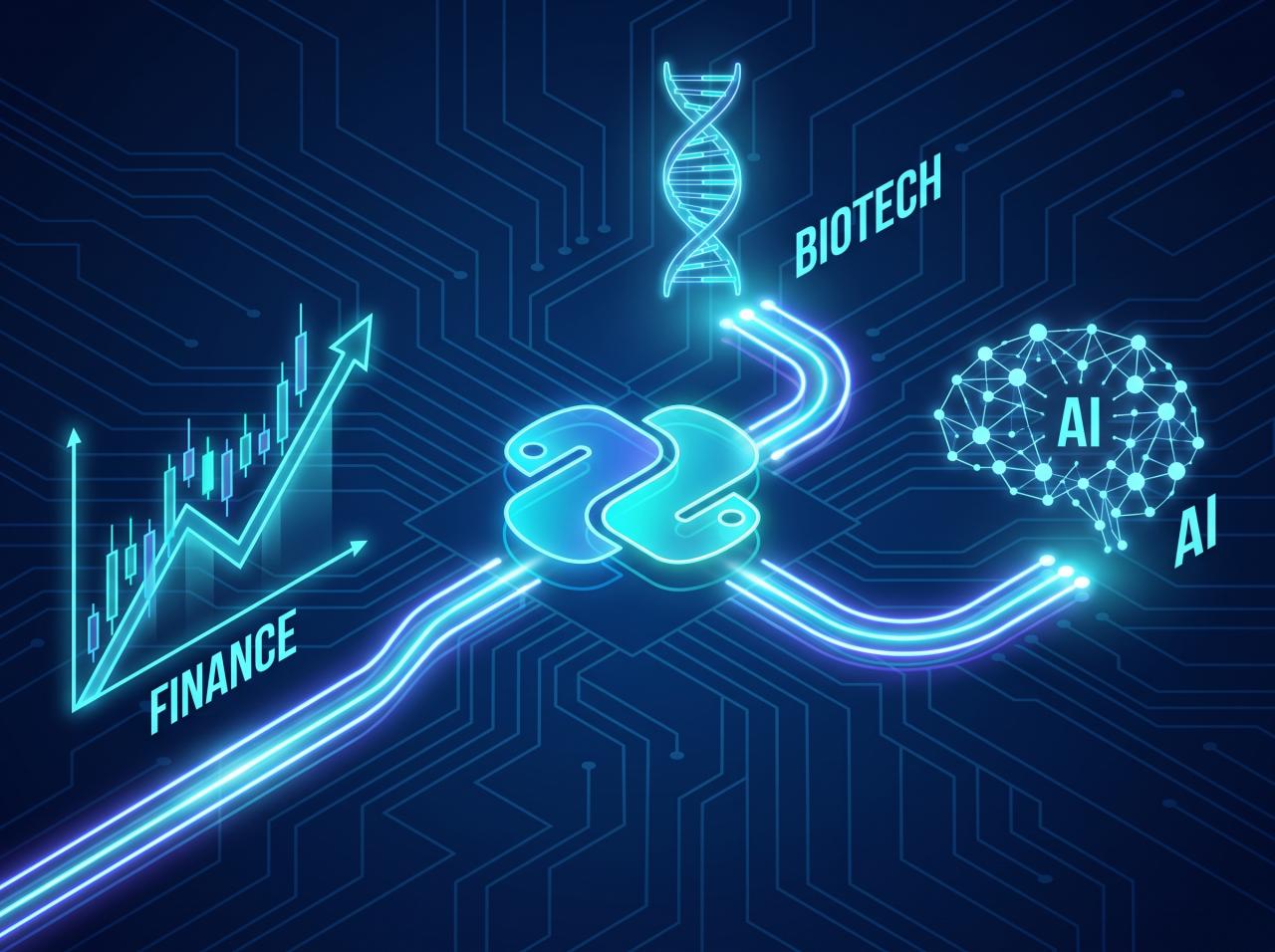
If you have been watching the rapid evolution of Artificial Intelligence and Large Language Models (LLMs), it is crucial to understand that Python is the language driving this revolution. The world’s most sophisticated machine learning and deep learning frameworks—such as TensorFlow, PyTorch, and Scikit-learn—are native to Python.
Implementing AI is no longer science fiction; it is a pragmatic business strategy. Companies are integrating Python-backed AI solutions to automate customer support through intelligent chatbots, parse legal documents for compliance checking, and utilize machine learning for predictive maintenance on manufacturing equipment. By establishing your business infrastructure on Python, you are inherently positioning your company to easily adopt and integrate AI/LLM solutions. This is exactly why Tool1.app focuses heavily on leveraging Python when building custom AI and LLM solutions designed to drive business efficiency. The architectural leap from a standard Python web application to an AI-enhanced application is significantly shorter than starting from scratch with legacy technologies.
Scalability and Integration: A Language for Growth
A common fear among business owners investing in new software architecture is the “ceiling effect.” Will the software that works for a company generating €2 million in revenue still function when the company scales to €20 million?
Python’s role in scaling applications is profound. It serves as an excellent “glue language,” meaning it is exceptionally good at connecting different, disparate systems together.
Microservices Architecture
Modern enterprise applications rarely exist as one giant, monolithic block of code. Instead, they are built using microservices—small, independent modules that communicate with each other. One service might handle user authentication, another handles payment processing, and another manages email notifications.
Python frameworks like FastAPI and Flask are perfectly designed for building robust REST APIs (Application Programming Interfaces) that allow these microservices to talk to each other rapidly. If your payment processing module experiences a massive spike in traffic during a Black Friday sale, a microservices architecture allows you to scale up just the resources for the payment service without having to duplicate your entire application infrastructure. Python handles this decentralized communication beautifully, ensuring your business stays online and responsive during crucial high-traffic events.
Bridging Legacy Systems
Many established businesses operate on critical legacy software written decades ago in C, C++, or Java. Replacing these legacy systems entirely can be a multi-million-euro nightmare filled with operational risks. Python provides a much safer alternative.
Because Python can easily wrap around and interact with C/C++ code, businesses can use it to build modern, sleek web interfaces and advanced analytics dashboards on top of their aging legacy databases. You get the modern functionality, automated reporting, and AI integrations of Python without the catastrophic disruption of tearing out your company’s existing foundational software. Python acts as a modern bridge, allowing older businesses to compete with digital-native startups.
Securing the Future: Python as a Strategic Business Asset
When choosing a technology stack, a business is not just making a technical decision; it is making a long-term strategic investment. You are investing in the future maintainability of the software and the availability of the talent required to run it.
Dominating the Talent Pool
Python is consistently ranked as the most popular programming language in the world. It is the primary language taught in top university computer science programs, and it is the first language learned by millions of self-taught developers.
For a business owner, this translates to a massive, accessible talent pool. If you build a proprietary internal system in a niche or outdated programming language, finding developers to maintain or upgrade that system will be difficult, and their salaries will command a massive premium. Because Python developers are abundant, hiring internal staff or finding a reliable external agency to maintain and expand your systems is significantly easier and more cost-effective.
Continuous Innovation and Future-Proofing
Technology moves at a blistering pace. The innovations of today become the standard expectations of tomorrow. Python is not a static language; it is continuously evolving. As new technological paradigms emerge—whether it is edge computing, advanced robotics, or next-generation artificial intelligence—the Python community is always at the forefront, developing the libraries and tools necessary to harness these new frontiers.
By building your digital infrastructure with Python, you ensure that your business is never locked out of the next wave of technological advancement. It provides a flexible, secure, and robust foundation that can pivot and adapt as your business goals evolve. From automating your most tedious administrative tasks to deploying an intelligent, LLM-powered customer service agent, Python provides the versatility required to outmaneuver competitors in a digital-first world.
The Secret to Modern Business Efficiency
The digital platforms that dominate our daily lives do not achieve their success by accident. They rely on elegant, scalable, and highly adaptable software architectures. The secret language behind your favorite apps is no longer a secret, and its benefits are no longer exclusive to tech conglomerates.
Whether you are looking to launch a disruptive new web application, automate the bottlenecks out of your back-office operations, or integrate predictive AI models into your sales pipeline, Python offers the fastest, most cost-effective, and most reliable path to achieving those goals. It transforms the way businesses operate, replacing slow manual effort with instantaneous automated precision.
Still managing a physical paper archive? Tool1.app can digitize and organize your documents automatically for maximum productivity, allowing your business to focus on innovation and efficiency, just like Python enables modern apps. If you are ready to modernize your operations, reduce overhead costs, and build custom digital solutions tailored to your exact business needs, reach out to us today. Let’s discuss how we can leverage the power of Python and AI to build the future of your company.





Leave a Reply
Want to join the discussion?Feel free to contribute!
Join the Discussion
To prevent spam and maintain a high-quality community, please log in or register to post a comment.