

How to Code a DCA (Dollar Cost Averaging) Crypto Trading Bot in Python
Table of Contents
- The Strategic Imperative of Dollar Cost Averaging
- 1Designing a Production-Ready Trading Architecture
- The Foundation: Connecting via the CCXT Library
- Security First: API Key Management and Whitelisting
- The Silent Killer: Floating-Point Errors and Precision
- Constructing the Core Trading Bot Logic
- Advanced Error Handling and System Resilience
- Centralized Monitoring: Professional Logging Best Practices
- Real-Time Treasury Alerts: Telegram Bot Integration
- Deploying to Production: Linux Cron Jobs and Cloud Infrastructure
- Evolving to Dynamic DCA: Incorporating Technical Indicators
- Bringing It All Together
- Show all

Architecting a Python Crypto Trading Bot: The Definitive Guide to Automating Dollar Cost Averaging
The digital asset landscape has undergone a monumental transformation. What began as a niche speculative market has matured into a robust financial ecosystem, increasingly serving as a core component of modern corporate treasury management. In the current financial environment, algorithmic trading systems account for the vast majority of trading volume across major global markets. This technological democratization means that both individual investors and small-to-medium enterprises (SMEs) now have access to the same algorithmic execution capabilities that were once exclusive to high-frequency trading firms and elite hedge funds. For businesses seeking to accumulate digital assets as a hedge against fiat currency inflation, or for developers tasked with building resilient financial infrastructure, mastering algorithmic execution is no longer optional—it is a strategic necessity.
Automating your cryptocurrency investments systematically eliminates the psychological pitfalls associated with market volatility. Human traders are inherently susceptible to fear and greed, often leading to impulsive decisions during severe market drawdowns or euphoric rallies. One of the most historically effective, mathematically sound, and low-risk strategies for long-term asset accumulation is Dollar Cost Averaging (DCA). By engineering a Python crypto trading bot, you can enforce strict, emotionless trading rules, ensuring that your capital is deployed methodically and efficiently.
At Tool1.app, we specialize in developing automated financial systems, custom Python automations, and AI-driven solutions that help modern businesses optimize their complex workflows. In this exhaustive, enterprise-grade guide, we will deconstruct the logic behind Dollar Cost Averaging, design a production-ready software architecture, securely connect to major cryptocurrency exchange APIs using Python, implement rigorous risk management protocols, and deploy the automated system onto a reliable execution schedule.
The Strategic Imperative of Dollar Cost Averaging
Dollar Cost Averaging is an investment methodology where an individual or corporate entity allocates a fixed amount of fiat currency—such as the EURO (€)—to purchase a specific asset at strictly regular intervals. This predetermined schedule is executed regardless of the asset’s current market price. Instead of attempting the statistically improbable task of timing the market by deploying a massive lump-sum investment at the absolute absolute price bottom, DCA systematically smooths out volatility over an extended time horizon.
The mathematical mechanism of DCA is beautifully simple yet profoundly effective. When market prices are elevated, your fixed fiat allocation naturally purchases fewer units of the cryptocurrency. Conversely, when the market experiences a severe correction and prices plummet, that exact same fixed fiat allocation acquires a significantly higher number of units. Over a prolonged period, this reality inherently lowers the average cost per unit of the acquired asset, heavily mitigating the sequence-of-returns risk.
This strategy has become particularly appealing to corporate treasuries and forward-thinking SMEs. A rapidly growing cohort of Digital Asset Treasury Companies (DATCOs) has begun holding cryptocurrencies like Bitcoin on their corporate balance sheets. For a traditional business, allocating a massive lump sum into a highly volatile asset class introduces severe balance sheet risk and complex accounting challenges. However, deploying a programmatic script that automatically purchases €500 or €2,000 worth of Bitcoin every single week effectively treats the asset acquisition like a standard, predictable operational expense. It builds long-term habits aligned with systematic wealth accumulation while completely neutralizing the emotional panic that inevitably occurs during sudden, sharp market drawdowns.
Comparative Analysis: Dollar Cost Averaging versus Lump Sum Investing
To truly grasp the value of a Python crypto trading bot dedicated to DCA, one must understand how the strategy performs mathematically against traditional lump-sum investing across various market conditions. While statistical evidence over multi-decade horizons in traditional equities sometimes favors lump-sum investing due to general upward market drift, the extreme volatility profile of cryptocurrency markets radically alters this calculus.
| Market Environment | Lump Sum Strategy Performance | Dollar Cost Averaging (DCA) Performance | Psychological Impact |
| Prolonged Bull Market | Generally captures maximum upside, as all capital is deployed at the lowest possible entry point before the prolonged rally. | Underperforms lump sum mathematically, as average buy prices increase over time. However, it still generates substantial positive returns. | Low stress for both strategies, though lump sum investors may feel superior validation. |
| Prolonged Bear Market | Experiences severe portfolio drawdowns. Capital is trapped at a high valuation, requiring massive percentage gains simply to break even. | Heavily outperforms lump sum. Continues to aggressively accumulate deeply discounted assets, lowering the average cost basis significantly. | Lump sum investors experience extreme panic and capitulation risk. DCA investors experience calm predictability. |
| High Volatility / Sideways | Performance is entirely dependent on the specific day of entry. Highly unpredictable and subject to timing luck. | Consistently captures the median price of the trading range. Effectively neutralizes the impact of the volatility chops. | DCA completely removes the anxiety of day-to-day price swings. |
In a volatile asset class, the psychological risk of a lump sum investment is the primary point of failure. If an SME treasury deploys €100,000 into Bitcoin at a local top, and the asset drops 40% the following month, the board of directors may panic and liquidate the position at a massive loss. A DCA strategy deployed via a Python crypto trading bot prevents this catastrophic human error by trickling the capital in, ensuring that the 40% drop becomes a prime accumulation opportunity rather than a devastating treasury loss.
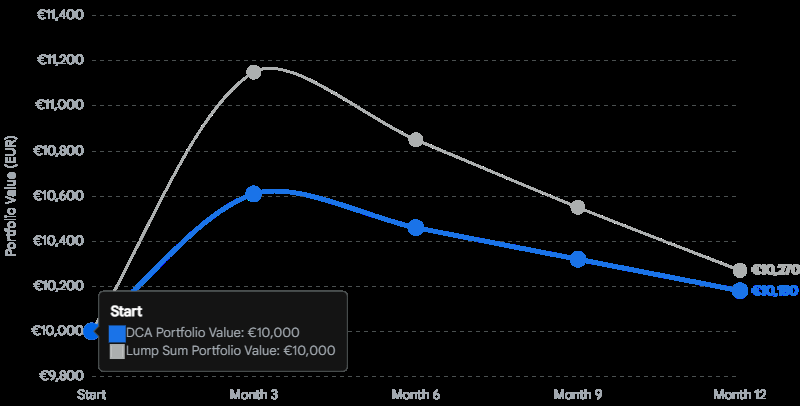
By automating regular fiat injections, the DCA strategy avoids the severe drawdowns associated with poorly timed lump-sum investments, resulting in a smoother equity curve.
1Designing a Production-Ready Trading Architecture
A pervasive and critical mistake that amateur developers make when writing a Python crypto trading bot is tightly coupling the application’s logic. Throwing the exchange API keys, the trading strategy, the error handling, and the execution loop into a single, massive procedural script inevitably leads to fragile systems. These monolithic scripts break disastrously during unexpected network outages, exchange API updates, or unhandled data type exceptions.
A production-ready architecture must be highly modular, rigorously separating concerns into distinct, isolated layers. This ensures that a failure in one component does not cascade and compromise the entire financial system.
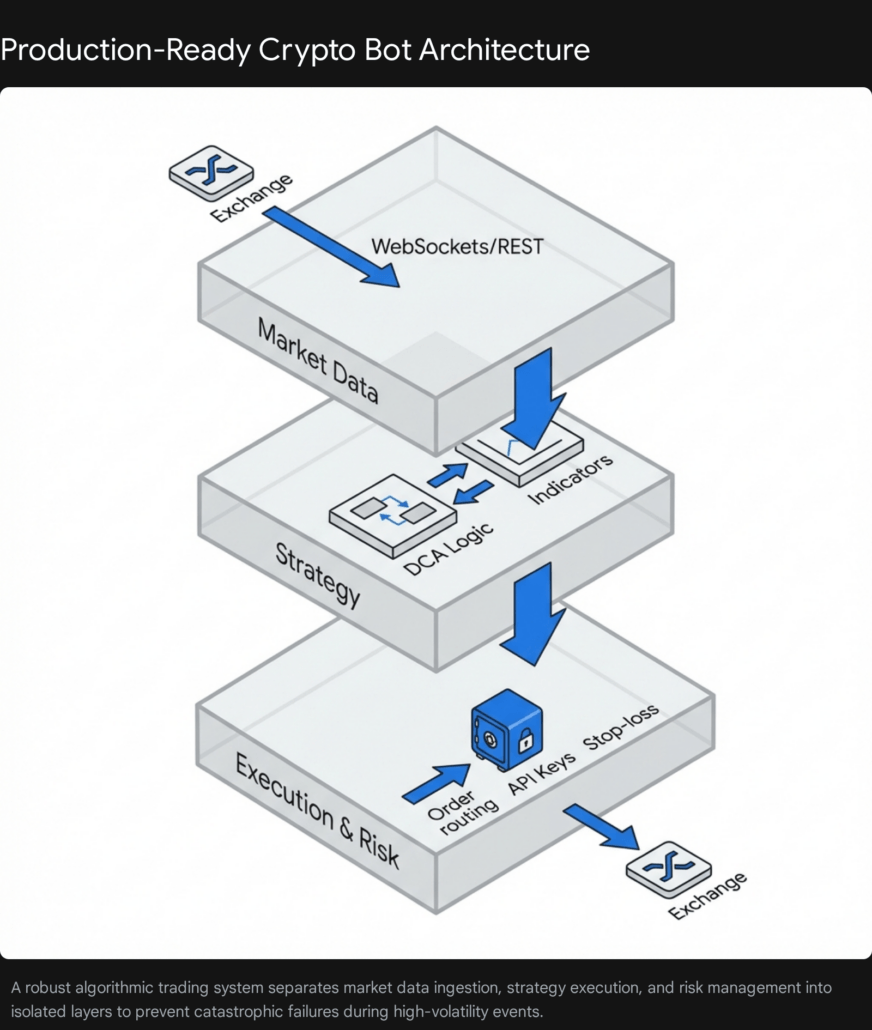
The ideal enterprise-grade architecture consists of three primary layers:
- The Market Data Layer: This module is solely responsible for communicating with the external exchange. It pulls current ticker prices, validates fiat balances, standardizes order book structures, and formats this raw JSON data into clean objects or Pandas DataFrames for the rest of the application. It handles rate limiting and network timeouts independently.
- The Strategy and Signal Layer: This layer acts as the analytical brain of the operation. For a standard DCA bot, this layer is relatively simple—it checks the execution schedule and determines the fiat amount to spend. However, in more advanced systems, this layer might ingest complex technical data to execute “dynamic DCA,” where the bot scales its purchase sizes based on moving averages. The strategy layer never touches API keys.
- The Execution and Risk Layer: This is the critical routing and safety mechanism. It is responsible for precision formatting, ensuring the proposed order meets the exchange’s strict minimum size requirements, checking maximum drawdown limits, and securely signing the transaction with your encrypted API keys. If the Strategy Layer suggests a trade that violates a hard-coded risk parameter (e.g., trying to buy more asset than the treasury limit allows), the Execution Layer blocks the order.
By structuring the bot using this modular approach, you ensure maximum maintainability. If an exchange significantly alters its API endpoints, you only need to update the Market Data Layer, leaving your core trading logic and execution safety nets completely untouched and functional.
Establishing the Professional Folder Structure
Before writing any Python logic, establishing a scalable repository structure is essential. At Tool1.app, we implement a standardized folder hierarchy for all our Python automations to guarantee clarity and ease of deployment.
A recommended structure for a Python crypto trading bot looks like this:
dca_trading_bot/
├── config/
│ ├── settings.json
│ └──.env
├── logs/
│ └── bot_activity.log
├── src/
│ ├── __init__.py
│ ├── market_data.py
│ ├── strategy.py
│ ├── execution.py
│ └── notifications.py
├── requirements.txt
└── main.py
This structure instantly communicates professionalism. Sensitive credentials live exclusively in the .env file, configuration parameters like trading pairs and fiat amounts live in settings.json, and the executable logic is neatly compartmentalized within the src/ directory.
The Foundation: Connecting via the CCXT Library
To build our bot, we require a modern Python environment. While major exchanges like Binance and Kraken provide their own official proprietary Python SDKs, the algorithmic trading community overwhelmingly relies on a unified library called CCXT (CryptoCurrency eXchange Trading Library).
CCXT is a massive open-source project that provides a completely unified interface for over 100 cryptocurrency exchanges. With tens of millions of downloads on the Python Package Index (PyPI), it is the undisputed global standard for connecting software to digital asset markets.
Why Choose CCXT Over Native Exchange SDKs?
The primary advantage of CCXT is the prevention of vendor lock-in. If you build your entire trading system using the official Binance SDK, and regulatory changes suddenly force your business to migrate its treasury to Kraken or Coinbase, you would have to completely rewrite your execution codebase.
With CCXT, the syntax to execute a market buy order on Binance looks virtually identical to the code used for Kraken. The library abstracts away the extreme complexities of handling different API endpoint URLs, different authentication signing algorithms (like HMAC SHA-256 vs RSA), and varying JSON response structures.
| Feature Comparison | CCXT Library | Native Exchange SDKs |
| Exchange Support | 100+ global exchanges | Single specific exchange |
| Code Portability | Extremely high; switch exchanges by changing one line of code. | None; requires complete rewrite for a new exchange. |
| Data Standardization | Unified output format for OHLCV, tickers, and order books. | Proprietary formats varying wildly by exchange. |
| Rate Limit Handling | Built-in automatic rate limiting (enableRateLimit = True). | Often requires custom implementation by the developer. |
| Maintenance | Open-source community driven, rapidly updated. | Maintained by the exchange, sometimes abandoned or slow. |
To begin building your bot, you must install the required libraries. Open your terminal and execute the following command:
pip install ccxt pandas python-dotenv python-telegram-bot
We include pandas for advanced data manipulation, python-dotenv to securely load environment variables, and python-telegram-bot for setting up a robust notification system so your corporate team is alerted whenever the bot executes a financial transaction.
Security First: API Key Management and Whitelisting
Before writing a single line of execution code, you must rigorously secure your exchange API keys. In the realm of automated finance, a compromised API key can lead to the devastating and irreversible loss of corporate funds. When you log into your exchange portal to generate your programmatic access keys, you must adhere to absolute zero-trust security protocols.
1. IP Whitelisting Constraints
Strictly enforce IP whitelisting. This is the most critical defense mechanism. When you generate your API key, the exchange will ask if you want to restrict access to specific IP addresses. You must enter the static IP address of the secure cloud server where your Python script is hosted. By doing this, even if a malicious actor successfully steals your API keys from a compromised database, the keys will be completely useless to them because the exchange will reject any command originating from an unauthorized IP address.
2. The Principle of Least Privilege
Configure your API permissions with extreme prejudice. Your Python crypto trading bot requires only two specific permissions to operate successfully:
- “Read Data”: To query current fiat balances and fetch live asset ticker prices.
- “Enable Trading” / “Spot Trading”: To place the actual market buy orders.
You must never, under any circumstances check the box that allows “Withdrawals” or “Transfers.” If your bot cannot withdraw funds, a worst-case scenario hack is isolated to unauthorized trading within your own account, completely preventing the draining of your fiat and crypto into an external, anonymous wallet.
3. Environment Variable Isolation
Never hardcode your API keys directly into your Python scripts. They should be stored in a .env file that is strictly excluded from version control systems like Git using a .gitignore file.
Your .env file should look like this:
EXCHANGE_ID=kraken
API_KEY=your_highly_secure_api_key_string_here


API_SECRET=your_highly_secure_api_secret_string_here
TELEGRAM_TOKEN=your_telegram_bot_token
TELEGRAM_CHAT_ID=your_target_chat_id
The Silent Killer: Floating-Point Errors and Precision
One of the most insidious bugs in algorithmic financial software is floating-point inaccuracy. Modern computers operate using base-2 binary logic, meaning they cannot accurately represent certain base-10 decimal fractions. If you rely on standard Python float data types for financial arithmetic, a calculation like 0.1 + 0.2 does not equal 0.3. Instead, it evaluates to 0.30000000000000004.
In traditional finance, rounding errors at the tenth decimal place are negligible. However, in cryptocurrency trading, assets like Bitcoin are divided into highly precise micro-fractions known as Satoshis (eight decimal places). These binary micro-errors compound rapidly. If your bot attempts to submit an order size of 0.00500000000000004 BTC, the exchange API will likely reject the order instantly, throwing a precision limit violation error.
Implementing the Python Decimal Module
To guarantee mathematical perfection, you must use Python’s built-in decimal module. The Decimal object provides fast, correctly rounded decimal floating-point arithmetic designed specifically for financial applications. It allows you to explicitly control rounding modes, ensuring you never attempt to spend fractions of a cent you do not possess.
Furthermore, you must be acutely aware of specific exchange minimums. Exchanges will reject orders that fall below their volume thresholds.
| Exchange | Minimum Fiat Order Size | Minimum BTC Volume Size |
| Binance | ~€5.00 | 0.0001 BTC |
| Kraken | €5.00 | 0.0001 BTC |
| Coinbase Advanced | ~€1.00 | 0.000016 BTC |
Note: These minimums are subject to change based on exchange policies, but hardcoding a slightly larger minimum (e.g., €10) in your bot provides a safe operational buffer.
Constructing the Core Trading Bot Logic
Let us architect the core executable code. We will design an object-oriented class that securely authenticates with the exchange, evaluates the available fiat balance in EURO, fetches the current price of the target asset, handles the precision math, and executes the market order.
First, we establish our imports and load our secure environment variables:
Python
import os
import ccxt
import logging
from decimal import Decimal, ROUND_DOWN
from dotenv import load_dotenv

# Load secure environment variables from the.env file
load_dotenv()

# Configure enterprise-grade logging
logging.basicConfig(
    level=logging.INFO,
    format='%(asctime)s - %(name)s - %(levelname)s - %(message)s',
    handlers=
)
logger = logging.getLogger("DCABot")
Next, we define our primary trading class. This encapsulates all logic, adhering to the separation of concerns discussed earlier.
Python
class CryptoDCABot:
def __init__(self, exchange_id, api_key, api_secret, symbol, fiat_amount):
self.symbol = symbol
self.fiat_amount = Decimal(str(fiat_amount))
self.quote_currency = symbol.split('/') # Extracts 'EUR' from 'BTC/EUR'
# Dynamically instantiate the correct exchange using CCXT
exchange_class = getattr(ccxt, exchange_id)
self.exchange = exchange_class({
'apiKey': api_key,
'secret': api_secret,
'enableRateLimit': True, # Crucial for preventing API bans
'options': {
'adjustForTimeDifference': True
}
})
logger.info(f"Initialized bot for {self.exchange.id} trading {self.symbol}")
def fetch_market_price(self):
"""Fetches the current ticker price for the target symbol."""
try:
ticker = self.exchange.fetch_ticker(self.symbol)
current_price = Decimal(str(ticker['last']))
logger.info(f"Current {self.symbol} market price: €{current_price}")
return current_price
except Exception as e:
logger.error(f"Failed to fetch market price: {e}")
raise
def verify_sufficient_funds(self):
"""Verifies that the corporate treasury holds enough fiat to execute the trade."""
try:
balance = self.exchange.fetch_balance()
available_fiat = Decimal(str(balance[self.quote_currency]['free']))
logger.info(f"Available {self.quote_currency} Treasury Balance: €{available_fiat}")
if available_fiat < self.fiat_amount:
logger.error(f"Insufficient funds. Required: €{self.fiat_amount}, Available: €{available_fiat}")
return False
return True
except Exception as e:
logger.error(f"Failed to verify funds: {e}")
raise
Notice the use of enableRateLimit: True. Exchanges implement aggressive Token Bucket rate-limiting algorithms to protect their infrastructure from DDoS attacks and rogue bots. If you query their endpoints too rapidly, they will temporarily ban your IP address. This single CCXT parameter automatically queues and throttles your requests to comply with the exchange’s specific operational limits.
Executing the Trade with Precision
Now we construct the execution method. This method brings together the price data and balance verification to calculate the precise cryptographic volume required, then dispatches the order.
Python
    def execute_dca_purchase(self):
        """Calculates exact volume and executes a market buy order."""
        if not self.verify_sufficient_funds():
            return None

        try:
            current_price = self.fetch_market_price()

            # Mathematical precision: Calculate volume and round down to 6 decimal places
            # Rounding down ensures we never request to buy more than our fiat allows
            raw_volume = self.fiat_amount / current_price
            quantized_volume = raw_volume.quantize(Decimal('0.000001'), rounding=ROUND_DOWN)

            logger.info(f"Attempting to purchase {quantized_volume} units of {self.symbol}")

            # Execute the Market Buy Order
            order = self.exchange.create_market_buy_order(self.symbol, float(quantized_volume))

            logger.info(f"SUCCESS: Order executed. ID: {order['id']}")
            return order

        except ccxt.InsufficientFunds as e:
            logger.critical(f"Execution Failed - Insufficient Funds: {e}")
        except ccxt.NetworkError as e:
            logger.error(f"Execution Failed - Network Connectivity Issue: {e}")
        except ccxt.ExchangeError as e:
            logger.error(f"Execution Failed - Exchange API Rejection: {e}")
        except Exception as e:
            logger.critical(f"Execution Failed - Unhandled Fatal Error: {e}")
Understanding the Importance of Market Orders in DCA
In the context of Dollar Cost Averaging, the script utilizes create_market_buy_order rather than a limit order. A limit order specifies an exact price at which you wish to buy. If the market suddenly spikes, your limit order may remain unfilled indefinitely, completely breaking the rigid schedule of your DCA strategy. A market order prioritizes execution speed and certainty over price precision, instructing the exchange to fill the order immediately at the best available current market prices. Because DCA is inherently designed to average out price volatility over years, securing the execution on schedule is vastly more important than fighting for a few cents of price optimization on a single trade.
Advanced Error Handling and System Resilience
A script running on a developer’s laptop during a sunny afternoon is vastly different from a headless daemon running unattended on a remote Linux server for six months. In a true production environment, the internet will eventually experience dropped packets, DNS resolution will temporarily fail, and exchanges will undergo unscheduled maintenance.
If your Python crypto trading bot does not handle exceptions gracefully, these minor infrastructural hiccups will crash the entire process, requiring manual restarts and causing missed investment windows.
As demonstrated in the execute_dca_purchase method, CCXT provides a highly granular exception hierarchy.
ccxt.NetworkError: Catches TCP/IP timeouts, DNS failures, and unreachable servers. If this occurs, a professional bot should implement an exponential backoff retry algorithm (e.g., wait 5 seconds, try again. If it fails, wait 15 seconds, try again).ccxt.ExchangeError: Catches application-level logic errors returned by the exchange, such as requesting a trading pair that has been recently delisted, or attempting to execute a trade during a frozen market state.ccxt.InsufficientFunds: Explicitly flags that the treasury account is empty. This should trigger an immediate, high-priority alert to the finance team to wire more EURO to the exchange.
Centralized Monitoring: Professional Logging Best Practices
When your Python crypto trading bot operates as a background process on a remote server, you will not be staring at a live terminal output. Robust, centralized logging is your sole window into the systemic health and financial actions of the bot.
In our initialization code, we set up logging.FileHandler. However, for a system meant to run perpetually, simply appending text to a single file is dangerous. Over months of high-frequency operation, that log file will grow to gigabytes in size, eventually consuming all available disk space and causing a server crash.
The enterprise solution is Python’s RotatingFileHandler. This utility automatically rotates log files when they reach a specific size limit, archiving the old ones and ensuring your server’s storage footprint remains small and predictable. Furthermore, you must ruthlessly audit your logging outputs to ensure that API keys, secret hashes, or complete server directory paths are never written to the logs in plain text.
Real-Time Treasury Alerts: Telegram Bot Integration
While reviewing rotating log files is essential for deep debugging and performance auditing, business owners and CFOs require real-time situational awareness of their treasury movements. Integrating a lightweight Telegram bot allows your Python script to push an instant notification directly to a secure corporate channel the exact second a financial order is executed.
Creating a Telegram bot is a rapid, frictionless process. Within the Telegram application, search for the official “BotFather” account, initiate a secure chat, and type the command /newbot. Follow the naming prompts, and the BotFather will issue you a unique API token. You can then add this newly created bot to a private channel containing your financial stakeholders.
Using the standard requests library, you can build a decoupled notification function:
Python
import requests

def send_telegram_alert(message):
    """Pushes real-time execution alerts to a secure corporate Telegram channel."""
    bot_token = os.getenv('TELEGRAM_TOKEN')
    chat_id = os.getenv('TELEGRAM_CHAT_ID')

    if not bot_token or not chat_id:
        logger.warning("Telegram credentials missing. Skipping alert.")
        return

    url = f"https://api.telegram.org/bot{bot_token}/sendMessage"
    payload = {
        'chat_id': chat_id,
        'text': message,
        'parse_mode': 'HTML' # Allows for bolding important financial metrics
    }

    try:
        response = requests.post(url, data=payload, timeout=10)
        response.raise_for_status()
    except requests.exceptions.RequestException as e:
        logger.error(f"Critical failure pushing Telegram alert: {e}")
You can seamlessly integrate this function into your main execution loop. Upon a successful CCXT order creation, calling send_telegram_alert(f"<b>DCA EXECUTED</b>: Successfully acquired {quantized_volume} BTC for €{self.fiat_amount}.") creates a professional-grade monitoring experience. It provides the executive team with absolute peace of mind that the automation is functioning exactly as intended without requiring anyone to manually log into the exchange’s web interface.
Deploying to Production: Linux Cron Jobs and Cloud Infrastructure
A Python script that a developer must manually execute defeats the entire foundational purpose of automation. To transform your DCA bot into an entirely hands-off, perpetual financial engine, you must deploy it to a highly available cloud server—such as an Amazon Web Services (AWS) EC2 instance, a Google Cloud Compute Engine, or a DigitalOcean Droplet—and schedule it to execute automatically.
The most lightweight, universally supported, and reliable method for scheduling scripts on a Linux server environment is using cron. Cron is a time-based job scheduler daemon that quietly runs in the background of almost all Unix-like operating systems.
To schedule your bot for automated execution, establish an SSH connection to your cloud server and open the cron table editor by executing:
crontab -e
A standard crontab entry consists of five distinct time-and-date fields, followed immediately by the system command to execute. The structural format is:
minute hour day month day-of-week /path/to/command
If your corporate strategy dictates that the DCA bot should execute a trade every single Monday morning at 08:00 server time, you would append the following line to the bottom of your crontab file:
0 8 * * 1 cd /opt/dca_trading_bot && /usr/bin/python3 main.py >> logs/cron_output.log 2>&1
Let us deconstruct the mechanics of this scheduling command. The syntax 0 8 * * 1 instructs the cron daemon to execute strictly at minute 0, hour 8 (8:00 AM), on any day of the month, during any month of the year, but exclusively on day 1 of the week (Monday). We first navigate into the project directory using cd /opt/dca_trading_bot, and then invoke the absolute path to the Python 3 interpreter. Finally, the syntax >> logs/cron_output.log 2>&1 captures both standard programmatic output and deep system error messages, appending them to a localized log file so your system administrators can review the bot’s historical triggering behavior.
For larger enterprises running highly complex grids of trading algorithms, simple cron jobs may not provide enough control. At Tool1.app, we frequently deploy these systems using advanced process managers like Linux systemd or Docker containers. These enterprise solutions ensure that if the server reboots unexpectedly due to a hardware fault, the trading bot process automatically restarts and resynchronizes itself without any human intervention.
Evolving to Dynamic DCA: Incorporating Technical Indicators
The inherent beauty of building a completely custom Python crypto trading bot, rather than relying on an exchange’s native, pre-packaged “recurring buy” feature, is the absolute architectural control you retain. Native exchange features frequently penalize users with premium convenience fees—sometimes doubling the standard spot trading fee—and offer zero algorithmic flexibility.
Once your foundational DCA infrastructure is stable and running smoothly via cron, you possess the capability to evolve a basic, time-rigid strategy into a highly sophisticated, data-responsive financial system. For example, by integrating market data libraries like pandas-ta (Pandas Technical Analysis), you can transition to “Dynamic DCA.”
In a Dynamic DCA model, instead of blindly buying €100 every week regardless of extreme market conditions, your bot calculates the 14-day Relative Strength Index (RSI) before executing the trade. The logic adapts in real-time:
- If the asset is heavily oversold and crashing (RSI drops below 30), the bot automatically doubles its fiat purchase amount to €200, aggressively accumulating deeper value during market panic.
- If the market is wildly euphoric and overbought (RSI surges above 70), the bot halves the purchase to €50, preserving fiat capital when the asset is statistically overpriced.
- If the market is trading in a normal, neutral range, it executes the standard €100 purchase.
This hybrid, intelligent logic merges the relentless consistency of traditional Dollar Cost Averaging with the optimized entry points of algorithmic trend-following. It allows corporate treasuries to maximize their accumulation efficiency without requiring a human trader to monitor charts constantly.
Bringing It All Together
The transition from manual market speculation and emotional timing to systematic algorithmic accumulation is one of the most highly impactful financial upgrades a modern business or sophisticated investor can make. Implementing a Dollar Cost Averaging strategy through code completely neutralizes the psychological friction of dealing with extreme asset volatility. It transforms cryptocurrency from a chaotic speculative gamble into a predictable, managed balance sheet asset.
However, while writing a basic Python crypto trading bot is an excellent internal educational project, deploying real corporate capital in live, fast-moving markets demands rigorous enterprise-grade infrastructure. Navigating CCXT exception handling, ensuring perfect decimal precision, locking down API endpoint security, and maintaining cloud server uptime requires deep software engineering expertise. A minor logic flaw in a looping script can drain a fiat treasury in minutes, underscoring the necessity of professional development and rigorous pre-deployment backtesting.
Ready to Automate Your Financial Infrastructure?
Tool1.app develops highly secure, custom algorithmic trading solutions and comprehensive Python automations designed specifically for business efficiency and treasury optimization. Whether you require a resilient DCA accumulation engine, a complex multi-exchange arbitrage scanner, or AI-driven market sentiment analysis tools, our team delivers production-ready software architecture. Stop relying on manual execution and emotional decision-making. Contact Tool1.app today to schedule a technical consultation, and let our engineers build the automated infrastructure that drives your digital asset strategy securely into the future.








Leave a Reply
Want to join the discussion?Feel free to contribute!
Join the Discussion
To prevent spam and maintain a high-quality community, please log in or register to post a comment.