

Building a Cryptocurrency Price Alert System Using Python
Table of Contents
- The Strategic Imperative for Custom Monitoring Infrastructure
- Selecting the Right Market Data Provider
- Architectural Foundations: REST API Polling vs. WebSockets
- Phase 1: Implementing REST API Polling Logic
- Phase 2: Building the WebSocket Ingestion Engine
- Defending Against Rate Limits: Exponential Backoff
- Enterprise State Management and Task Routing
- Integrating Instant Notification Gateways
- Webhooks and Downstream System Integrations
- Cloud Deployment Strategies: Why Serverless Fails for Real-Time Crypto
- Security Protocols for Financial Automation
- Conclusion: Turning Code into Competitive Advantage
- Show all

The cryptocurrency market is relentlessly volatile and operates continuously, without opening or closing bells. For institutional investors, fintech startups, algorithmic traders, and dedicated enthusiasts, relying on manual portfolio checks or delayed exchange notifications is an archaic strategy. Manually refreshing mobile applications routinely results in missed opportunities, catastrophic drawdowns, and severe operational fatigue. Building a custom Python crypto price alert system bridges the critical gap between market volatility and actionable intelligence, allowing businesses and individuals to react in milliseconds.
While consumer-grade portfolio trackers exist, they often suffer from delayed push notifications, inflexible threshold logic, and data privacy concerns. By engineering your own infrastructure, you gain total control over the execution logic, enabling downstream integrations with corporate databases, algorithmic trading modules, or team communication channels.
This comprehensive guide details the architecture, code implementation, and cloud deployment strategies required to build a resilient, real-time cryptocurrency price monitoring system from the ground up.
The Strategic Imperative for Custom Monitoring Infrastructure
Before diving into the code, it is vital to understand why organizations and sophisticated traders are moving away from off-the-shelf consumer tools and investing heavily in proprietary price alert systems.
The institutional adoption of digital assets has reached unprecedented levels. With the approval of spot exchange-traded funds, we have witnessed billions of euros flow into the market in a matter of weeks. Some prominent funds reached over €9.2 billion in assets under management in less than two months. Concurrently, corporate treasuries are diversifying their cash reserves into digital assets to hedge against fiat inflation, while fintech applications are aggressively integrating crypto top-ups to serve a global user base that now exceeds five hundred and sixty million owners.
In these high-stakes environments, a custom Python crypto price alert system provides three distinct business advantages:
First, it ensures total data ownership and privacy. Third-party alert applications require you to share your portfolio composition, trading strategies, and target thresholds on their servers. For a corporate treasury or a competitive trading desk, leaking this metadata is a severe security risk. A proprietary system keeps your operational alpha strictly internal.
Second, it provides zero-latency execution. Off-the-shelf applications often rely on batched push notifications that can be delayed by seconds or even minutes during peak network congestion. A bespoke Python application connected directly to exchange data streams processes data instantly, triggering alerts or automated trades the exact millisecond a threshold is breached.
Third, it enables seamless workflow integration. A custom system can do much more than send a simple text message. It can trigger downstream corporate actions, such as updating a PostgreSQL database, opening a ticket for the risk management team, sending a formatted alert to a private Slack channel, or initiating a smart contract function.
Selecting the Right Market Data Provider
The foundation of any price alert system is the data source. Developers have access to a wide array of cryptocurrency APIs, which generally fall into two categories: data aggregators and direct exchange APIs.
Data aggregators like CoinGecko and CoinMarketCap pull data from hundreds of exchanges to calculate a global volume-weighted average price. These are excellent for general portfolio tracking and offer extensive developer documentation. CoinGecko, for instance, provides a highly popular Python wrapper (pycoingecko) and does not require an API key for its basic public tier, making it ideal for prototyping.
Conversely, direct exchange APIs like Binance, Kraken, or Coinbase provide the exact order book and trade data for their specific platforms. If your alert system is designed to eventually trigger automated trades on a specific exchange, you must use that exchange’s API to avoid price discrepancies caused by arbitrage gaps between platforms.
Architectural Foundations: REST API Polling vs. WebSockets
The first major technical decision in building a Python crypto price alert system is determining how to ingest market data. The two primary methods are REST API polling and WebSocket connections.
Polling involves sending repeated HTTP requests to an endpoint to ask for the current price. While simple to implement, polling is profoundly inefficient for real-time applications. Each request requires establishing a new connection, negotiating security handshakes, and sending heavy HTTP headers. This consumes significant bandwidth and inevitably introduces latency. Furthermore, aggressive polling will quickly trigger exchange rate limits, resulting in IP bans.
WebSockets, on the other hand, provide a full-duplex, persistent communication channel over a single connection. Once the handshake is complete, the exchange pushes lightweight data frames to your application the moment a trade occurs. This reduces network overhead to a fraction of that used by polling and delivers true real-time data.
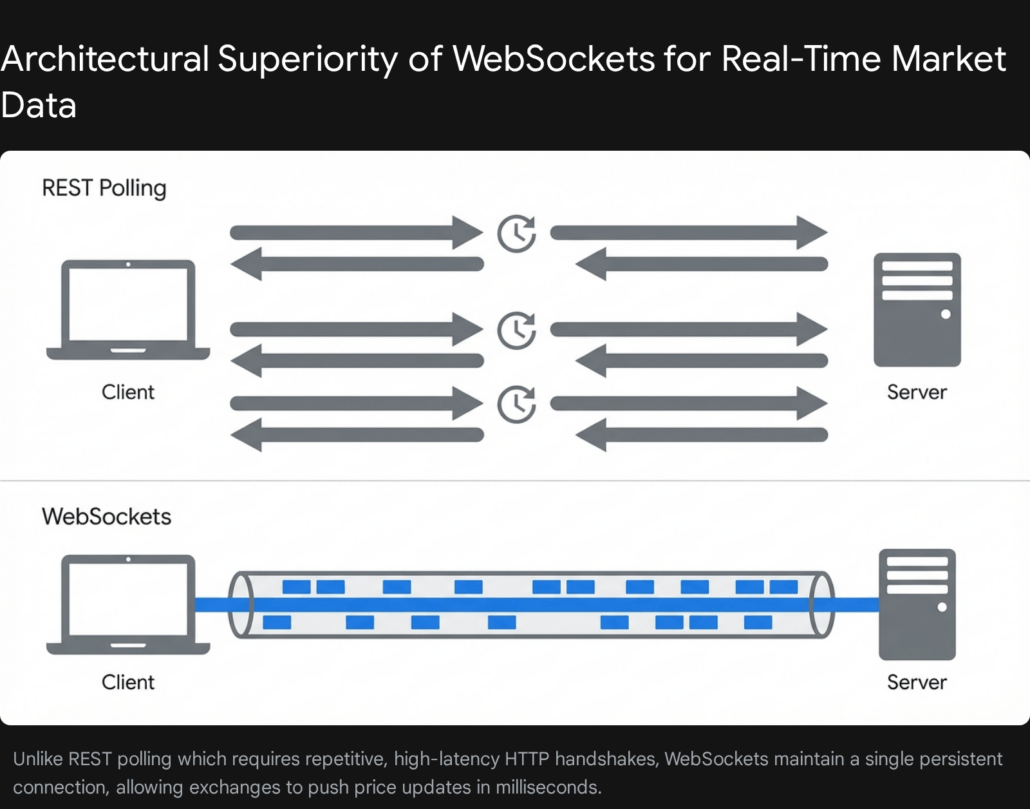
While WebSockets represent the enterprise standard, building a REST polling mechanism is the logical first step for understanding API interactions and is often sufficient for systems that only require updates every few minutes.
Phase 1: Implementing REST API Polling Logic
To demonstrate how to poll an API for real-time prices and set up threshold logic, we will use the CoinGecko API. The logic requires a continuous loop that fetches the price, compares it against a target, and sleeps for a designated period to avoid rate limits.
Below is a robust Python implementation utilizing the requests library.
Python
import requests
import time

def fetch_crypto_price(coin_id, currency="eur"):
    url = f"https://api.coingecko.com/api/v3/simple/price?ids={coin_id}&vs_currencies={currency}"
    try:
        response = requests.get(url, timeout=10)
        response.raise_for_status()
        data = response.json()
        return data[coin_id][currency]
    except requests.exceptions.RequestException as e:
        print(f"Network error fetching price: {e}")
        return None

def monitor_price_polling(coin_id, target_price, check_interval_seconds=60):
    print(f"Starting monitor for {coin_id}. Target alert: €{target_price}")

    while True:
        current_price = fetch_crypto_price(coin_id)

        if current_price is not None:
            print(f"Current {coin_id} price: €{current_price}")

            if current_price >= target_price:
                print(f"ALERT: {coin_id} has reached €{current_price}! Triggering notification...")
                # Notification logic goes here
                break # Exit loop after alerting, or reset target

        # Sleep to prevent hitting rate limits
        time.sleep(check_interval_seconds)

# Example execution
# monitor_price_polling('bitcoin', 85000.00)
This script establishes the foundational logic of a Python crypto price alert tool. It requests the data, parses the JSON response, evaluates the logical condition, and incorporates a time.sleep() mechanism to respect the server’s bandwidth. However, if you are tracking hundreds of assets or need split-second accuracy, this polling method will inevitably fail due to rate limits and latency.
Phase 2: Building the WebSocket Ingestion Engine
For an enterprise deployment, we must transition to WebSockets. We will utilize the websocket-client library in Python alongside threading to prevent the continuous stream from blocking the execution of the rest of our application.
A critical aspect of consuming WebSocket streams in a production environment is handling disconnections. Network anomalies, exchange server maintenance, and forced daily disconnects will drop your connection. A robust system must automatically recognize the drop and reconnect without human intervention.
Here is a structural example of how to implement a resilient, self-healing WebSocket connection to Binance for real-time Bitcoin prices:
Python
import websocket
import json
import time
import threading

class CryptoWebSocketStreamer:
    def __init__(self, symbol):
        self.symbol = symbol.lower()
        # Binance raw trade stream endpoint
        self.url = f"wss://stream.binance.com:9443/ws/{self.symbol}@trade"
        self.ws = None
        self.is_running = True

    def on_message(self, ws, message):
        data = json.loads(message)
        # Extract the price from the payload
        price = float(data['p'])
        self.evaluate_thresholds(price)

    def on_error(self, ws, error):
        print(f"WebSocket Error encountered: {error}")

    def on_close(self, ws, close_status_code, close_msg):
        print(f"WebSocket Closed. Status: {close_status_code}. Reconnecting in 5 seconds...")
        if self.is_running:
            time.sleep(5)
            self.start_connection()

    def on_open(self, ws):
        print(f"Successfully connected to the {self.symbol.upper()} live stream.")

    def evaluate_thresholds(self, current_price):
        # Placeholder for complex evaluation logic
        # In a real system, this would query Redis for user thresholds
        pass

    def start_connection(self):
        self.ws = websocket.WebSocketApp(
            self.url,
            on_message=self.on_message,
            on_error=self.on_error,
            on_close=self.on_close,
            on_open=self.on_open
        )
        # run_forever() blocks the thread, so we execute it in a daemon thread
        wst = threading.Thread(target=self.ws.run_forever, daemon=True)
        wst.start()

# Initialization
# streamer = CryptoWebSocketStreamer('btceur')
# streamer.start_connection()
This implementation ensures that if the WebSocket drops, the on_close method intercepts the event and initiates a reconnection delay, preventing infinite crash loops. The use of a daemon thread ensures that the main Python program can continue executing other tasks, such as serving an API or managing user input, while the market data streams silently in the background.
At Tool1.app, our engineering teams build upon this exact foundation when developing high-frequency data pipelines, ensuring that market events are captured with absolute precision.
Defending Against Rate Limits: Exponential Backoff
When your application interacts with external REST APIs—whether it is fetching historical data to calculate moving averages or sending notifications via third-party providers—you will inevitably encounter HTTP 429 (Too Many Requests) errors.
Exchanges and notification gateways strictly enforce rate limits to protect their infrastructure from abuse. If your bot crashes or aggressively retries immediately upon receiving a 429 error, your IP address will be temporarily or permanently banned.
The industry standard for handling this scenario is the exponential backoff algorithm. Instead of retrying immediately, the system waits a short period (for instance, one second). If the second attempt fails, it waits two seconds, then four seconds, and so on, up to a defined maximum threshold. Adding a random “jitter” to this delay prevents multiple workers from retrying at the exact same millisecond, a scenario known as the thundering herd problem.
You can elegantly implement this in Python using custom decorators:
Python
import time
import random
from functools import wraps

def exponential_backoff(max_retries=5, base_delay=1.0):
    def decorator(func):
        @wraps(func)
        def wrapper(*args, **kwargs):
            current_retry = 0
            while current_retry < max_retries:
                try:
                    return func(*args, **kwargs)
                except Exception as e:
                    current_retry += 1
                    if current_retry >= max_retries:
                        print(f"Maximum retries reached. Operation failed: {e}")
                        raise e

                    # Delay formula: base_delay * (2 ^ retry) + random jitter
                    delay = (base_delay * (2 ** current_retry)) + random.uniform(0, 1)
                    print(f"API request failed. Retrying in {delay:.2f} seconds...")
                    time.sleep(delay)
            return wrapper
        return decorator
By wrapping your external API call functions with @exponential_backoff(max_retries=5, base_delay=1.0), you ensure your application remains resilient, recovers gracefully from transient network anomalies, and stays strictly within enterprise API compliance boundaries.
Enterprise State Management and Task Routing
If you are building a tool for personal use, storing your target price in a simple Python variable is sufficient. However, if you are tracking thousands of assets or serving multiple users with distinct alert thresholds, evaluating every single market tick against a traditional database will instantly bottleneck your application.
Reading and writing to a standard SQL database for every WebSocket frame—which can arrive dozens of times per second during volatile periods—is an architectural anti-pattern. The database connections will exhaust, and the system will crash.


For production-grade architecture, the system must be decoupled into specialized layers:
1. In-Memory Caching (Redis): The WebSocket stream should do nothing but update the latest price of an asset in a Redis cache. Redis operates entirely in RAM, making it capable of handling millions of reads and writes per second with sub-millisecond latency.
2. Persistent Storage (PostgreSQL): User configurations, such as phone numbers, Telegram chat IDs, and specific alert thresholds (e.g., “Alert me when Ethereum drops below €2,500”), belong in a highly structured relational database like PostgreSQL.
3. Asynchronous Task Queues (Celery): A separate background worker constantly evaluates the Redis price cache against the PostgreSQL thresholds. When a condition is met, it triggers an asynchronous Celery task to send the notification. This ensures that the time taken to establish an HTTPS connection to a notification provider does not block the WebSocket from processing incoming market data.
When the engineering team at Tool1.app architects high-concurrency systems, we deploy this exact microservices structure. By isolating the data ingestion layer from the notification execution layer, the application achieves maximum throughput and near-zero latency, even during massive market sell-offs.
Integrating Instant Notification Gateways
A Python crypto price alert is entirely useless if the notification goes unseen. Email is notoriously slow and frequently buried in spam folders. For actionable financial intelligence, you must integrate immediate delivery channels: SMS and push notifications via messaging applications.
Twilio for SMS Integration
Twilio remains the gold standard for programmatic SMS delivery. It is highly reliable, supports intelligent global routing, and offers a comprehensive Python SDK. To implement Twilio, you need to register for an account to obtain an Account SID, an Auth Token, and a verified outbound phone number.
Security is paramount here. Never hardcode your credentials directly into your Python scripts. Always use environment variables to prevent accidental exposure in version control systems like Git. If bad actors gain access to your Twilio credentials, they can rack up massive bills sending fraudulent SMS messages.
Python
import os
from twilio.rest import Client

def send_sms_alert(asset, price, user_phone):
    # Retrieve secure credentials from the environment
    account_sid = os.environ.get("TWILIO_ACCOUNT_SID")
    auth_token = os.environ.get("TWILIO_AUTH_TOKEN")
    twilio_number = os.environ.get("TWILIO_PHONE_NUMBER")

    # Initialize the Twilio client
    client = Client(account_sid, auth_token)

    # Construct the message payload
    message_body = f"URGENT ALERT: {asset} has breached your threshold. Current market price is €{price:.2f}."

    try:
        message = client.messages.create(
            body=message_body,
            from_=twilio_number,
            to=user_phone
        )
        print(f"SMS dispatched successfully. Message SID: {message.sid}")
    except Exception as e:
        print(f"Failed to send SMS: {e}")
Telegram Bot Integration (Asynchronous v20+)
While SMS is universally accessible, it incurs a tangible cost per message, typically ranging from €0.01 to €0.05 depending on the destination country. For high-frequency traders requiring dozens of alerts per day, this can become prohibitively expensive.
Telegram offers a completely free, highly customizable alternative with instant push notifications. The python-telegram-bot library is the premier tool for this integration. It is important to note that the library recently underwent a massive structural change in version 20, shifting entirely to an asyncio architecture.
This architectural shift is highly beneficial for a price alert system, as asynchronous input/output allows the bot to handle thousands of outbound messages concurrently without blocking the main execution thread.
To send an alert to a specific Telegram Chat ID using the modern v20+ async approach:
Python
import asyncio
from telegram import Bot
from telegram.error import TelegramError

async def dispatch_telegram_alert(chat_id, message_text):
    # In production, load this from environment variables
    bot_token = "YOUR_TELEGRAM_BOT_TOKEN_HERE"

    # Initialize the asynchronous bot instance
    bot = Bot(token=bot_token)

    try:
        await bot.send_message(chat_id=chat_id, text=message_text)
        print("Telegram alert delivered successfully.")
    except TelegramError as e:
        print(f"Telegram delivery failed: {e}")

# To execute the async function from a standard synchronous context:
# asyncio.run(dispatch_telegram_alert("123456789", "Bitcoin crossed €85,000!"))
For more advanced implementations, Telegram allows you to build interactive bots. A user could message the bot directly, typing “Alert BTC > 85000”. The Python backend would parse this natural language, update the PostgreSQL database with the new threshold, and dynamically begin monitoring the market on the user’s behalf.
Webhooks and Downstream System Integrations
Beyond personal notifications, a robust Python crypto price alert system should serve as the trigger mechanism for broader corporate workflows. This is achieved through webhooks.
A webhook allows your Python application to send an HTTP POST request to another system the moment an alert condition is met. The possibilities for business automation are vast:
- Risk Management: If a treasury asset drops by more than 5% in an hour, the Python system fires a webhook to Jira, automatically creating a high-priority incident ticket for the risk management team to review.
- Team Communication: Instead of texting a single person, the system sends a formatted JSON payload to a dedicated Slack or Discord channel, keeping the entire trading desk informed simultaneously.
- Accounting Systems: The system can trigger a webhook to a customized enterprise resource planning (ERP) tool, logging the exact time and price of the threshold breach for audit and compliance purposes.
Building a webhook dispatcher in Python requires only a few lines of code using the requests library, transmitting a JSON payload containing the asset, price, timestamp, and triggering condition.
Cloud Deployment Strategies: Why Serverless Fails for Real-Time Crypto
Once your Python crypto price alert logic is sound, deploying it to reliable cloud infrastructure is the final, and often most misunderstood, hurdle. Developers frequently default to “serverless” architectures like AWS Lambda for new projects due to the allure of zero server maintenance and automatic scaling.
However, for a 24/7 WebSocket-driven application, deploying to AWS Lambda is both a costly and technical mistake.
AWS Lambda is explicitly designed for event-driven, short-lived executions. It charges based on the total number of requests and the execution duration, measured in GB-seconds. More critically, AWS Lambda imposes a hard maximum execution timeout of exactly fifteen minutes.
If you attempt to deploy a continuous WebSocket listener on Lambda, the function will run perfectly for fourteen minutes and fifty-nine seconds. At the fifteen-minute mark, AWS will forcefully terminate the process. To maintain a constant connection, you would be forced to orchestrate a complex, fragile system of recursive Lambda invocations, inevitably dropping incoming market ticks during every cold start and restart cycle. Furthermore, the GB-second pricing model scales terribly when a function is forced to run continuously around the clock.
Monthly Infrastructure Cost: 24/7 Persistent Workload
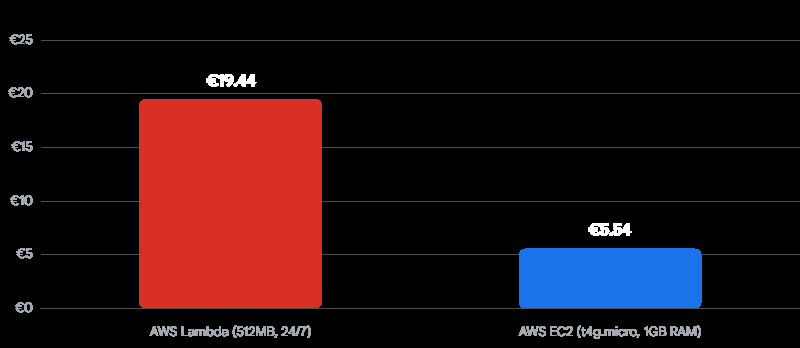
While Lambda is excellent for sporadic, event-driven tasks, running a continuous 512MB function 24/7 incurs massive GB-second duration charges. A dedicated EC2 instance (e.g., t4g.micro) provides a flat, highly economical rate for persistent WebSocket connections.
The financially and technically superior choice for a continuous Python crypto price alert tool is provisioning a dedicated virtual server, such as an AWS EC2 instance, or utilizing a containerized service like Amazon Elastic Container Service (ECS).
| Infrastructure Metric | AWS Lambda (512MB RAM) | AWS EC2 (t4g.micro – 1GB RAM) |
| Maximum Execution Limit | 15 Minutes (Hard AWS limit) | Unlimited (Runs 24/7/365) |
| Billing Model | Per request + GB-seconds utilized | Hourly flat compute rate |
| Estimated Hourly Cost | ~€0.028 | ~€0.008 |
| Estimated Monthly Cost | ~€20.16 | ~€5.76 |
| WebSocket Suitability | Terribly suited (Frequent forced disconnects) | Excellently suited (Persistent socket stability) |
By packaging your Python application inside a Docker container, you can deploy it to an EC2 instance running a modern, cost-effective ARM64 Graviton processor (such as the t4g family). This approach guarantees uninterrupted WebSocket connections, absolute control over the networking environment, and highly predictable monthly infrastructure costs.
At Tool1.app, we utilize Continuous Integration and Continuous Deployment (CI/CD) pipelines, such as GitHub Actions, to automatically build these Python Docker images and deploy them seamlessly to high-availability EC2 clusters. This ensures our clients’ automation tools are not only performant but completely resilient to underlying hardware failures.
Security Protocols for Financial Automation
When managing financial infrastructure, security cannot be an afterthought. If your system incorporates trading capabilities alongside price alerts, compromised API keys can result in devastating financial losses.
Cryptocurrency exchanges offer highly granular, permission-based API keys. You must strictly enforce the principle of least privilege. An API key used solely to fetch historical market data or read account balances must have “Withdrawal” and “Margin Trading” permissions explicitly disabled at the exchange level.
Furthermore, secure your infrastructure by implementing strict IP whitelisting. Configure the exchange API settings to only accept incoming requests that originate from the static Elastic IP address attached to your AWS EC2 instance. This simple step guarantees that even if a bad actor manages to steal your API credentials, they cannot execute malicious requests from an unauthorized geographic location.
Finally, rigorously audit your environment variables. Never commit .env files containing Twilio auth tokens, Telegram bot tokens, or database passwords to source control. Utilize secure secret managers like AWS Secrets Manager, Azure Key Vault, or HashiCorp Vault to inject credentials into your Docker containers securely at runtime.
Conclusion: Turning Code into Competitive Advantage
Building a cryptocurrency price alert system requires assembling a precise puzzle of distinct technologies. From handling the continuous, high-volume firehose of WebSocket data and managing rapid states in Redis, to orchestrating asynchronous task queues with Celery and delivering sub-second push notifications via Telegram and Twilio, the technical complexity scales rapidly.
However, mastering this architecture yields a profound competitive advantage. A robust, custom-built tracking system eradicates emotional trading, protects corporate digital assets from sudden downside volatility, and ensures you never miss a highly profitable market entry. It transforms raw, chaotic market data into structured, automated, and actionable business intelligence.
If your business requires a tailored approach to financial automation, relying on off-the-shelf consumer tools will ultimately restrict your growth, introduce unacceptable latency, and compromise your proprietary data.
Want custom blockchain monitoring tools, automated trading scripts, or high-performance financial backends? Contact Tool1.app for tailored crypto automation and expert Python software development services.








Leave a Reply
Want to join the discussion?Feel free to contribute!
Join the Discussion
To prevent spam and maintain a high-quality community, please log in or register to post a comment.