

Migrating from Magento to WooCommerce: Is It Worth It?
Table of Contents
- The Shifting Paradigm of Enterprise E-Commerce
- Deconstructing the Total Cost of Ownership
- The Scalability and Performance Myth
- The Engineering of Data Migration: An ETL Perspective
- The Role of AI in E-Commerce Replatforming
- SEO Strategy: Safeguarding Organic Traffic and Revenue
- Maximizing Operational Efficiency and Post-Migration ROI
- Transforming Your Digital Infrastructure
- Show all

The global e-commerce landscape is undergoing a massive architectural shift. For over a decade, Magento (now formally recognized as Adobe Commerce) reigned as the undisputed heavyweight champion for businesses with complex catalogs, multi-store requirements, and intricate global B2B operations. It offered unparalleled flexibility, deep customization, and robust scaling capabilities for organizations that possessed the budgets and technical teams required to wield it. However, as e-commerce technology evolves and the push toward composable, agile commerce accelerates, the historical narrative surrounding enterprise platforms is rapidly changing. In the current market, mid-market businesses face a watershed moment: the escalating maintenance costs, sluggish development agility, and intense technical debt associated with legacy Magento builds are forcing a strategic and financial reevaluation.
Increasingly, enterprise directors and mid-market business owners are asking a critical question: is it financially and operationally viable to migrate Magento to WooCommerce? Historically dismissed by some enterprise developers as a simple tool suited only for small boutique shops, WooCommerce has matured into a highly scalable, flexible, and financially efficient powerhouse. Supported by modern headless architectures, robust cloud hosting infrastructure, and intelligent automation, WooCommerce now regularly powers vast digital storefronts generating tens of millions of euros in annual revenue.
Replatforming is a monumental decision. It is not merely a swap of software; it is a fundamental restructuring of your digital revenue engine. This comprehensive report delves into the financial, technical, and operational realities of such a transition. We will meticulously dissect the long-term total cost of ownership, detail the granular complexities of database migration, explore how custom Python automations and artificial intelligence can streamline the transition, and provide a strict technical SEO blueprint to safeguard your organic traffic during the move.
The Shifting Paradigm of Enterprise E-Commerce
To understand why so many businesses are abandoning legacy systems, one must first understand the changing economic pressures of online retail. E-commerce is no longer just a growth channel; for most mid-market brands, it is the backbone of long-term business success. With global retail e-commerce sales projected to continue their upward trajectory toward the €7.3 trillion mark, the competition is no longer simply about having an online presence. It is about building a sustainable, adaptable, and customer-first digital ecosystem.
Mid-market brands face a unique balancing act. They lack the virtually limitless IT budgets of multinational enterprise players, yet their operations—involving complex logistics, tiered B2B pricing, and vast product variants—are vastly more complicated than those of small businesses. This dynamic often results in fragmented systems, inconsistent user experiences, and internal data silos that stunt growth.
Customer expectations are at an all-time high. Modern consumers demand lightning-fast page loads, hyper-personalized product recommendations, and seamless omnichannel experiences. When a platform’s underlying architecture is so heavy that deploying a simple promotional landing page takes a development team days instead of minutes, the business loses its competitive edge. This phenomenon, often referred to as the “consultation crisis” or agility lag, is precisely where traditional, monolithic shop systems begin to fail. The “unlimited control” that developers once praised in Magento often translates into unlimited ways for the system to break, requiring unlimited security patches and generating unlimited technical debt.
Deconstructing the Total Cost of Ownership
Evaluating an e-commerce platform requires looking far beyond the initial software licensing fees or the hourly rate of a development agency. The Total Cost of Ownership encapsulates initial capital expenditures (CapEx) for the build, ongoing operational expenditures (OpEx) for maintenance, hosting infrastructure, security compliance, third-party software licensing, and, crucially, the opportunity cost of platform agility.
Many SaaS and enterprise platforms bank on businesses ignoring the long-term math. They bet that organizations will accumulate so much technical debt and face such steep switching costs that they will feel trapped by the time they realize they made the wrong infrastructural choice.
The Financial Burden of Legacy Architecture
Magento offers two primary avenues: Magento Open Source (the free software edition) and Adobe Commerce (the enterprise-licensed software). While the open-source version carries no upfront licensing fee, it requires a massive infrastructural and developmental budget to operate securely and efficiently at scale.
A standard mid-market implementation involves steep initial capital expenditures. Development costs for a custom build typically range between €27,000 and €75,000. Because of the platform’s heavy, complex architecture, it demands robust, specialized server environments. Monthly dedicated virtual private server (VPS) or cloud hosting can easily run from €180 to over €1,800, translating to €2,100 to €21,000 annually simply to keep the site online and responsive.
The true financial drain, however, lies in ongoing operational expenditures. Maintaining a store requires constant vigilance regarding security patches, PHP version updates, and extension compatibility. Businesses typically secure ongoing maintenance retainers with specialized agencies, costing anywhere from €1,000 to €3,500 per month (€12,000 to €42,000 annually). Furthermore, if a business requires the advanced B2B functionality of Adobe Commerce, they must factor in a starting license fee of approximately €29,000 to €36,000 per year, which scales upward based on Gross Merchandise Value.
The Financial Viability of Agile Commerce
WooCommerce operates on a fundamentally different financial model. Built on top of WordPress—the content management system that powers a massive percentage of the global web—its open-source nature allows businesses to achieve extreme precision in their cost structures. Rather than paying for bundled, proprietary features they may never use, businesses pay only for the infrastructure and extensions they specifically require.
For a mid-market European retailer generating roughly €1.8 million in annual revenue, a high-end, highly customized WooCommerce build might require an initial investment of €9,000 to €23,000. Annual operational costs—including premium plugins, robust autoscaling cloud hosting, global content delivery networks, and enterprise-grade security firewalls—are drastically lower. Yearly maintenance typically ranges from €4,500 to €13,500, depending on the complexity of the integrated enterprise resource planning (ERP) systems and customer relationship management (CRM) tools.
When analyzing a business generating approximately €2.75 million in annual revenue over a three-year timeline, the financial divergence between the two platforms becomes glaringly apparent. A legacy environment can easily consume a quarter of a million euros in Total Cost of Ownership. Conversely, a functionally identical agile environment—engineered with scalable cloud infrastructure and customized checkout logic—often operates at less than half that cost.
To illustrate this disparity, consider the following comparative analysis of projected expenses over a 36-month lifecycle for a mid-market brand:
| Cost Category | Magento Open Source (3-Year Projection) | WooCommerce (3-Year Projection) | Difference |
| Initial Build & Deployment | €45,000 – €75,000 | €15,000 – €25,000 | +€30,000 to +€50,000 |
| Hosting & Infrastructure (Annual) | €12,000 – €24,000 | €3,500 – €8,500 | +€8,500 to +€15,500/yr |
| Maintenance Retainers (Annual) | €24,000 – €42,000 | €6,000 – €15,000 | +€18,000 to +€27,000/yr |
| Premium Extensions/APIs (Annual) | €3,000 – €8,000 | €1,000 – €3,000 | +€2,000 to +€5,000/yr |
| Total Estimated 3-Year TCO | €162,000 – €297,000 | €46,500 – €104,500 | Massive Capital Drain |
The capital freed from this overhead is not merely saved; it can be aggressively redirected toward customer acquisition, AI-driven marketing campaigns, product line expansion, and improving the overall user experience. By lowering the Total Cost of Ownership, businesses fundamentally improve their operating margins and resilience in a competitive market.
The Scalability and Performance Myth
A lingering myth in the e-commerce sector—often perpetuated by enterprise software sales teams—is that open-source, WordPress-based platforms cannot scale to handle enterprise-level traffic, complex database queries, or catalog sizes exceeding a few thousand SKUs. This misconception stems from a fundamental misunderstanding of modern web architecture and is usually based on observations of poorly optimized, do-it-yourself setups running on cheap, shared hosting environments.
In reality, scaling an e-commerce platform is less about the core application software and almost entirely about the underlying server infrastructure, database indexing optimization, and the intelligent layering of caching systems.
High-volume stores successfully manage hundreds of thousands of daily orders and vast catalogs containing millions of SKUs without buckling under the pressure. Achieving this level of performance requires a decoupled, performance-engineered environment. By leveraging dedicated cloud computing environments, autoscaling server clusters that spin up new resources during traffic spikes, and global Content Delivery Networks, the platform performs identically to—if not faster than—a heavy legacy instance.
Real-World High-Volume Use Cases
To contextualize this capability, consider the operational realities of high-revenue businesses currently thriving on these streamlined architectures.
A high-ticket luxury goods merchant based in Europe, averaging roughly €1.8 million in annual revenue, recently executed a replatforming strategy. They required true checkout customization to handle complex European VAT rules, localized payment gateways (such as Klarna and Nets EASY), and highly configurable product logic involving custom engraving. While proprietary SaaS platforms required expensive enterprise-tier upgrades to unlock checkout customization, the open-source alternative provided this flexibility natively. The total initial capital expenditure was contained, and their ongoing annual operational footprint stabilized at approximately €82,000, roughly 4.5% of their revenue, leaving massive room for profit.
On a larger scale, a regulated medical retailer operating across Europe with €9.2 million in annual revenue relies on the same agile infrastructure. Their profile includes a complex user flow involving medical prescription validation, strict identity verification, and multi-platform communication with rigorous data protections. Even with the integration of specialized third-party services like Algolia for high-speed faceted search across a massive SKU count, enterprise-grade email automation, and robust customer support ticketing, their ongoing annual costs remain highly optimized at around €218,000, representing just 2.3% of their annual revenue.
Furthermore, the open REST API allows for a headless commerce approach. Businesses can utilize the core platform strictly as a backend data management and order processing engine, while serving the frontend presentation layer via lightning-fast JavaScript frameworks like React, Vue, or Next.js. This composable architecture guarantees sub-second page loads, a critical metric for both maximizing user conversion rates and satisfying Google’s stringent Core Web Vitals for search engine ranking.
The Engineering of Data Migration: An ETL Perspective
Executing a migration is arguably the most technically perilous phase of replatforming. Deciding to migrate Magento to WooCommerce means transferring hundreds of thousands of complex, highly relational data points across completely different database schemas without incurring business downtime, data corruption, or catastrophic data loss.
For small, simplistic stores, a manual export and import process via generic CSV files might be viable. However, for mid-market entities with intricate B2B pricing tiers, complex product variations, and years of historical customer data, manual handling is a recipe for disaster. Professional data migration requires robust Extract, Transform, Load (ETL) pipelines, often engineered and executed through custom Python automations.
Restructuring the Product Catalog
Legacy enterprise platforms handle product data through a notoriously complex Entity-Attribute-Value (EAV) database model. This means a single product’s information might be scattered across dozens of different database tables. Products are categorized as Simple, Configurable, Bundled, Grouped, or Virtual, each with its own set of rules and relational dependencies.
Conversely, modern WordPress-based commerce uses a simpler, flatter architecture based on custom post types and post metadata. A “Configurable” product in the legacy system maps to a “Variable” product in the new system. Translating this data requires sophisticated scripting that extracts the parent product, maps all of its associated child products, flattens all permutations of custom attributes (such as size, color, material, or technical specifications), and then reconstructs them perfectly into the new relational schema.
When utilizing custom scripts or advanced automation solutions, developers can programmatically sanitize and map these attributes. For example, Python’s highly powerful pandas data manipulation library is incredibly effective at taking raw, messy CSV exports or direct database dumps, cleaning the data structures, mapping column headers to modern REST API standards, and pushing the sanitized data to the new server in seamless batches.
Automating the Transition with Python
As an agency highly specialized in Python automations and custom software integrations, Tool1.app approaches data migration as an automated software engineering task rather than a manual data entry chore. Below is a conceptual implementation example illustrating how Python can be utilized to build an automated ETL pipeline that extracts messy product data, sanitizes it, and securely pushes it to the new platform via the REST API:
Python
import requests
import pandas as pd
import json
import logging

# Configure logging for the migration process
logging.basicConfig(level=logging.INFO, format='%(asctime)s - %(levelname)s - %(message)s')

# Initialize target REST API credentials and endpoints
API_URL = "https://your-new-store.com/wp-json/wc/v3/products"
CONSUMER_KEY = "ck_your_secure_consumer_key"
CONSUMER_SECRET = "cs_your_secure_consumer_secret"

def clean_and_migrate_catalog(raw_export_path):
    """
    Extracts raw legacy data, transforms it to fit the new schema,
    and loads it into the new platform via API.
    """
    logging.info("Starting ETL pipeline for product catalog...")

    try:
        # Step 1: Extract - Load raw, messy data into a pandas DataFrame
        df = pd.read_csv(raw_export_path)

        # Step 2: Transform - Automate data cleaning and normalization
        # Fill null prices with 0, convert to float
        df['price'] = df['price'].fillna(0).astype(float)

        # Standardize SKUs (strip whitespace, ensure uppercase)
        df['sku'] = df['sku'].astype(str).str.strip().str.upper()

        # Clean HTML descriptions or handle missing text
        df['description'] = df['description'].fillna('No description available.')

        # Ensure inventory quantities are integers
        df['qty'] = df['qty'].fillna(0).astype(int)

        success_count = 0
        failure_count = 0

        # Step 3: Load - Iterate through sanitized data and push via API
        for index, row in df.iterrows():
            product_payload = {
                "name": str(row['name']),
                "type": "simple", # Logic can be expanded for variable products
                "regular_price": str(row['price']),
                "description": str(row['description']),
                "short_description": str(row['short_description']),
                "sku": row['sku'],
                "manage_stock": True,
                "stock_quantity": row['qty'],
                "status": "publish" if row['status'] == 'Enabled' else "draft"
            }

            # Execute the API POST request
            response = requests.post(
                API_URL,
                auth=(CONSUMER_KEY, CONSUMER_SECRET),
                json=product_payload,
                timeout=10
            )

            if response.status_code in :
                logging.info(f"Successfully migrated SKU: {row['sku']}")
                success_count += 1
            else:
                logging.error(f"Failed to migrate SKU: {row['sku']} - API Error: {response.text}")
                failure_count += 1

        logging.info(f"Migration Complete. Success: {success_count}, Failures: {failure_count}")

    except Exception as e:
        logging.error(f"Critical failure in ETL pipeline: {str(e)}")

# Example execution trigger
# clean_and_migrate_catalog('/data/legacy_magento_export_v1.csv')
By engineering the migration through robust scripts like this, businesses can migrate tens of thousands of complex SKUs in a matter of hours, ensuring mathematical accuracy and eliminating human error. Furthermore, these scripts can be scheduled to run incrementally, continuously syncing inventory levels between the old site and the new site right up until the exact moment the DNS is switched, guaranteeing zero disruption to sales.
Migrating Customers: The Cryptographic Hurdle
Migrating standard customer profile metadata—such as names, billing addresses, shipping addresses, phone numbers, and company names—is a straightforward data mapping exercise. However, the largest, most dangerous technical hurdle when migrating user accounts involves authentication and password encryption.


To ensure rigorous cybersecurity, enterprise platforms hash customer passwords using specific cryptographic algorithms, often a salted MD5, SHA-256, or Argon2 implementation. The destination platform, by default, utilizes a completely different cryptographic standard, specifically the Portable PHP password hashing framework. Because password encryption relies on one-way mathematical hashing functions, you cannot simply “decrypt” a legacy password to reveal the plain text and then re-encrypt it into the new format.
If customer data is migrated improperly without addressing this cryptographic mismatch, every single existing customer will be locked out of their account the moment the new site goes live. When loyal, returning customers attempt to log in to check an order status or make a repeat purchase, their valid password will be rejected. They will be forced to initiate a frustrating, multi-step “Forgot Password” reset flow. This friction point is a guaranteed way to damage brand trust, drastically increase customer support tickets, and suffer a measurable drop in repeat conversion rates.
To solve this critical issue without impacting the end-user experience, software engineers must build a custom authentication bridge. This advanced solution involves migrating the exact legacy password hash and its unique cryptographic salt into the new database as hidden user metadata, rather than placing it in the standard password field. A custom PHP function is then written to hook directly into the new platform’s core login processing logic.
When a returning customer attempts to log in to the newly migrated site, the system intercepts the authentication request. It takes the plain-text password the user just typed into the browser and hashes it in real-time using the legacy cryptographic method. If the resulting hash matches the legacy hash stored in the hidden metadata, the authentication bridge grants access. Immediately upon successful login, the system silently captures the plain-text password, re-hashes it using the modern, secure standard, updates the core database, and deletes the legacy metadata. The customer is seamlessly transitioned into the new security architecture without ever realizing a complex cryptographic migration just occurred in the background.
Preserving Order History and Logistics
Order history is the lifeblood of customer service, financial reporting, and predictive marketing. A customer expects to log into their account and see an invoice from three years ago just as easily as an order placed yesterday.
Migrating order data involves meticulously mapping legacy order statuses (such as Pending, Processing, Complete, Canceled, or On Hold) to their precise new equivalents (e.g., wc-pending, wc-processing, wc-completed). If this mapping is flawed, fulfillment systems will break, and automated shipping confirmation emails could misfire.
Furthermore, guest checkouts present a unique relational challenge. In legacy systems, an order might be associated with an email address but no formal customer account ID. A sophisticated migration script must identify these orphaned orders. It must then either dynamically create a hidden guest profile in the new system to anchor the data or, intelligently, link those historical guest orders to a newly created user account if the email address matches a recent registration. Ensuring that historical tracking numbers, precise tax records, applied discount codes, and shipping invoices transfer cleanly is absolutely paramount for post-migration continuity and accounting compliance.
The Role of AI in E-Commerce Replatforming
A major platform migration is not merely about moving data from point A to point B; it is an unprecedented strategic opportunity to enrich, sanitize, and optimize that data. The traditional “lift and shift” approach often imports years of messy, unoptimized, and obsolete data into a clean new system, defeating the purpose of the upgrade. Today, advanced AI/LLM solutions for business efficiency allow forward-thinking merchants to completely revitalize their catalogs simultaneously with the migration.
When executing an ETL pipeline, intelligent data workflows can route raw product descriptions through highly tuned Large Language Models (LLMs) before they are ever inserted into the new database. This allows for the bulk, automated generation of high-converting, localized marketing copy. For example, if a store contains 15,000 products featuring thin, duplicate, or manufacturer-provided descriptions, an AI agent can rapidly analyze the raw product attributes (dimensions, materials, use cases), extract the key consumer selling points, and generate unique, persuasive, SEO-optimized descriptions and meta tags in seconds.
Additionally, AI-driven computer vision tools can be deployed during the asset migration phase to analyze vast image libraries. These tools can automatically tag products with descriptive keywords, assign them to new, more intuitive taxonomies based on visual attributes, and identify and purge duplicate or low-resolution images.
For technical agencies like Tool1.app, leveraging powerful Python automations combined with the latest generative AI models ensures that the newly launched store is not just a structural replica of the old infrastructure, but a vastly superior, data-enriched, and highly optimized upgrade designed for the modern retail environment.
SEO Strategy: Safeguarding Organic Traffic and Revenue
A replatforming project is essentially a high-stakes organ transplant for a website. If the complex neurological pathways—the Search Engine Optimization (SEO) structures—are ignored or mishandled, the digital body will reject the new organ. This results in a catastrophic, sometimes permanent, loss of organic search traffic, keyword rankings, and associated revenue. Different e-commerce platforms generate URLs, XML sitemaps, and canonical tags in fundamentally different ways. Managing these structural changes requires meticulous planning and rigorous execution.
URL Architecture and the 301 Redirect Matrix
Legacy enterprise platforms typically create product URLs with an explicit .html suffix (for example, www.example.com/red-industrial-widget.html) or they embed dynamic category paths directly into the product URL string (such as www.example.com/hardware/tools/red-industrial-widget.html).
Modern agile platforms utilize a highly standardized, hierarchical permalink structure designed for clean routing. This typically results in URLs formatted like www.example.com/product/red-industrial-widget/ and category pages structured as www.example.com/product-category/hardware/.
Because the underlying URL strings fundamentally and unavoidably change during the migration, search engine crawlers like Googlebot will register a massive spike in 404 (Page Not Found) errors if the old URLs are not explicitly and permanently linked to the new ones. When a search engine encounters a 404 error on a historically ranking page, it strips the PageRank authority from that URL and removes it from the search index, destroying years of accumulated SEO equity.
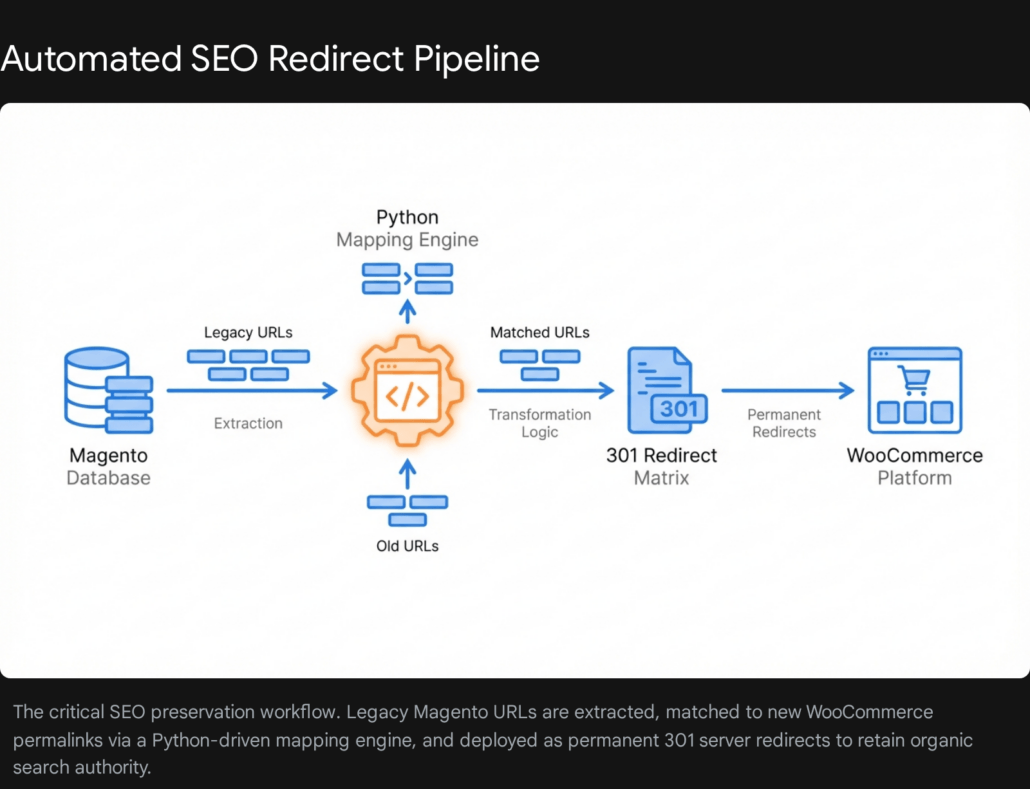
The definitive solution to this existential threat is a comprehensive, mathematically perfect 301 Redirect map. A 301 redirect is a server-level HTTP instruction that tells search engine crawlers and user browsers that a specific web page has permanently moved to a new location. Crucially, a 301 redirect passes nearly all of the accumulated SEO authority from the old URL to the new URL.
Months before turning off the legacy server, technical SEO engineers must scrape and catalog every single existing URL indexed by Google or generating traffic. Using Regular Expressions (Regex) in the new server’s configuration file (such as the Apache .htaccess file or an Nginx server block), broad pattern redirects can be established to handle standard structural shifts.
For instance, an Apache .htaccess server directive designed to catch legacy category-based .html product pages and gracefully redirect them to the new standardized product structure might look conceptually like this:
Apache
# Enable the URL rewrite engine
RewriteEngine On

# Redirect legacy.html product pages to new clean product slugs
# Assuming the core product name slug remains identical minus the.html extension
RewriteRule ^.*/([^/]+).html$ /product/$1/

# Redirect old legacy category pages to the new product-category architecture
RewriteRule ^catalog/category/view/id/([0-9]+)/?$ /product-category/
While Regex algorithms can efficiently handle broad, pattern-based architectural changes, large stores often have thousands of custom URL rewrites, promotional vanity URLs, or legacy anomalies that do not follow any logical pattern. In these instances, a massive 1-to-1 redirect matrix must be generated programmatically. This is typically achieved by querying the legacy URL rewrite database tables, mapping the old request paths to the corresponding new product IDs based on SKU, and generating a comprehensive RewriteMap that the new server can reference instantly.
Post-Launch Technical SEO Maintenance
The SEO strategy absolutely does not end on launch day; in many ways, the real work is just beginning. Immediately post-migration, the technical team must generate a new, dynamically updating XML sitemap and submit it directly to Google Search Console and Bing Webmaster Tools. This proactive submission forces search engine bots to rapidly crawl the new site architecture, discover the new URLs, and process the millions of 301 redirects, accelerating the indexation update.
Furthermore, operations teams must actively monitor the site for broken internal links, redirect loops (where page A redirects to page B, which redirects back to page A), and server crawl errors. Analytics dashboards should be heavily scrutinized daily for the first three months.
It is important for stakeholders to understand that a slight, temporary dip in organic traffic and keyword volatility is a normal symptom of Google recalibrating its index to understand the new site structure. However, a well-engineered and flawlessly executed SEO migration ensures that this volatility is minimized. Ultimately, organic traffic will stabilize and is highly likely to experience robust growth due to the new platform’s substantially cleaner code base, superior mobile responsiveness, and significantly faster server response times.
Maximizing Operational Efficiency and Post-Migration ROI
Ultimately, the primary goal of navigating the complexities of replatforming is to liberate your internal operations from the sluggishness, friction, and expense of legacy technology. Agile commerce inherently integrates beautifully with a massive, global ecosystem of modern, API-first business tools.
Whether your enterprise requires native, real-time syncing with marketing automation platforms like HubSpot, sophisticated global inventory management through ERPs like Oracle NetSuite, or advanced financial reconciliation via accounting software like Xero, the modern ecosystem provides seamless REST API integrations that cost a mere fraction of what custom legacy development demands.
Moreover, the training time and operational overhead for internal staff are drastically reduced. The administrative dashboard of modern agile platforms is globally recognized for its highly intuitive, user-friendly interface. E-commerce managers and marketing teams can deploy complex new promotional landing pages, run sophisticated A/B tests, dynamically adjust tiered pricing structures, and publish rich media content without ever needing to submit a high-priority ticket to a specialized backend developer.
This democratization of content management and site operation accelerates marketing cycles, reduces time-to-market for new initiatives, and drives immediate return on investment. The business pivots from spending the majority of its digital budget simply keeping a heavy system running, to investing that budget directly into customer acquisition, conversion rate optimization, and brand growth.
Transforming Your Digital Infrastructure
The decision to migrate Magento to WooCommerce represents a profound strategic pivot toward financial efficiency, technological agility, and sustainable, scalable growth. The era of mid-market businesses paying exorbitant monthly maintenance retainers simply to keep an overly complicated, legacy monolithic system afloat is rapidly coming to an end.
By embracing composable, open-source architecture, mid-market enterprises can drastically reduce their Total Cost of Ownership, regain total ownership and control over their codebase, and redirect their capital toward customer-centric innovations and aggressive global scaling.
While the technical mechanics of the transition—ranging from complex Python-driven data extraction and meticulous password cryptography bridging to high-risk SEO preservation—are undeniably complex, treating the migration as an automated, engineering-driven process guarantees success. By removing human error through automation, businesses can achieve a flawless transition with zero revenue downtime and fully preserved search engine authority.
Ready to dramatically lower your e-commerce overhead and escape the stifling limitations of legacy platforms? Let Tool1.app handle your seamless migration. From engineering complex Python data ETL pipelines to executing custom website replatforming and deploying AI-driven catalog optimization, our dedicated team delivers high-performance solutions engineered strictly for business efficiency and scale. Contact us today for a comprehensive architectural consultation and project assessment.








Leave a Reply
Want to join the discussion?Feel free to contribute!
Join the Discussion
To prevent spam and maintain a high-quality community, please log in or register to post a comment.