

Flutter vs. React Native in 2026: The Final Verdict for Startups
Table of Contents
- React Native: The "New Architecture" and Accelerated Velocity
- Flutter: Pixel-Perfect Consistency and the Impeller Engine
- Performance Head-to-Head: Cold Starts vs. Data Processing
- The Business Strategy: Capital Allocation and TCO
- The AI Imperative: Conversational Interfaces vs. Edge AI
- The Backend Bottleneck: FastAPI and Python
- Conclusion: Architecting for Success
- Show all
The mobile app development landscape has matured significantly by 2026, leaving startup founders and enterprise technology directors with a critical architectural decision that will unequivocally dictate their engineering velocity, budget burn rate, and ultimate scalability. Choosing between Flutter and React Native is no longer a rudimentary debate over basic viability or cross-platform limitations. Both frameworks have systematically eradicated their historical bottlenecks to deliver near-native, uncompromising performance.
However, their underlying architectural philosophies, ecosystem dependencies, and developer workflows remain fundamentally opposed. Making the right choice requires looking far beyond generic benchmark tests; it requires aligning the technology stack with your startup’s specific financial constraints, talent acquisition strategy, and long-term product vision. At Tool1.app, we frequently guide business owners through this exact decision matrix, ensuring their custom software development investments yield robust, future-proof applications that delight users and satisfy investors.
React Native: The “New Architecture” and Accelerated Velocity
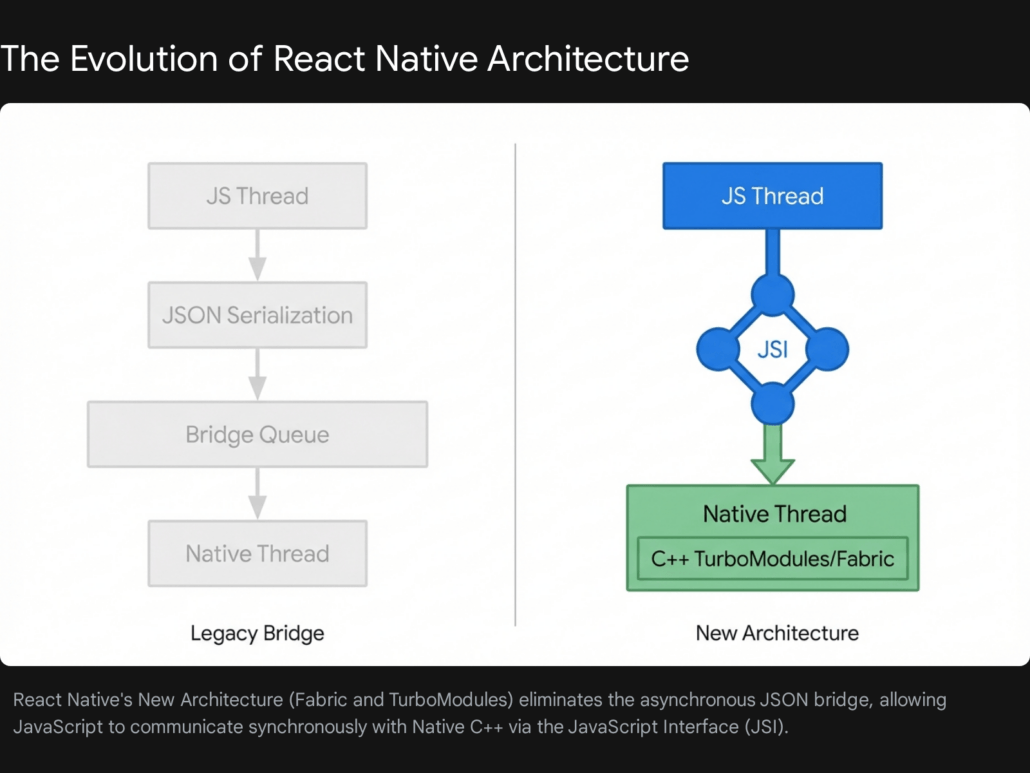
For years, React Native’s most significant critique was its reliance on an asynchronous JSON bridge. Every time your application’s JavaScript code needed to communicate with native device components—such as triggering an animation, accessing the camera, or responding to a swipe gesture—the data had to be serialized into JSON, pushed across the bridge, and deserialized on the native side. Under heavy load, this bridge became a notorious performance bottleneck.
In 2026, that bridge is entirely a relic of the past. The “New Architecture”—comprising Fabric for modern rendering and TurboModules for native logic execution—is now the mandatory standard across the ecosystem. By utilizing the JavaScript Interface (JSI), React Native allows JavaScript code to communicate synchronously and directly with native C++ modules, completely eliminating serialization delays and asynchronous queueing.
Furthermore, the recent release of React Native 0.84 has fundamentally shifted the framework’s baseline capabilities:
- Hermes V1: Now the default, unchangeable JavaScript engine, bringing automatic, zero-configuration performance gains and drastically smaller memory footprints to all applications out of the box.
- Precompiled iOS Binaries: By downloading precompiled
.xcframeworkbinaries automatically, clean build times on Apple hardware have been slashed. Previously, developers had to compile the core from source, bottlenecking CI/CD pipelines.
For startups, this translates directly to faster feature rollouts, reduced server costs for automated testing, and lower overall development overhead.
Flutter: Pixel-Perfect Consistency and the Impeller Engine
While React Native focused heavily on optimizing its connection to the host operating system, Google’s Flutter team doubled down on their distinct strategy of bypassing the OS almost entirely. Flutter does not use native OEM widgets. Instead, it draws every single pixel on the screen from scratch using its own rendering engine. This guarantees absolute pixel-perfect UI consistency across an iPhone 16, a five-year-old budget Android device, or a desktop web browser.
The undisputed game-changer for Flutter in the 2026 landscape (up to the current 3.41 “Year of the Fire Horse” release) is the Impeller graphics engine. Historically, Flutter relied on Skia, a highly capable 2D engine that nonetheless suffered from “early frame jank” due to Just-In-Time (JIT) shader compilation.
Impeller decisively solves this through Ahead-Of-Time (AOT) compilation:
- It pre-compiles all necessary shaders offline during the application’s build process.
- The result is predictable, buttery-smooth 60 to 120 FPS animations right from the very first frame, with zero dropped frames.
- Combined with Dart 3.x’s highly optimized garbage collection and robust null safety, Flutter operates less like a traditional app framework and more like a high-performance 3D video game engine custom-tailored for complex business applications.
Performance Head-to-Head: Cold Starts vs. Data Processing
When evaluated through empirical data and rigorous testing in 2026, the performance differences highlight the distinct architectural paths of both frameworks. Neither framework is objectively “faster” in every scenario; rather, they excel in different computational domains.


- Cold Startup Time: Flutter generally boasts faster cold start times, frequently achieving sub-200 milliseconds on mid-range devices due to Dart’s AOT compilation. React Native still requires a fraction of a second to initialize the JavaScript runtime, resulting in start times around 2.5 to 2.8 seconds for heavy apps.
- Memory Footprint: React Native frequently maintains a slightly smaller idle memory footprint (~120 MB) compared to Flutter (~150 MB), because Flutter must maintain its own embedded graphics engine state in RAM.
- Visual vs. Data Heavy Tasks: During massive list scrolling, Flutter’s Impeller engine demonstrates superior stability. Conversely, React Native’s Hermes engine excels in raw, invisible data processing (e.g., parsing massive JSON payloads from a backend server).
The Business Strategy: Capital Allocation and TCO
Technical benchmarks must ultimately translate to tangible business value. For European startups, technology choice is fundamentally a capital allocation strategy.
In 2026, leveraging strategic outsourcing provides immense financial leverage. Highly skilled Eastern European developers typically command hourly rates between €40 and €65, whereas equivalent senior talent in Western Europe or the US often charges between €80 and €150 per hour.
When analyzing costs, a fascinating paradox emerges:
- Initial MVP Build (React Native Wins): React Native has a massive talent pool because it is based on JavaScript. Existing web developers can be cross-trained in weeks, making hiring faster and initial development slightly cheaper. Flutter’s Dart requires a dedicated 4-to-6 week learning curve.
- Total Cost of Ownership (Flutter Wins): Founders must aggressively calculate the Total Cost of Ownership (TCO). React Native apps often suffer from “dependency churn” when core updates break community-maintained libraries. Flutter relies on deeply integrated, first-party packages from Google and guarantees visual uniformity, significantly lowering QA and multi-year maintenance costs.
The AI Imperative: Conversational Interfaces vs. Edge AI
We have entered an era where a static application is essentially a dead application. Users now expect hyper-personalized data recommendations, natural language conversational interfaces, and predictive automation.
Both frameworks handle AI integrations flawlessly, but with different architectural paradigms:
- Flutter’s Frontend Dominance: With the maturity of the
flutter_ai_toolkit, developers get out-of-the-box chat UI widgets handling multi-turn context, real-time streaming, and voice input. It also integrates seamlessly with the Model Context Protocol (MCP) for secure tool triggering. - React Native’s “Edge AI”: TurboModules allow direct, synchronous access to C++ via JSI, enabling tight integration with bare-metal ML libraries like
llama.cppor PyTorch’s ExecuTorch. This allows devices to load quantized LLMs directly into RAM for zero-latency, highly private inference without cloud GPU bills.
The Backend Bottleneck: FastAPI and Python
No mobile application—regardless of how meticulously crafted the UI may be—can overcome the severe limitations of a sluggish, poorly architected backend. In 2026, monolithic backends are fading, replaced by highly performant, asynchronous microservices. This is precisely why our backend and Python automations teams at Tool1.app overwhelmingly architect infrastructure using Python and FastAPI.
FastAPI represents a massive paradigm shift:
- ASGI Standards: Natively supports handling thousands of concurrent WebSocket connections with minimal memory overhead, vital for real-time data streaming.
- AI Integration: Python remains the undisputed global standard for AI. Writing your API layer in FastAPI allows seamless integration of cutting-edge libraries like PyTorch or LangChain.
- Data Validation: Combined with Pydantic for strict schema validation, it guarantees every JSON payload matches a defined structure, vastly reducing frontend crashes.
Conclusion: Architecting for Success
To establish a concrete framework for decision-making, let us examine how this dynamic plays out across distinct startup scenarios. The debate between Flutter and React Native has matured past religious framework wars. Both platforms have systematically conquered their historical demons to become elite, enterprise-grade tools.
- React Native has abolished its asynchronous bridge, making it a powerhouse for heavy processing and rapid, JavaScript-driven development.
- Flutter has eradicated rendering jank with its Impeller engine, cementing its status as the king of customized, pixel-perfect user interfaces.
Making the wrong architectural decision today can cost tens of thousands of Euros in technical debt tomorrow. At Tool1.app, we analyze your specific business requirements, timeline, and budget to engineer the optimal solution. Whether you need a highly optimized React Native application, a visually stunning Flutter experience, a massively scalable Python FastAPI backend, or advanced custom software development to automate your business efficiency, our expert teams are equipped to deliver.
Contact us today for a comprehensive consultation, and ensure your next digital product is architected for immediate market impact and long-term success.