

Agentic AI vs. Standard Automation: Why Your Business Needs Autonomous Agents
Table of Contents
- The Breaking Point of Standard Automation
- The Evolution from Rules to Goals — What is Agentic AI?
- The Engine of Autonomy — Reasoning, Acting, and Observing
- Standard Python Scripts vs. Agentic AI — A Technical Comparison
- Five Real-World Business Use Cases for Agentic Workflows
- Multi-Agent Systems — Building the Autonomous Corporate Department
- The Strategic and Economic Advantages of Agentic Workflows
- Overcoming Implementation Challenges — Security and Governance
- A Roadmap for Implementing Agentic AI in Your Organization
- Conclusion
- Show all

For the past decade, the digital transformation of the enterprise has been largely defined by standard automation. Businesses have relied heavily on rigid workflows, robotic process automation (RPA), and traditional scripting to eliminate repetitive tasks and connect disparate software systems. However, as we navigate the technological landscape of 2026, a massive paradigm shift is actively rewriting the rules of business efficiency. We are moving beyond tools that merely “generate” text or “follow instructions” to advanced systems capable of autonomous reasoning, decision-making, and execution.
Welcome to the era of Agentic workflows.
Implementing Agentic AI for business is no longer just a futuristic concept or an experimental IT project; it is the most significant technological trend of the year and the definitive baseline for competitive survival. While the generative AI models of the recent past were exceptional at drafting emails, summarizing lengthy documents, or answering queries, they remained fundamentally passive. They waited for a human prompt, provided a static output, and stopped. Agentic AI completely shatters this mold. It takes an overarching business goal, formulates a step-by-step strategic plan, autonomously utilizes digital tools to execute that plan, and dynamically self-corrects when it encounters errors or roadblocks.
If you are a business owner, a chief technology officer, or an operations leader, you might be wondering how this new paradigm fundamentally differs from the Python automations, Zapier flows, and if/then scripts you already have deeply embedded in your operations. In this comprehensive, deep-dive guide, we will dissect the architecture of Agentic workflows, meticulously explain the critical “Reasoning → Acting → Observing” loop, compare it directly with traditional programming through technical examples, and explore why adopting these autonomous solutions is vital for maintaining an agile, scalable enterprise.
The Breaking Point of Standard Automation
To truly understand the sheer power and necessity of Agentic AI, we first must look critically at the limitations of the technology it is replacing.
The Anatomy of Deterministic Logic
Standard automation operates entirely on deterministic logic. Whether it is a complex RPA bot moving invoice data from a spreadsheet into an enterprise resource planning (ERP) system, or a Python script pulling daily advertising metrics from a marketing API, the foundation is always built upon strict “if/then/else” rules.
A software developer writes a script that explicitly dictates: If condition A is met, perform action B. If condition C is met, perform action D. If an unrecognized condition occurs, throw an error and halt.
This deterministic approach works beautifully for highly structured, perfectly predictable, and perfectly repetitive environments. However, the modern business landscape is rarely perfectly structured. When standard automation encounters a scenario the developer did not explicitly program—an “edge case”—it inherently breaks.
- If a vendor sends an invoice in a
.jpegformat instead of a.pdf, the document parser script crashes. - If a partner API changes its JSON response format slightly overnight, the data pipeline throws a parsing error.
- If a customer replies to an automated text message with nuanced human context (e.g., “I want to cancel my order but only if it hasn’t shipped yet”), the rule-based chatbot loops back to a frustrating, unhelpful main menu.
The “Happy Path” Dilemma
In software engineering, the “happy path” is the default scenario where everything goes exactly as planned, with no exceptions or errors. Standard automation is entirely dependent on the happy path. Because human developers must hardcode the logic for every single potential deviation, it becomes economically and technically impossible to account for the infinite variability of the real world.
These rigid systems are brittle. They require constant maintenance, human supervision, and frequent, costly updates from engineering teams to adapt to a changing environment. They save time on mundane tasks, but they do not solve the fundamental problem of cognitive overhead. The automation that was supposed to liberate your workforce ends up requiring a dedicated team just to babysit the scripts and manually resolve the endless queue of flagged exceptions.
The Evolution from Rules to Goals — What is Agentic AI?
Agentic AI for business represents the transition from deterministic, rule-based scripts to probabilistic, goal-oriented autonomy. Instead of programming the exact steps a machine must take, you program the tools available to the machine and the goal it needs to achieve.
At the core of an Agentic system is a Large Language Model (LLM) acting as the cognitive “brain.” However, rather than simply conversing with a user, this brain is connected to a set of digital “hands” (APIs, web browsers, internal databases, and Python interpreters). When presented with a complex, unstructured objective, the autonomous agent uses its semantic understanding to break the overarching goal down into smaller, actionable tasks.
Most importantly, if an Agentic AI encounters an error, it doesn’t just crash and send an alert. It reads the error message, understands what went wrong contextually, adjusts its strategic approach, and tries again using a different method. It behaves much like a human employee tasked with solving a problem: it navigates ambiguity, evaluates context, and iterates to find a viable solution.
At Tool1.app, we specialize in bridging the gap between your legacy software infrastructure and this new frontier of artificial intelligence. We have observed firsthand how organizations transform when they stop hardcoding rigid business rules and start deploying intelligent agents capable of dynamic problem-solving.
The Engine of Autonomy — Reasoning, Acting, and Observing
The operational magic behind an autonomous agent is not entirely in the underlying LLM’s parameter size, but rather in the architectural loop that drives it. This orchestration framework is commonly referred to as the ReAct pattern (Reasoning + Acting). To grasp how Agentic AI functions as a digital worker, we must break down this continuous cognitive loop.
#1. Reasoning (The “Thought” Phase)
When an agent is given a directive, it does not immediately execute code blindly. First, it enters the Reasoning phase. The agent analyzes the prompt, evaluates the current state of its environment, reviews its accessible tools, and determines the logical sequence of steps required to achieve the outcome.
Business Goal: “Analyze the Q3 sales data, identify the top three underperforming regions, and draft a summary email to the regional managers detailing why based on recent supply chain delays.”
The Agent reasons internally:
- Thought 1: I need to query the CRM database for Q3 sales data categorized by region.
- Thought 2: I need to sort the regions by revenue to find the bottom three performers.
- Thought 3: I need to access the supply chain logistics database for those specific three regions to find records of shipment delays.
- Thought 4: I need to synthesize this data and draft personalized emails.
- Thought 5: I need to send the emails via the corporate email API.
#2. Acting (The “Execution” Phase)
Once the immediate next step is reasoned out, the agent moves into the Acting phase. An Agentic AI has access to a defined toolkit. These tools are predefined functions written by developers that allow the AI to interact with the real world securely.
The agent writes a command to execute a tool. For example, it might trigger a SQL query tool, launch a headless web browser to scrape a site, or make a POST request to Salesforce.
#3. Observing (The “Feedback” Phase)
After taking an action, the agent observes the result. This is the crucial differentiator from standard scripts. The result of the action (whether it is a successful data payload or a system error) is fed directly back into the agent’s context window.
If the observation is a successful data retrieval, the agent ticks off step 1 and begins reasoning about step 2. But what happens when things go wrong?
Observation: SQL Syntax Error: Column 'Q3_Sales' does not exist in table 'Regional_Revenue'.
A standard Python script would halt immediately, throw a fatal exception, and alert a human. An Agentic AI, however, ingests the error and enters the loop again: Reasoning: “The column ‘Q3_Sales’ doesn’t exist. I should check the schema of the ‘Regional_Revenue’ table to find the correct column names.” Acting: Executing a tool to retrieve the database schema. Observation: Retrieves the schema showing the column is actually named Quarter_3_Sales_Total. Reasoning: “I will rewrite my SQL query using the correct column name.” Acting: Executes the corrected query.
This autonomous self-correction loop (Reasoning → Acting → Observing) is the bedrock of Agentic AI. It allows the agent to navigate highly dynamic, messy, and unstructured business environments without requiring human hand-holding or constant developer intervention.
Standard Python Scripts vs. Agentic AI — A Technical Comparison
To clearly illustrate the profound difference between these two paradigms, let’s look at a practical, technical scenario: Automated Customer Refund Processing.
A mid-sized e-commerce business receives hundreds of emails daily from customers requesting returns or refunds. The goal is to identify valid refund requests, check the internal database to ensure the purchase was made within the strict 30-day return window, process the refund via Stripe, and email the customer a confirmation.
The Traditional Approach: Brittle Python Automation
A traditional software developer would approach this with deterministic logic, writing a Python script that searches for specific keywords and relies on strictly formatted data.
Python
# A conceptual example of standard, rigid automation
import email_parser
import crm_database
import stripe_api

def process_refund_emails(inbox):
    for email in inbox:
        # Rigid keyword checking - fails if customer says "money back" or "return"
        if "refund" in email.subject.lower():

            # Brittle extraction based on assumed formatting (e.g., "Order ID: 12345")
            order_id = email_parser.extract_regex(email.body, r"Order ID:s*([A-Z0-9]+)")

            if order_id:
                order_details = crm_database.get_order(order_id)

                # Rigid logic: fails if 'date' format slightly changes in the database
                if crm_database.is_within_30_days(order_details['date']):
                    stripe_api.issue_refund(order_details['transaction_id'])
                    email_parser.send_reply(email.sender, "Your refund has been processed.")
                else:
                    email_parser.send_reply(email.sender, "Sorry, your order is past the 30-day window.")
            else:
                # Script fails to find Order ID because the customer wrote "Order #"
                log_error("Could not find Order ID. Manual review required.")
The Fatal Flaw: This script only works on the happy path. If a customer writes, “Hi, this shirt didn’t fit. I want to send it back. My order number is 99887,” the script skips it entirely because the word “refund” isn’t in the subject, and the regular expression strictly looks for “Order ID:”. The business ends up with a massive backlog of failed automations requiring human support agents to manually resolve.
The Agentic Workflow Approach
When we architect and deploy custom Agentic AI for business applications at Tool1.app, we do not try to anticipate every single grammatical variation a frustrated customer might use. Instead, we give an intelligent agent the overarching goal, the required tools, and the autonomy to figure it out contextually.
Python
# A conceptual example of Agentic AI using a ReAct architecture
from agentic_framework import Agent, Tool
import crm_database
import stripe_api
import email_system

# 1. Define the tools the Agent is explicitly allowed to use
tools = [
    Tool(
        name="SearchCRM",
        description="Search customer database by name, email, approximate date, or order number.",
        function=crm_database.smart_search
    ),
    Tool(
        name="ProcessStripeRefund",
        description="Issue a financial refund given a valid transaction ID.",
        function=stripe_api.issue_refund
    ),
    Tool(
        name="SendEmail",
        description="Send a context-aware email reply to a customer.",
        function=email_system.send
    )
]

# 2. Initialize the Agent with an LLM core and the defined tools
refund_agent = Agent(llm="GPT-Next-Reasoning", tools=tools)

# 3. The Agent handles the email autonomously via natural language prompts
def handle_incoming_email(email_content):
    prompt = f"""
    You are an autonomous customer service agent. Read the following email.
    If the customer is asking for a refund or return, figure out their order details.
    Use your tools to check if they are within the 30-day policy using the CRM.
    If they are eligible, process the refund via Stripe and email them a confirmation.
    If they are missing an order ID, use the CRM search tool with their name to find it.
    If they are outside the policy, politely deny the request via email.

    Email Content: {email_content}
    """

    # The agent automatically enters the Reason -> Act -> Observe loop
    result = refund_agent.execute(prompt)
    return result
The Strategic Advantage: If the customer emails: “Hey, this shirt didn’t fit. Can I send it back? I lost my receipt but I bought it last Tuesday under the name Jane Doe.”


- Reasoning: The agent recognizes this is a return request. It notes the missing order ID but extracts the name “Jane Doe” and the approximate purchase date.
- Acting: The agent uses the
SearchCRMtool with the query{"name": "Jane Doe", "date": "last Tuesday"}. - Observing: The CRM returns two recent orders for Jane Doe.
- Reasoning: The agent reviews the data, sees one order was for a “shirt” bought on that specific Tuesday, and extracts the transaction ID.
- Acting: It checks the date against the 30-day policy (it passes), then executes the
ProcessStripeRefundtool. - Observing: Stripe returns a 200 OK status confirming the refund is successful.
- Acting: It uses the
SendEmailtool to draft a highly personalized response: “Hi Jane, no problem at all! I found your order for the shirt from last Tuesday and have processed the refund to your original payment method…”
This is not a script. This is an autonomous digital worker. It handles nuance, messy data, unstructured inputs, and complex problem-solving effortlessly, freeing your human workforce to focus on strategy, relationship building, and growth.
Five Real-World Business Use Cases for Agentic Workflows
Understanding the underlying architecture is one thing, but visualizing how this transforms daily corporate operations is where the true value lies. At Tool1.app, we have seen businesses completely revolutionize their cost structures, radically reduce operational latency, and boost productivity by implementing Agentic AI. Here are five major areas where autonomous agents are dominating in 2026.
#1. Dynamic Supply Chain & Inventory Optimization
Traditional inventory automation is purely reactive. It alerts a warehouse manager when stock falls below a hardcoded threshold. The manager then has to manually look at demand forecasts, contact suppliers, negotiate rates, and draft a purchase order.
An Agentic AI handles the entire procurement process autonomously and proactively.
- It actively monitors stock levels and cross-references them with real-time market demand (e.g., observing an unexpected spike in social media trends for a specific product or monitoring upcoming weather events that might disrupt shipping routes).
- When stock is projected to run low, the agent autonomously emails multiple suppliers to request current pricing and lead times.
- It reads the unstructured PDF or email replies from the suppliers, compares the quotes, selects the optimal vendor based on a balance of cost and delivery speed, and generates the purchase order.
- It then logs the expected delivery date into the company’s ERP system and notifies the warehouse floor manager.
#2. Advanced Lead Qualification and Autonomous Sales Outreach
Chatbots and standard email sequences of the past were just interactive FAQs or spam engines. Today’s autonomous Sales Agents are proactive, highly intelligent revenue generators.
Imagine a B2B service company. An autonomous sales agent is deployed to monitor LinkedIn, industry news sites, and financial press releases for a list of 500 target accounts.
- The agent reads an article stating that a target company just acquired a new, smaller subsidiary.
- It reasons that this company will likely need complex data migration services to merge the two IT infrastructures.
- It uses a web-scraping tool to find the contact information of the target company’s Chief Information Officer (CIO).
- It drafts a hyper-contextual, deeply personalized email referencing the recent acquisition by name, congratulating them, and explaining how your specific services can ensure a smooth data transition.
- If the CIO replies asking about pricing tiers, the agent queries your internal secure pricing documentation, drafts a bespoke response, and includes a link to book a meeting directly on your sales director’s calendar.
#3. Intelligent Financial Reconciliation and Auditing
Finance and accounting departments spend countless late-night hours at the end of every month manually reconciling bank statements with ledger entries. Standard automation struggles immensely when vendor names on bank statements do not perfectly match the names in the accounting software (e.g., a charge for “AMZN MKTPLACE” versus an invoice from “Amazon Web Services”).
Agentic AI uses its semantic understanding to recognize that these are related entities. It can autonomously match invoices to bank transactions, read unstructured receipt images to verify line items, flag anomalies that violate company spending policies, and even generate draft financial reports. This turns the painful month-end close from a multi-day manual ordeal into an automated task completed in minutes.
#4. Automated Software Testing and QA Remediation
For software development agencies and technology companies, Quality Assurance (QA) is traditionally a massive bottleneck. Standard automated UI tests (like Selenium scripts) only check exactly what developers explicitly tell them to check. If a button moves one pixel to the left, the rigid test breaks.
Agentic QA bots act like actual human testers. Given the prompt, “Test the entire checkout flow of our new e-commerce web app,” the agent uses web-browsing tools to click through the site visually. It tries adding items to the cart, intentionally enters invalid credit card numbers to see how the UI handles errors, and actively explores edge cases. When it finds a bug, it doesn’t just log a vague alert—it analyzes the browser console network tab, captures the error trace, creates a highly detailed Jira ticket, and assigns it to the appropriate developer with a suggested code fix.
#5. Next-Generation IT Helpdesk and System Administration
Internal IT helpdesks are often swamped with mundane requests like password resets, software provisioning, or basic troubleshooting. Standard automations usually just point employees to Wiki articles.
An IT Agent integrated into a company’s Slack or Microsoft Teams acts as a fully capable system administrator. If an employee messages, “I need access to the AWS staging environment,” the agent checks the employee’s role in the HR database. If the role permits access, the agent uses AWS Identity and Access Management (IAM) tools to provision the correct permissions, generates the temporary credentials, and securely sends them to the employee. If the role does not permit access, it routes an approval request to the employee’s direct manager.
Multi-Agent Systems — Building the Autonomous Corporate Department
As we push further into 2026, the frontier of Agentic AI for business is expanding beyond single agents into Multi-Agent Systems (MAS).
Just as a single human cannot run an entire enterprise, a single AI agent is constrained by context windows and cognitive overload if tasked with too many disparate functions. Multi-Agent Systems solve this by creating specialized AI agents that collaborate, debate, pass data between each other, and delegate tasks.
Imagine an autonomous marketing department. You don’t deploy one massive agent trying to do everything. Instead, you deploy an orchestrated ecosystem:
- The Strategy Agent: Analyzes market trends, competitor pricing, and historical ad performance to formulate a campaign objective.
- The Copywriter Agent: Takes the objective and writes the ad copy, optimizing for specific keywords.
- The QA / Brand Agent: Reviews the copywriter’s work strictly against corporate brand guidelines. If the tone is wrong, the QA Agent rejects it and sends it back to the Copywriter Agent for revision (a multi-agent observe and act loop).
- The Deployment Agent: Once the copy is internally approved by the QA agent, this final agent uses API tools to push the campaign live to LinkedIn, Google Ads, and Meta.
This orchestrated collaboration mirrors human organizational structures but operates at machine speed, 24/7, with near-zero marginal cost.
The Strategic and Economic Advantages of Agentic Workflows
The shift toward Agentic AI is not just an incremental IT upgrade; it is a fundamental reimagining of organizational capabilities and business economics. Companies that adopt this technology are experiencing benefits that vastly outperform competitors still relying on manual labor or rigid automation.
- Eradication of the “Happy Path” Bottleneck As demonstrated in the technical examples, standard automation demands perfect data. In the real world, data is messy. Customers make typos, vendors change invoice templates, and APIs occasionally fail. Agentic workflows thrive in messy environments because they possess the cognitive flexibility to self-correct. This drastically reduces the time and money human employees spend fixing “broken” automations.
- Uncoupling Business Growth from Headcount Historically, scaling a service-based business meant hiring more people. If customer support tickets doubled, you needed twice as many support staff. Agentic AI breaks this linear relationship. Because these agents handle complex reasoning—not just rote tasks—businesses can scale their operations exponentially without a corresponding explosion in payroll, HR overhead, and training costs.
- Strategic Resource Allocation By delegating complex, multi-step workflows to AI agents, your human workforce is elevated, not eliminated. Instead of spending 20 hours a week resolving invoice discrepancies, manually qualifying leads, or answering basic IT tickets, your employees can pivot to high-impact strategy, relationship building, and creative problem-solving. You are removing the robotic, soul-crushing work from the human experience.
- Interoperability Across Legacy Systems One of the greatest challenges businesses face is integrating ancient legacy software with modern cloud tools. Standard automation usually requires expensive, custom-built APIs to bridge software A and software B. Agentic AI can bridge the gap natively using UI-navigation tools. If an old legacy database lacks an API entirely, the agent can literally be granted screen-control vision tools to “look” at the screen, “click,” and “type” into the legacy interface just like a human operator would, moving data seamlessly into modern platforms.
Overcoming Implementation Challenges — Security and Governance
A common, and highly valid, concern among business owners is the risk associated with giving an AI autonomy. “What if the agent hallucinates and refunds every single customer?” or “What if it accidentally deletes our production database?”
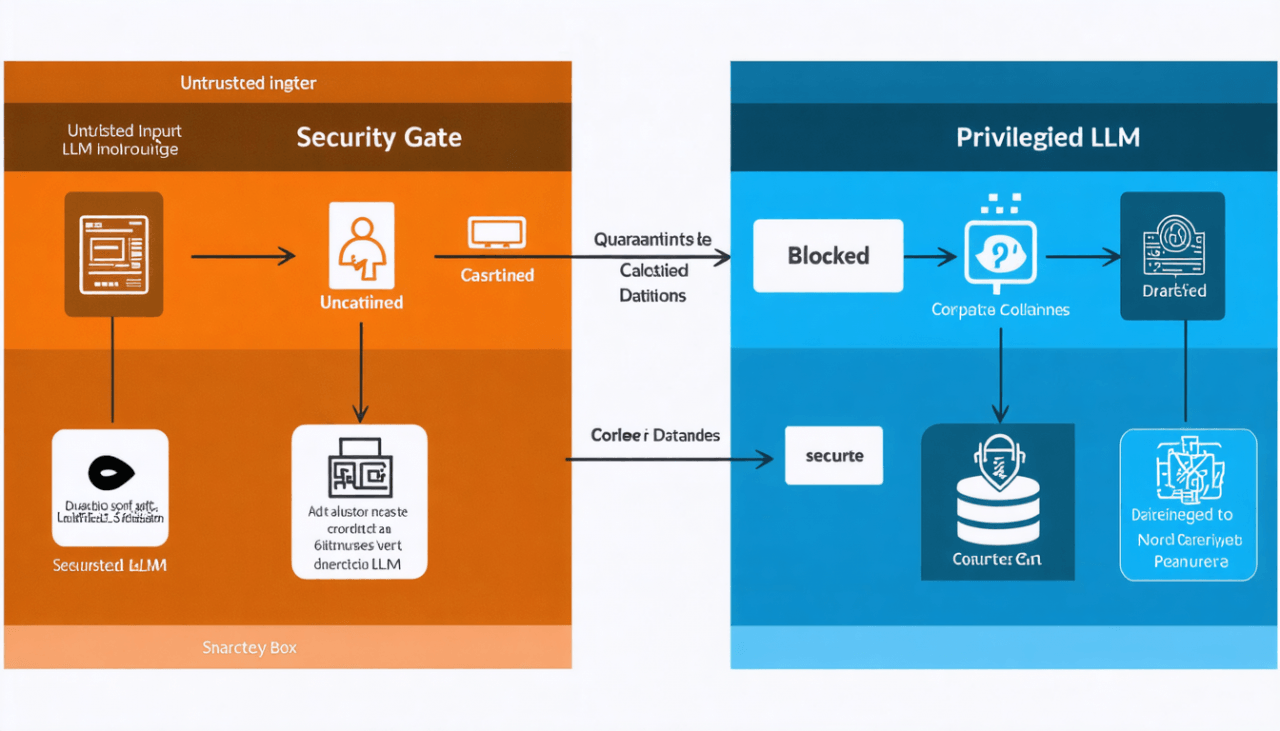
Enterprise-grade Agentic AI for business relies heavily on strict governance, guardrails, and secure infrastructure. Implementing autonomous workflows does not mean giving an LLM the keys to the kingdom.
Secure Tool Sandboxing and Least Privilege Agents are only as dangerous as the tools they are given. By applying the cybersecurity principle of “Least Privilege,” agents are strictly sandboxed. A customer support agent is given database read access, but never write or delete access. A database deletion tool is simply never provided in the agent’s toolkit. If an agent hallucinates and tries to delete a table, the system physically prevents it, logs the error, and corrects the agent.
Human-in-the-Loop (HITL) Workflows Fully autonomous execution is the end goal, but it is rarely the starting point for high-stakes environments. The safest way to deploy Agentic AI is to implement a Human-in-the-Loop checkpoint. For instance, an agent tasked with issuing refunds might be given full autonomy to process refunds under $50 instantly. However, if the agent reasons that a $5,000 refund is warranted, the toolset is designed to draft the refund request and pause. It sends a Slack notification to a human financial manager: “I have reasoned that we should refund this $5,000 transaction based on the attached policy. Click Approve or Deny.” The human acts as the final observer.
A Roadmap for Implementing Agentic AI in Your Organization
Reading about the potential of autonomous agents is exciting, but integrating them into a live business environment requires a strategic, measured approach. Here is the blueprint for adopting Agentic AI workflows successfully.
Step #1: Identify High-Friction, Cognitive Workflows Do not start by trying to build a single agent that runs your entire company. Start by identifying specific workflows that are too complex for standard automation but too repetitive for human intelligence. Ideal candidates are tasks that require referencing multiple sources of information to make a routine decision (e.g., Tier 1 & Tier 2 customer support, vendor invoice reconciliation, specialized data entry, or outbound lead generation).
Step #2: Digitize and Organize Your Data Ecosystem An agent is only as intelligent as the context and data it can access. If your company’s knowledge base is scattered across poorly formatted Word documents, outdated spreadsheets, and siloed local hard drives, the agent will struggle to reason effectively. Preparing for Agentic AI requires centralizing your data (often using Vector Databases for Retrieval-Augmented Generation) and ensuring your internal systems are accessible via APIs.
Step #3: Define the Toolset and Guardrails Document exactly what tools the agent will need. Does it need a web scraper? A connection to Salesforce? Access to a corporate Gmail account? Define the inputs and outputs of these tools clearly, and establish the HITL boundaries for high-risk actions.
Step #4: Choose the Right LLM and Orchestration Framework The landscape of AI models changes monthly. Open-source models, specialized enterprise models, and massive foundational models all have different strengths. Building the infrastructure requires selecting the right “brain” for the task (often prioritizing models heavily fine-tuned for reasoning and tool-calling) and orchestrating it using advanced frameworks.
This is where technical execution becomes critical. Designing the prompt architecture, managing memory across long workflows, and parsing tool outputs securely requires deep engineering expertise.
Conclusion
The transition from standard, rule-based scripting to fully autonomous, intelligent workflows represents a watershed moment in the history of enterprise technology. Traditional automation taught computers how to rigidly follow our explicit instructions; Agentic AI teaches computers how to dynamically achieve our high-level goals.
By leveraging the “Reasoning → Acting → Observing” loop, businesses can deploy tireless digital workers that navigate ambiguity, self-correct through errors, and execute complex, multi-step processes with unprecedented speed, accuracy, and resilience. From dynamic supply chain management and self-healing software testing, to highly personalized, autonomous sales outreach, Agentic AI for business is actively redefining what is operationally possible.
The businesses that adopt this technology today will drastically lower their operational costs, multiply their output, and effortlessly outmaneuver competitors who remain bogged down by manual processes and brittle, outdated scripts. The future of business efficiency is not just automated; it is autonomous.
Ready to build your first autonomous workforce? Contact us for custom AI agent development
At Tool1.app, our team of technical experts specializes in transforming ambitious AI concepts into highly functional, secure, and deeply profitable realities. Whether you need to transition away from brittle legacy Python automations, build intelligent custom web applications, or deploy enterprise-grade Agentic workflows tailored specifically to your unique operations, we have the specialized expertise to deliver. Don’t let your business fall behind the technology curve. Reach out to Tool1.app today for a strategic consultation or project discussion, and let’s start building the intelligent systems that will exponentially drive your business forward into the future.







Leave a Reply
Want to join the discussion?Feel free to contribute!
Join the Discussion
To prevent spam and maintain a high-quality community, please log in or register to post a comment.